Artificial Intelligence
The 7B model that beats bigger ones, runs on a phone, and changes the AI cost equation
Alibaba Cloud's Qwen2.5-Omni is a 7B model that handles text, images, audio, and video, generating speech and text in real time. Its Thinker-Talker architecture and TMRoPE position embedding enable streaming interaction, and the 3B variant runs on mobile SoCs like Snapdragon 8 Gen 1 at usable speeds.
Emmanuel Fabrice Omgbwa Yasse AI-assisted
2026-07-23 · Last updated: 2026-07-30 · 2 min read
Most multimodal models stack separate encoders for each modality and call it a day. Qwen2.5-Omni does something different. It treats text, images, audio, and video as first-class citizens inside a single end-to-end architecture and generates both text and natural speech in a streaming fashion. The model, released by the Qwen team at Alibaba Cloud in late March 2025, has since topped the Hugging Face trending page twice and made its way into mobile runtimes via MNN. This is part of a broader push by Alibaba to ship AI beyond the lab, as seen in their $53 billion infrastructure bet, a push that now includes a unified subscription bundle for all its cloud models, Qwen Cloud's Token Plan.
Two architectural choices set Qwen2.5-Omni apart. First, the Thinker-Talker separation: a Thinker module handles multimodal perception and reasoning, while a Talker module handles speech generation. This lets the model decode text and audio in parallel rather than in sequence, which is why it can stream a spoken answer while still finishing its sentence. Second, TMRoPE (Time-aligned Multimodal RoPE) aligns the positional embeddings of video frames with their corresponding audio timestamps, so the model understands that a visual event and a sound belong to the same moment. The problem of synchronizing multimodal signals is a known challenge that other architectures also tackle, as explored in an AI that corrects its own cross-modal outputs and in Qwen's robotics-specific foundation models.
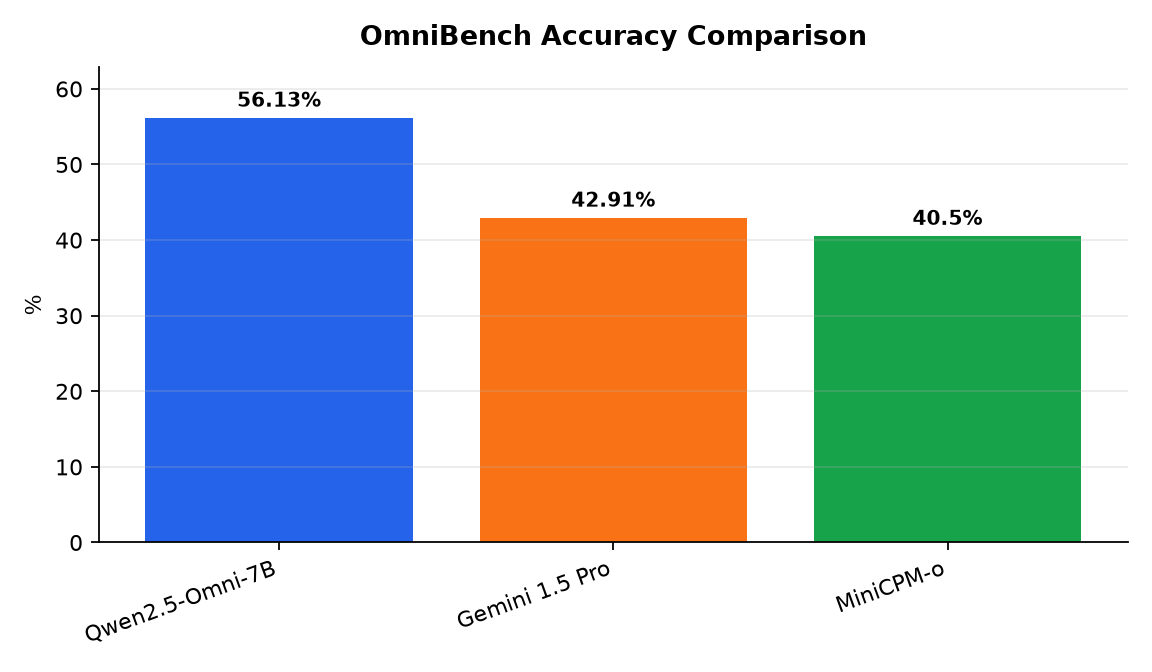
The 7B version delivers competitive or better scores across most benchmarks compared to similarly sized models. On OmniBench, which tests speech-to-text reasoning across sounds, music, and speech, Qwen2.5-Omni-7B hit 56.13% accuracy, well ahead of Gemini 1.5 Pro's 42.91% and MiniCPM-o's 40.50%. On MMAU, an audio understanding and reasoning benchmark, it scored 65.60% overall, beating Qwen2-Audio by over 16 points. On video understanding without subtitles (Video-MME), it reached 64.3%, close to Qwen2.5-VL-7B and GPT-4o-mini. The 3B variant, released a month later, stays competitive: 52.19% on OmniBench and 63.30% on MMAU. These benchmarks show a broader trend of smaller models challenging larger ones, a pattern visible in the Laguna XS model that beat 137B models.
On the resource side, the numbers that matter for deployment are clear. The 3B model requires about 3.6 GB of peak memory on a mobile SoC and runs Thinker decode at 15.84 tok/s on a Snapdragon 8 Gen 1, or 23.31 tok/s on an 8 Elite. The Talker and Code2Wav modules add latency, but total end-to-end throughput stays in the range of 8 to 20 tok/s for decoding, depending on hardware. That puts a real-time multimodal assistant into a phone's thermal budget, not just a demo. This trend of smaller models handling real-world tasks is part of a broader shift where orchestration beats raw size.
The 7B variant at BF16 needs about 31 GB for a 15-second video input
Get the tech essentials in 3 minutes every morning
One email, every weekday, with what actually matters in AI and tech.