Qwen Cloud
Qwen Cloud just made 40% of your AI costs vanish, and it works with Claude Code
Qwen Cloud's Token Plan bundles access to text, vision, speech, and image generation models under one subscription, promising 40% savings versus pay-as-you-go. It works with Cline, Claude Code, and other tools that support OpenAI and Anthropic protocols.
Emmanuel Fabrice Omgbwa Yasse AI-assisted
2026-07-24 · 3 min read
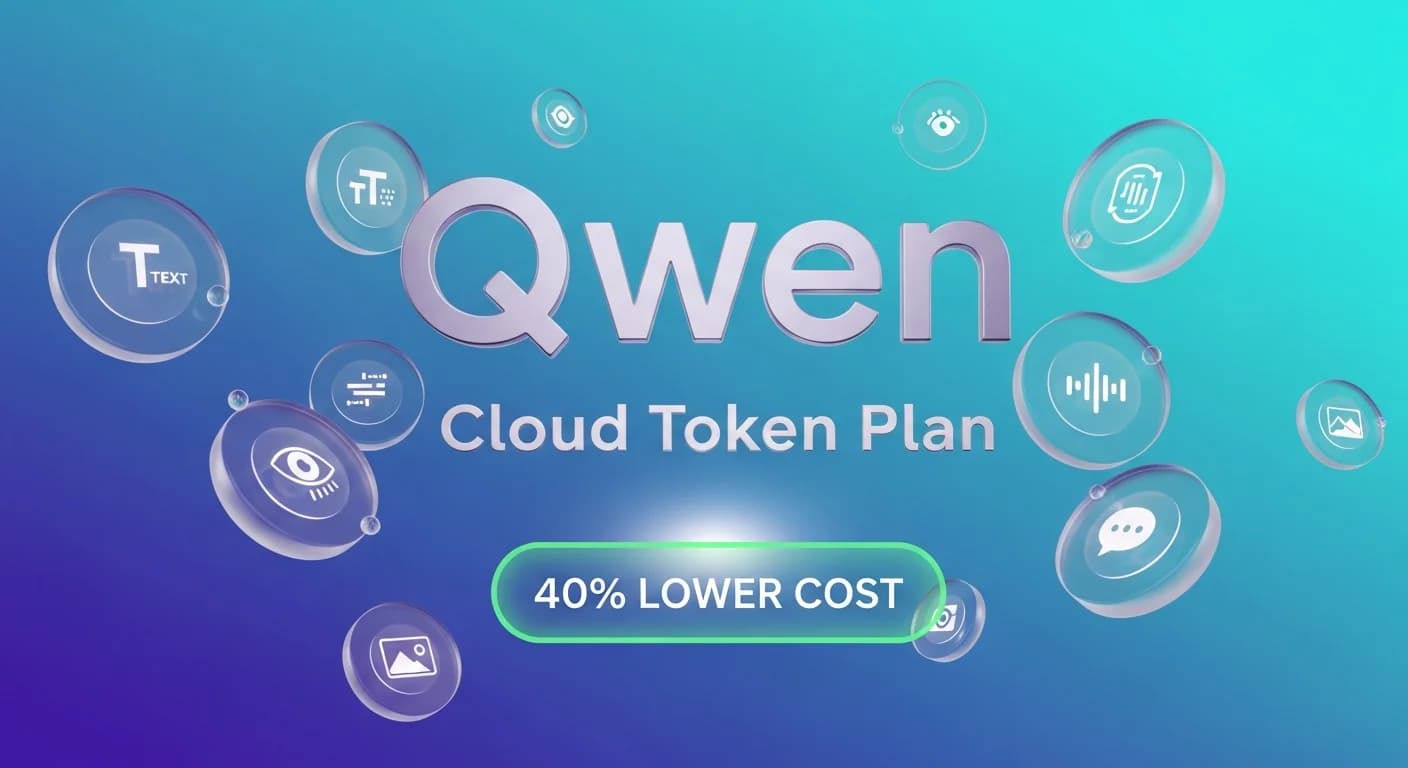
Qwen Cloud has a new pricing strategy for its model lineup, and the headline is essentially this: one subscription, multiple models, lower cost. The move mirrors what other AI platform providers have been doing lately, but Qwen Cloud brings a wider breadth of model types under one plan rather than forcing developers to pay separately for text, vision, and image generation with different vendors.
The company rolled out what it calls the Token Plan Individual and Team tiers, bundling access to text, vision, speech, and image generation models under a single monthly fee. Individual subscribers start with a Lite plan, with Standard and Pro tiers above it, each one offering more credits (the company calls them credits rather than tokens here) and allowing more concurrent agent sessions. Team plans are structured similarly, with the promise of being more affordable than before, though Qwen Cloud did not share specific Team numbers in the announcement. This tiered approach is a common strategy in the AI platform space, as seen in OpenCode's recent 80% cost cut.
Pricing details are thin in the public materials, but the company emphasizes that the Token Plan can cut costs by roughly 40% compared to its pay-as-you-go model. How that figure lands for a given user depends on their usage pattern, but the framing is clear: this is a volume play for heavier or more consistent users. The savings could be significant for teams, especially when compared to the economics of using frontier models from other providers, a topic explored in the analysis of Kimi K3's impact on AI economics.

The plan includes access to models like the previewed Qwen3.8-Max-Preview, alongside glm-5.2, deepseek-v4-pro, and wan2.7-image-pro, among others. Users are not locked into a single model line, they can mix text, vision, speech, and image generation within the same subscription. This model diversity is part of a broader strategy at Alibaba, which is investing heavily in an integrated AI stack rather than chasing a single flagship model, as detailed in Alibaba's platform play.
What makes this interesting is the toolchain integration angle. The Token Plan works with tools that support OpenAI and Anthropic protocols, meaning it slots into existing setups rather than requiring users to adopt Qwen's own IDE. Qwen Cloud lists compatibility with Cline, Claude Code, Cursor, Codex, Kilo CLI, OpenClaw, and its own Qwen Code IDE. The setup instructions are straightforward: get a base URL and API key from the API Keys page, then configure the tool of choice. This kind of interoperability is crucial for developers already using tools like Claude Code, and it builds on the idea that AI agents need standardized foundations, as argued in the case for agent stacks.
For developers already using tools like Cline or Claude Code, this could be a way to test Qwen models without reconfiguring their workflow, provided the models hold up in practice. The promise of roughly 40% savings is the hook, but the real test is whether the bundled models deliver on quality and reliability for production work. Recent benchmarks show that open models are closing the gap with frontier models, with differences as small as a few percentage points on metrics like LiveBench, as noted in the LiveBench analysis.
The FAQ section of the announcement addresses a few practical questions: users cannot stack multiple Individual plans, refunds are not offered, and credit usage can be tracked. None of those are dealbreakers, but they suggest the plan is designed for straightforward use rather than heavy customization.
Qwen Cloud's Token Plan is a sensible move. It simplifies pricing, cuts costs for regular users, and keeps the toolchain agnostic. Whether it pulls developers away from existing subscriptions depends on how well Qwen models compare in practice, but the price and flexibility give it a reason to try.
- Source : Qwen Cloud Token Plan landing page
Get the tech essentials in 3 minutes every morning
One email, every weekday, with what actually matters in AI and tech.