AI Coding
OpenCode slashes AI coding costs by 80% with two new Gemini models
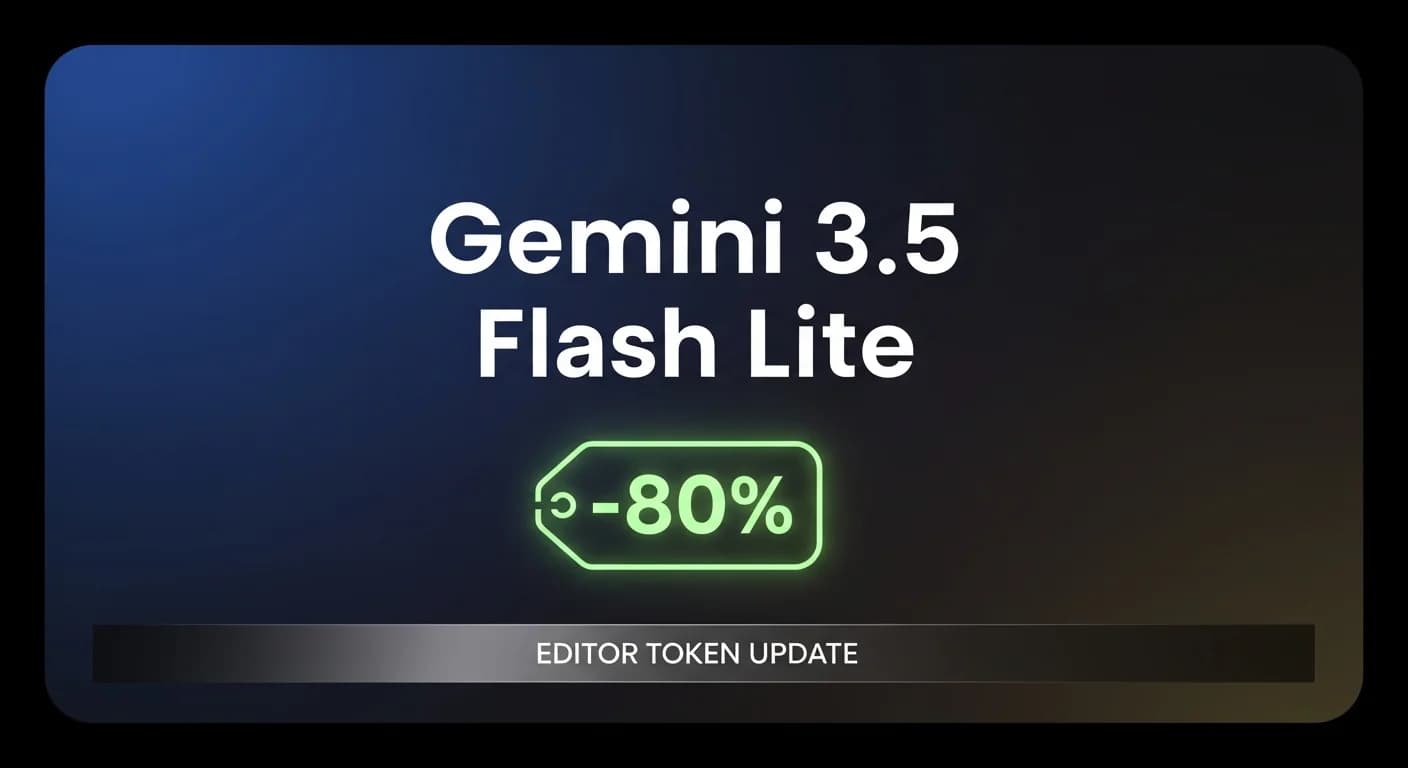
OpenCode adds Gemini 3.6 Flash and 3.5 Flash Lite with 1M context. The lite model is 80% cheaper than 3.5 Flash, a pricing shift that could make AI coding the default for more teams.
Emmanuel Fabrice Omgbwa Yasse AI-assisted
2026-07-21 · 3 min read

OpenCode, the open-source AI code editor that ships models as interchangeable components, added two new Gemini variants on July 21: Gemini 3.6 Flash and 3.5 Flash Lite. Both come with 1 million tokens of context window, matching the ceiling of Google's current API offering.
The pricing gap is the headline. Gemini 3.5 Flash Lite undercuts the standard 3.5 Flash by 80% on output tokens, according to OpenCode's announcement on X. That makes the lite tier roughly as cheap as the smallest Gemini Nano class models, but with the full Flash attention architecture, a trade-off Google presumably made by reducing the number of expert parameters or the precision of output logits. The exact mechanism is not disclosed. As competitor models enter the fray, that price-performance envelope is shaking up the whole market, see Microsoft's own cost-cutting experiments.

Gemini 3.6 Flash, meanwhile, is 17% cheaper on output than its predecessor, 3.5 Flash. The version jump from 3.5 to 3.6 has drawn attention because Google never shipped a 3.5 Pro, the expected mid-range workhorse of the Gemini 3.x lineup remains absent. A leak earlier this month from an X account tracking unreleased Google models suggested a 3.6 flash model was being tested internally, but the post did not mention a Pro variant. The new OpenCode integration confirms that 3.6 Flash is real, but says nothing about whether a 3.6 Pro exists or when it might arrive. For more on that missing piece, see the full analysis of the leak.
OpenCode is a command-line and IDE-adjacent tool that lets developers pick from a list of hosted models, OpenAI, Anthropic, Google, and open-weight models served through its own infrastructure, and switch between them per session. Adding Gemini 3.6 Flash and 3.5 Flash Lite expands the low-cost end of that menu. For a developer running a long refactor session, the difference between 3.5 Flash and the new lite variant is substantial: an 80% reduction in output cost means roughly five times the number of completions for the same budget. The same budget flexibility is driving other editors to add similar model tiers, Cursor's parallel chats and mobile agents are another example of the trend.
The 1M context length is significant for code work. A context window that size can hold an entire moderate codebase, a few hundred files, each a few hundred lines, without chunking. That makes it viable for tasks like cross-file refactoring or linting against a full project tree, though the practical throughput at 1M tokens depends heavily on how Google schedules attention. Flash models use a mixture-of-experts architecture with sparse attention, which keeps latency lower than dense models at long contexts but can produce variable quality on long-tail tokens far from the prompt's start. Researchers are exploring more efficient attention mechanisms, as BMW's work on hierarchical global attention shows.
Neither Google nor OpenCode has published benchmarks comparing the lite tier's output quality against the standard 3.5 Flash on code tasks. The 80% price cut implies some degradation, whether in accuracy, instruction following, or multilingual support, but without independent evals, the gap is a guess. Developers adopting 3.5 Flash Lite for production workflows will want to run their own regression tests before relying on it.
OpenCode's announcement comes as the AI coding tool space heats up. Cursor, GitHub Copilot, and Codeium have all added cheaper model tiers in the past quarter, and several open-source editors have begun offering a la carte model selection. The availability of a 1M-context model at deep-discount pricing could push more development teams to adopt code-level AI as a default rather than a premium add-on. For a look at how far the coding agent race has come, Cursor 2.0's agent-first redesign marks a similar milestone.
- Source : OpenCode on X
Get the tech essentials in 3 minutes every morning
One email, every weekday, with what actually matters in AI and tech.