AI coding security
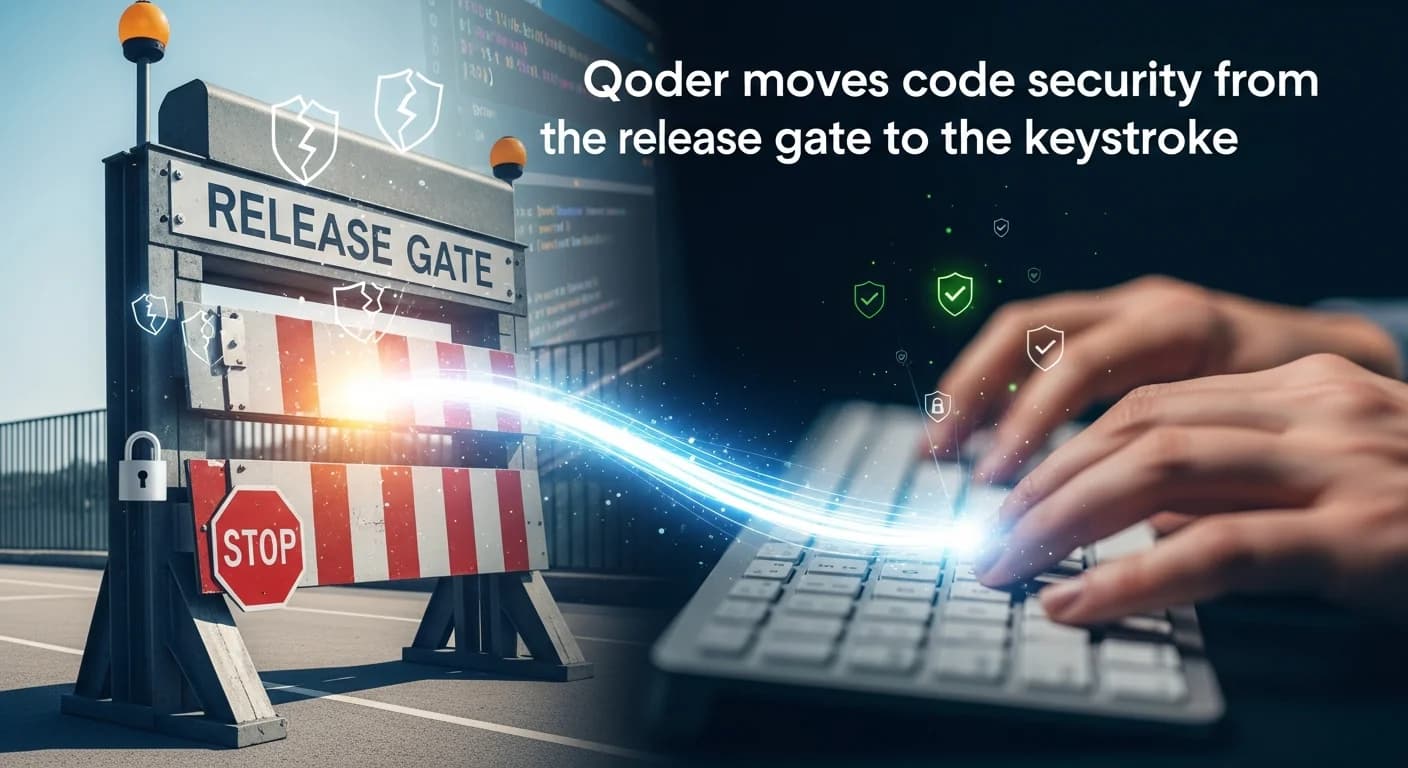
Qoder moves code security from the release gate to the keystroke
Qoder Desktop and CLI now run security checks at three depths, from live keystroke screening to cross-file data-flow analysis before a merge. Alibaba Cloud reports roughly 60% better vulnerability detection and a 35% to 45% drop in security feedback during code review.
Emmanuel Fabrice Omgbwa Yasse AI-assisted
2026-08-13 · 4 min read
AI coding assistants have changed the math on code review. Teams generate more changes in less time, and the same accelerant is working for attackers, who now automate discovery and exploitation of vulnerabilities. The tools were supposed to remove work; instead, a majority of workers report AI adds to their workload, the core finding of the productivity paradox research. Run security checks only at the pre-release gate and the context that explains a bug is usually gone by the time it reaches a developer.
Alibaba Cloud's Qoder is moving the checks into the writing. Its native code security, launched in July 2026, ships first in Qoder Desktop and Qoder CLI, with other Qoder products to follow in upcoming releases. It is the latest step in a redesign that started with Qoder 1.0 abandoning the single-workspace IDE. Instead of one gate, the design runs three tiers of scanning, matching depth to the moment in the workflow and trading feedback speed for analytical depth.
The first tier runs while the code is being written. Using lightweight pattern matching at the character-stream level, it flags known high-risk patterns, such as dangerous function calls that could lead to command injection, and surfaces them during coding. Alibaba Cloud says this layer runs automatically, detects issues instantly, and costs zero added compute. Fast and shallow, it is the first line of defense rather than the last word.
The second tier waits until a round of changes is done. It performs semantic analysis on the current work, combining input sources, usage patterns, and local context, to catch the issues that pattern matching alone cannot judge. The client prompts the developer to run a security scan at an appropriate moment, reviews only the incremental code, and looks at intent alongside syntax.
The third tier is the deep pass. It traces the full path of data from entry point to sensitive operation across a wider scope, catching risks that are invisible inside a single file. Qoder recommends running it before committing or merging.
| Layer | When it runs | What it catches |
|---|---|---|
| Pattern interception | While coding, automatically | Known high-risk patterns like dangerous function calls, with instant detection and zero added compute |
| Semantic review | After a task, on approval | Issues pattern matching can't judge, using code plus input sources, usage patterns, and local context |
| Data-flow analysis | Before commit or merge | Complex risks traced from entry point to sensitive operation across files |
The checks are designed not to interrupt the flow. The first layer runs automatically; the other two prompt the developer and execute only on explicit approval. When an issue is found, remediation stays inside the same tool: Qoder explains the cause, proposes a fix, and once the developer confirms, the agent applies the change and shows the diff. It is the same principle behind the Qoder Canvas design system, which argues the chat window is the wrong container for complex agent output. Alibaba Cloud says the loop, from detection to review, takes under ten minutes, and cuts the back-and-forth between security and engineering teams.
What it covers, and what it leaves for humans
Current coverage targets six vulnerability classes: SQL injection, command injection, path traversal, sensitive information disclosure, improper use of cryptography, and insecure deserialization. These are the classes with recognizable patterns in code. The gaps are just as deliberate: broken access control, authentication flaws, and business-logic vulnerabilities depend heavily on business context and are not yet part of primary coverage, with accuracy expected to improve as models advance.
The company is explicit that the feature does not replace code review, testing, or professional security audits. Remediation suggestions are meant to be adopted after developer review, and every change is confirmed by a human. The agent proposes; the developer disposes.
Alibaba Cloud's numbers, and what they don't say
On results, Alibaba Cloud reports that Qoder Security improves vulnerability detection rates by roughly 60% compared with traditional approaches, drawing on cases where a vulnerability is built from maliciously crafted payloads that no single file can expose. Its own engineering teams, which have used the workflow internally for some time, saw security-related feedback in code review drop by about 35% to 45%. These are the company's own figures for its own products; independent verification is still pending.
Alibaba Cloud also describes Qoder as the first mainstream agentic AI coding platform in China to offer this kind of integrated, proactive security. The feature is enabled with a single click in settings, with no extra plugins or configuration, and the company has published five hands-on walkthroughs of the feature in real workflows.
The part worth watching is the timing of the checks, not the feature list. Security built into the authoring moment, asking for attention when context is freshest, is a direct answer to the problem that AI coding created: more code, fewer calm hours, and a widening window for exploitation. Rivals so far are competing on cost, not security: Cursor's July release centers on a ₹649 India plan and a model router that steers requests toward cheaper models. If it works in production, rival agentic coding platforms will have to make the same argument, or explain why they still gate.
- Source : Qoder moves code security from the release gate to the keystroke — 2026-06-16
Get the tech essentials in 3 minutes every morning
One email, every weekday, with what actually matters in AI and tech.