Alibaba / AI IDEs
Why Qoder 1.0 gave up on the single-workspace IDE
Qoder 1.0 splits workspace, execution, artifact, and delivery boundaries across isolated worktrees so parallel agent tasks stop colliding. Alibaba's own A/B data says its scoped memory engine cut input tokens by 40%.
Emmanuel Fabrice Omgbwa Yasse AI-assisted
2026-08-04 · 4 min read
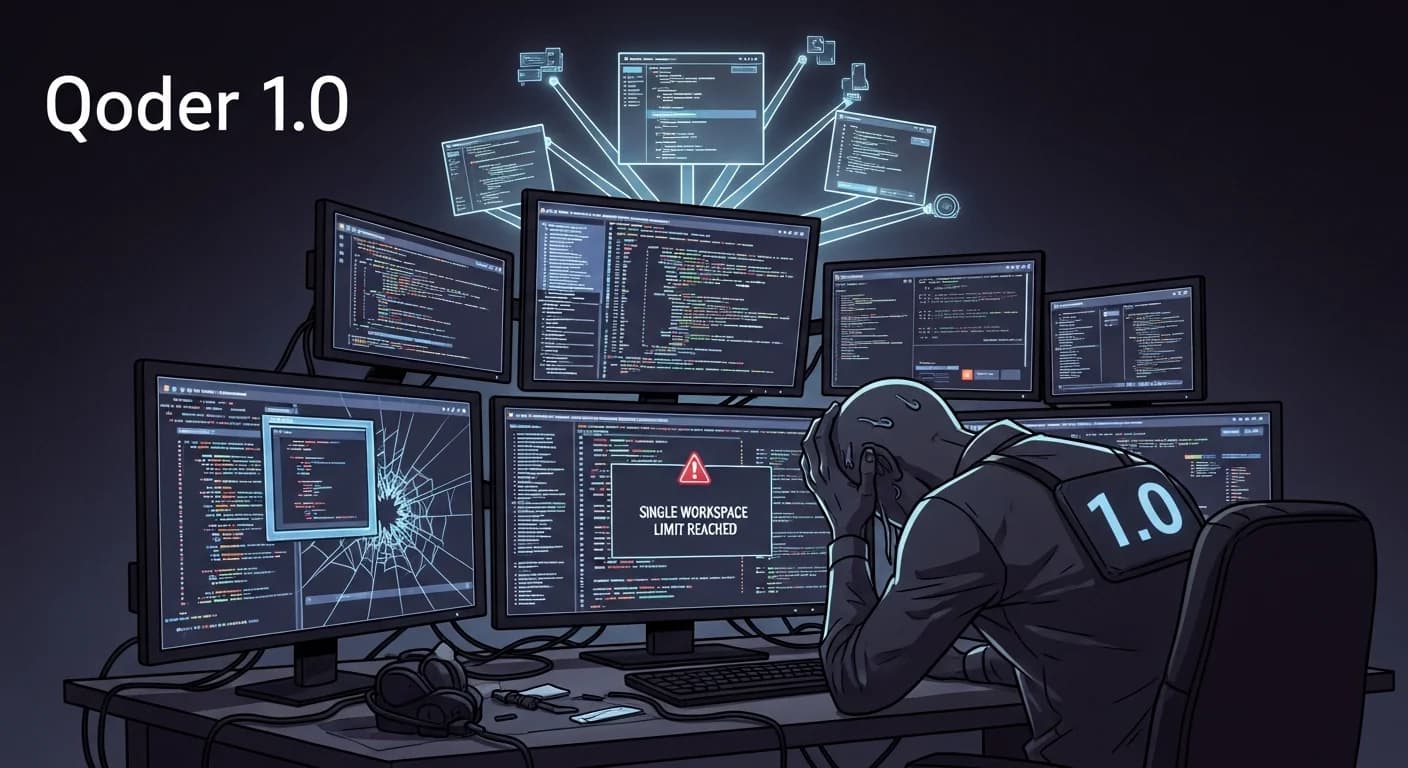
Traditional IDEs run on an unspoken bargain: the folder you open is the folder where code gets written, and that is the folder you deliver from. Qoder 1.0, Alibaba Cloud's coding agent IDE, treats the bargain as the bug. The write-up barely talks about model quality. It talks about boundaries. Rival agents are still selling model quality: Zcode's GLM-5.2-powered agent claims to edge past Claude 4.8 in coding tests. Qoder is betting the next round comes down to process.
From chat to task runtime
Qoder 1.0 upgrades Chat into what the team calls an agentic task runtime, giving each task its own workspace, execution, artifact, delivery, and knowledge boundaries. Qoder is far from alone in that shift: Cursor 2.0 rewrote its interface around the same agent-first premise. In a plain IDE these layers all point at one directory: the open window's folder is also the execution folder, the artifact folder, and the single Git root that Review and Commit act on.
That collapses once an agent is in the loop, because one task can span several workspace states. In Agent mode the layers still overlap: the current directory is also the execution and artifact directory. Introduce a Worktree and they separate. The task is created from the source repository, the agent runs in an isolated worktree, files and Review follow the worktree, and the next Quest starts back in the source repository.
The gain is parallelism without collisions. Multiple Quests move forward at once while you inspect the artifact area and decide whether to Review, Apply, or Commit. Cursor is chasing the same concurrency from its own angle: parallel chats, a mobile app, and phone-dispatched agents. Alibaba is blunt: it can look like creating one more branch directory, but it is really assigning an independent execution boundary to each task. The three-column Quest view shows how a task becomes a reviewable, committable result. The summary and reference area exposes the context the agent relied on, so Review examines the reasoning, not just the code.
What the memory A/B test actually measured
Memory and project knowledge are part of the execution environment in Qoder 1.0, not bolt-on features; they decide whether the agent understood intent, project constraints, and team conventions. Alibaba ran two evaluations, both on internal projects.
The online test compared memory enabled against memory disabled over a three-day A/B run across the top five categories, tracking four metrics:
| Metric | Change with memory on |
|---|---|
| Dissatisfaction rate | -22.09% |
| Code retention rate | +11.10% |
| Input tokens | -40.13% |
| Conversation turns | -32.60% |
The offline evaluation built task sets around architecture understanding, convention compliance, and tech-stack adaptation. Architecture knowledge lifted task completion scores about 25% while token consumption dropped about 30%; tech-stack knowledge improved end-to-end scores about 25% with roughly 15% fewer tokens.
These are Alibaba's numbers, measured on Alibaba's codebases, with no independent replication yet. Read them as directional. The gap between public benchmark scores and private-code behavior is well documented: top models hit 96% on SWE-bench Verified yet barely clear 23% on enterprise code. The larger claim is that knowledge enhancement behaves like a measurable engineering capability rather than a prompt trick.
Knowledge has to be scoped, not injected
The design constraint Qoder keeps returning to is scope. Knowledge cannot simply be injected into the agent as a global prompt pool; without a scope it becomes a source of pollution. So knowledge boundaries are bound to the workspace: which user, team, and repository the information comes from is part of the task's frame of reference.
The same conclusion shows up elsewhere in enterprise agent design. Our coverage of dynamic capability scoping for enterprise agents reaches a similar answer through a synthetic dataset and a three-source permission architecture. Context that cannot be traced to a boundary gets mistrusted, which is worse than no context at all.
The failure that only shows up at delivery
The clearest argument for this architecture is the failure chain it prevents. If an execution boundary is unstable, Apply can write to the wrong directory, Reject can roll back the wrong files, Review can compare the wrong diff, and Commit can calculate against the wrong Git root. The unpleasant part is timing: these errors rarely appear while the agent writes code. They surface when the work is ready to hand over.
That turns boundary discipline into a trust problem. Stable boundaries are what make parallel execution safe; without them, Review has nothing solid to judge and delegating the task is a gamble. The fix is to stabilize the whole chain: task created from the source project, execution in a bound environment, artifacts and diffs resolved from the current task, commit aimed at the right delivery target.
It fits where Qoder is positioned. Our earlier coverage noted its Repo Wiki and background indexing are built for existing codebases rather than greenfield apps, and established teams lose real work when an agent misfires at handoff. It is also the battlefield where Gartner's recent enterprise assessment puts Cursor out front, per our reporting.
Multi-task parallelism was never hard to demo. The hard part is guaranteeing that parallel work does not detonate at commit time. That demo-versus-delivery gap is not Qoder's alone; a 957,253-record benchmark corpus shows coding surging while enterprise-critical work stalls. Qoder 1.0 is selling a smaller claim than better code: a handoff that is boringly safe.
- Source : Why Qoder 1.0 gave up on the single-workspace IDE — 2026-01-20
Get the tech essentials in 3 minutes every morning
One email, every weekday, with what actually matters in AI and tech.