AI research: arXiv paper, 3 September 2026
One training query covers 71.5% of what a full LLM distillation dataset does
A new arXiv paper finds that one training query reaches 71.5% of the state coverage a full distillation dataset does, and that 16 diverse queries match full-data training. The bottleneck, the paper argues, is how fast a student absorbs supervision.
Emmanuel Fabrice Omgbwa Yasse AI-assisted
2026-09-17 · 4 min read

Train an on-policy distillation run on a single query and it will keep improving for hundreds of steps. A paper submitted to arXiv on 3 September 2026 reports that this one example recovers most of the gain a full dataset produces, across task domains and model families.
On-policy distillation (OPD) pairs a student model's own rollouts with dense, token-level supervision from a teacher. Earlier work in the series concentrated on how the algorithm behaves, leaving the role of the training data open. This paper pushes the data question to its minimum by training on one query and watching what the student does.
One query, most of the gain
The headline number is not a small fraction of the full-data run. One-shot OPD keeps improving for hundreds of steps and closes most of the gap to training on everything the paper tested. Read purely as an efficiency result, that makes distillation look cheap. Read the way the paper frames it, it raises a harder question about what the extra data was ever doing. That question runs the other way in Ai2's EMO, where modularity emerges from the data itself rather than from a hand-set prior.
What state coverage measures
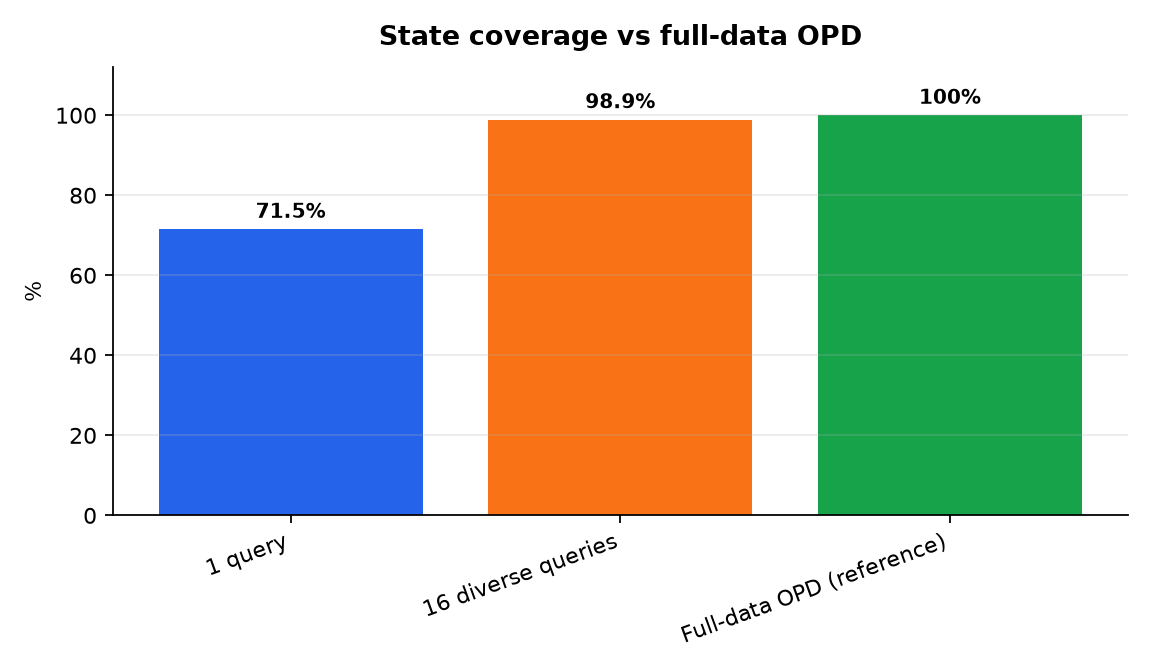
To explain the result, the paper looks at the states the student visits during training and defines state coverage as the fraction of the states a full-data OPD run reaches that a given query set's rollouts also reach. One query already covers 71.5% of them, and most of that coverage arrives within the first 100 steps. Front-loaded returns of that shape keep turning up in training systems: CoBa reaches best-of-16 voting accuracy with 58.9% fewer tokens.
Growth after that comes from diversity, not volume. Adding semantically distinct queries raises coverage and validation accuracy together, until 16 queries reach 98.9% and match full-data training. Volume as a proxy for progress has looked shaky elsewhere too: Boris-2 gives its 125M model 90B tokens and its 250M model only 60B.
| Training set | State coverage | Result reported |
|---|---|---|
| Single query | 71.5% | Most coverage reached within the first 100 steps |
| 16 semantically distinct queries | 98.9% | Matches full-data OPD |
| 16 diverse queries per domain (multi-teacher OPD) | Not reported | Matches full-data multi-teacher training |
The student absorbs slower than the data arrives
If one query supplies nearly all the coverage, why does one-shot training still need hundreds of steps to improve? The paper's answer is that alignment between student and teacher slows at roughly the same pace whether OPD trains on one query or the whole dataset. Even a fixed set of states, handed over and no longer changing, takes hundreds of steps to absorb.
That mismatch produces the paper's blunt diagnosis: OPD is "data-overfed but algorithm-starved." Its rollouts expose broad supervision quickly, while the student absorbs that supervision at a decaying rate. The same wall shows up at inference time, where longer chain-of-thought hits diminishing or even negative returns.
Templates and off-domain prompts come close
Two stress tests push against the idea that the content of the query is the active ingredient. Content-light templates, which carry little task substance, approach the real-query baseline. So do off-domain WildChat queries. The paper concludes that task content and induced state coverage can come apart, which would mean a query set can be nearly empty of the task and still get the student close to the states that matter.
What the listing does not settle
It names no task domains or model families, and reports no independent replication, a gap that stands out in a season when a single RTX 4090 can rerun a self-improvement loop. Coverage is also measured against one reference, the states that full-data OPD visits, so the metric describes how much of that run's territory a smaller run reaches rather than an absolute measure of how much supervision is enough.
The same pattern extends to multi-teacher OPD, where 16 semantically diverse queries per domain match full-data training. The paper's stated hope is that these results redirect work toward the step efficiency of the method and prompt a fresh look at the data and the mechanisms behind its recent successes in frontier post-training.
Cutting a training set to 16 queries and matching the baseline is an odd result for a technique whose recent frontier successes the paper attributes partly to data. Its reading is that more data changes how quickly supervision arrives, not how much of it a student can take in. If that holds, the next round of improvements belongs to the training loop, not the corpus.
- Source : One training query covers 71.5% of what a full LLM distillation dataset does — 2026-09-03
Get the tech essentials in 3 minutes every morning
One email, every weekday, with what actually matters in AI and tech.