AI Economics
Alibaba's $18 plan runs Qwen and DeepSeek inside Claude Code
Alibaba Cloud's Token Plan Individual bundles Qwen and third-party models such as DeepSeek into a single credit pool, from $6 a month, usable inside Claude Code and Cursor. The company claims roughly 40% savings over pay-as-you-go, but the plan only works from Singapore and only inside approved tools.
Emmanuel Fabrice Omgbwa Yasse AI-assisted
2026-08-14 · 4 min read
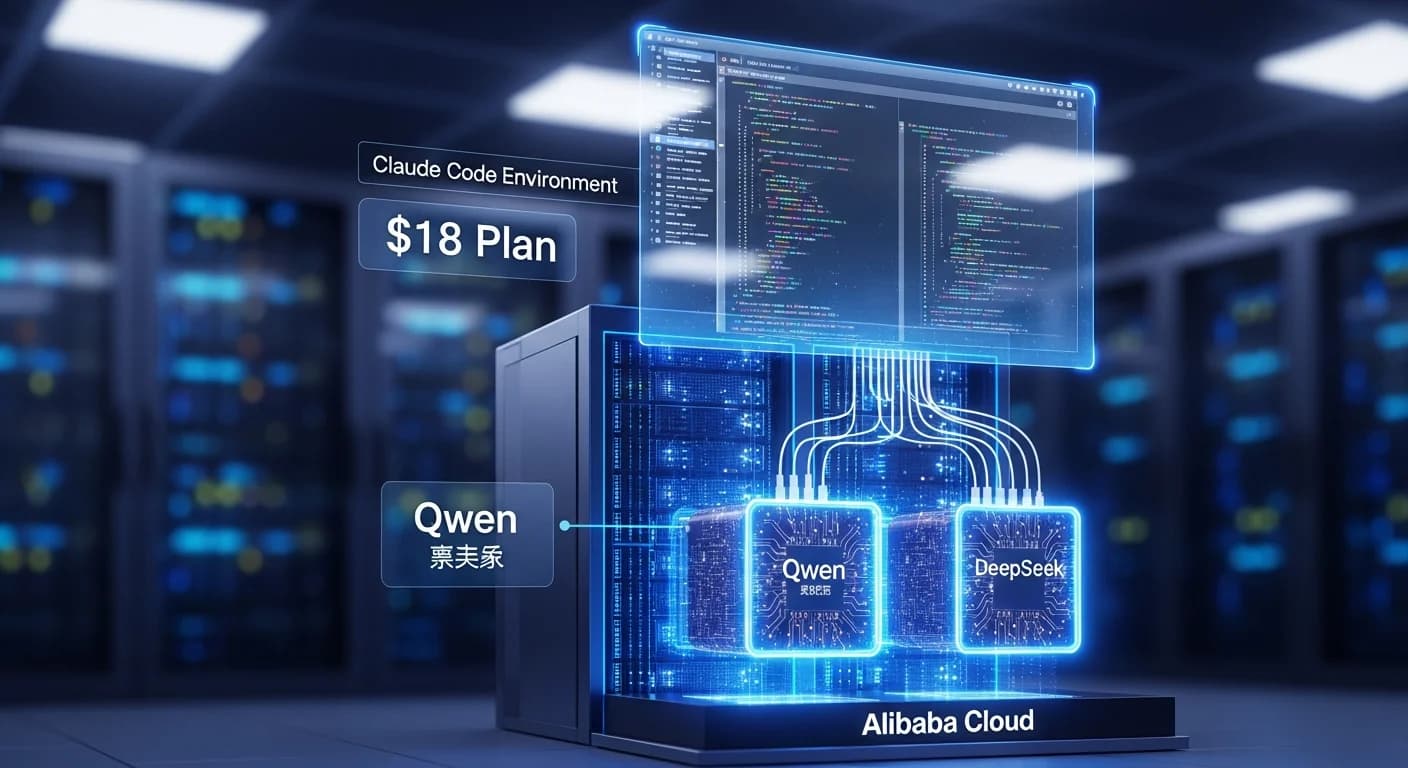
Alibaba Cloud now sells one subscription that lets you run Qwen and DeepSeek models inside Claude Code. Token Plan Individual, part of Alibaba Cloud Model Studio, starts at $6 a month, works inside tools built by companies that compete with Alibaba, and the pitch is mostly price: roughly 40% below the company's own pay-as-you-go rates.
The discount is the hook, but the structure matters more. Think of it as one credit pool, several model vendors, and access through the two API protocols those tools already speak. For a developer, that changes the math of trying a new model family: the second vendor sits on the same bill. This is the bundling logic Qwen Cloud has pushed with its own Token Plan.
Three tiers, one credit pool
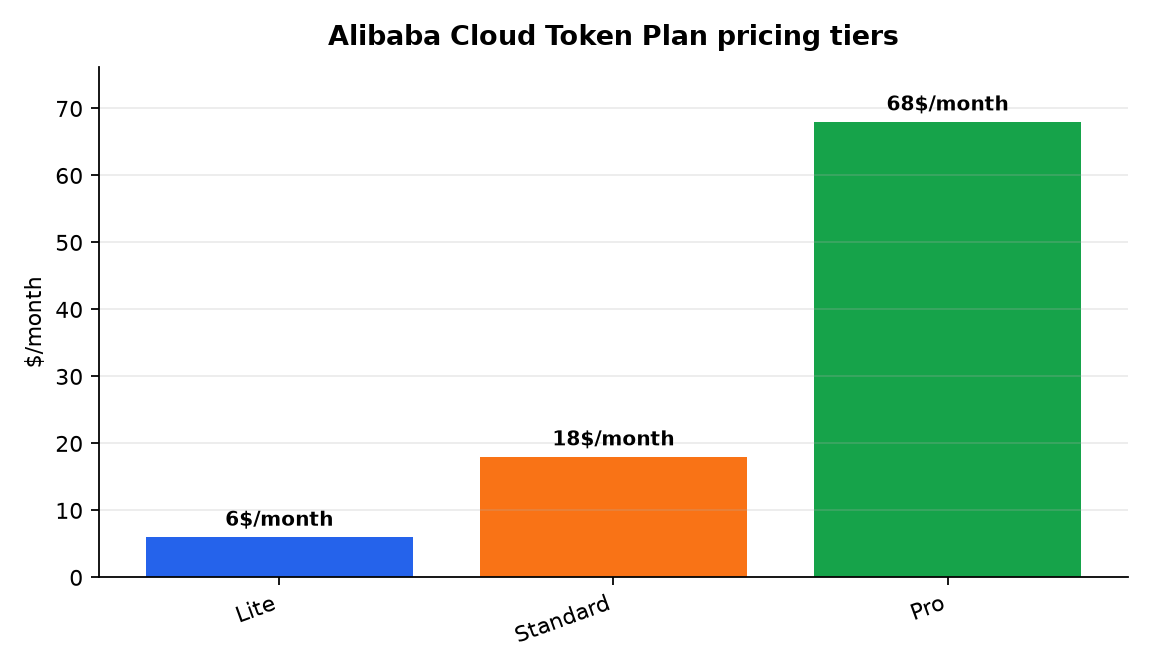
Token Plan Individual meters usage in credits across text, image, and video models. The subscription covers Qwen's full lineup in all three modalities, plus built-in Web search and a Code Interpreter. Alibaba's subscriber guide lists three tiers:
| Tier | Price | Target user |
|---|---|---|
| Lite | $6 per month | Entry-level exploration |
| Standard | $18 per month | Daily high-frequency use, marked as recommended |
| Pro | $68 per month | Heavy professional workloads |
Exact credit quotas are not published in the guide, which points buyers to the subscription page for the numbers. Billing runs monthly, quarterly, or yearly, with auto-renew available, and a separate Team tier exists for group usage.
The more interesting part is what else sits in the pool. Inside Qoder, a Token Plan user can pick Qwen-3.8-Max, the model that coded alone for 16 days, or DeepSeek-V4-Pro from the same list. Alibaba's plan materials also name third-party models like glm-5.2 and image generators like wan2.7-image-pro. The same pool serves models from several vendors.
Where the 40% claim comes from
The saving, as Alibaba frames it, is measured against its own pay-as-you-go API pricing, not against another cloud. Whether it lands depends on usage. Flat-rate plans pay off when a user burns enough credits each month, so the 40% figure is a marketing number until you run your own workload against it. The structure is the real product: shared credits across vendors remove the need to hold prepaid balances at several providers, and the subscription stays put while models change underneath it.
The price comparison misses a convenience layer. Heavy users get one key prefix and one billing cycle, and the choice of model happens in the settings of whatever agent they opened.
The fine print: tools only, Singapore only
This is deliberately not a general API. Credits work only inside six tools: Claude Code, Cursor, Qwen Code, Qoder, Qoder CN, and OpenClaw. Alibaba forbids using the plan to power automated scripts or a custom application backend. That rules it out as cheap inference for anything you ship. If you wanted a backend for a product, this is not it.
Region is the other constraint. The plan is available only in Singapore and involves cross-border data transfers; Alibaba tells subscribers to check that using it complies with local law. The API keys carry a distinct prefix, sk-sp-, and will not work as ordinary Alibaba Cloud keys. They pair with dedicated Base URLs: one speaking the OpenAI protocol, for tools like Cursor, Cline, and Cherry Studio, and one speaking the Anthropic protocol, for Claude Code and Qwen Code.
One quirk is worth remembering. The API key is shown exactly once at creation. Close that window without copying it and it's gone; if it leaks, a Reset action voids it immediately.
Why Alibaba is pushing subscriptions
The timing fits a bigger spending plan. Alibaba Group has said it will invest at least RMB 380 billion in cloud and AI infrastructure over three years, about $53 billion, more than it spent on both categories in the previous decade. A subscription tier turns that capacity into predictable recurring revenue instead of bursty API traffic, and a plan that reaches into tools like Claude Code extends that reach without building an IDE from scratch. The broader $53 billion program, from lab curiosities to hospitals and pig farms, is the context for the subscription push.
Alibaba's research arm has also pointed to Qwen's appeal in Asia: strong performance in local languages, with support for over 200 languages and dialects in the latest generation, is one reason it is especially popular in Japan and South Korea. The subscription model gives those users a single on-ramp to the whole family.
The open question is what flat-rate bundles do to a market built on per-token billing. Alibaba's answer, for now, is a working demo at $18 a month: two model vendors, one bill, and a discount that holds only if you actually use the credits. For a heavy user with a calculator, that is worth checking against their own numbers, and it fits Alibaba's stated aim of locking in the enterprise before the model race is over.
Get the tech essentials in 3 minutes every morning
One email, every weekday, with what actually matters in AI and tech.