NVIDIA
Nvidia and Hugging Face just made distributed diffusion training boring (that's the point)
Nvidia's NeMo Automodel now integrates directly with Hugging Face Diffusers, enabling production-grade distributed training for models like FLUX, Wan 2.1, and HunyuanVideo. The Apache 2.0 library handles parallelism as a config toggle and lets fine-tuned checkpoints load straight back into inference pipelines.
Emmanuel Fabrice Omgbwa Yasse AI-assisted
2026-07-19 · Last updated: 2026-07-30 · 3 min read
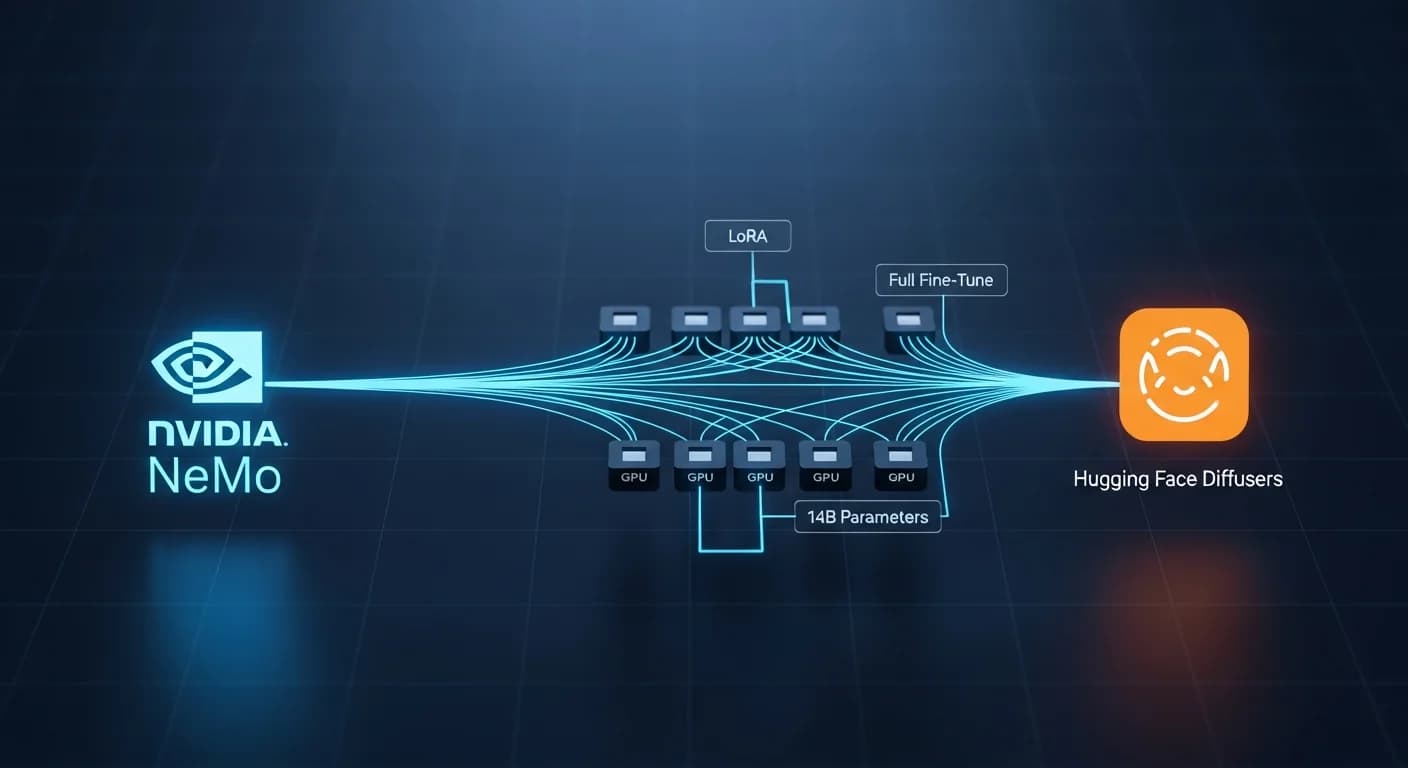
Diffusion models keep getting bigger, and training them keeps getting more awkward. FLUX.1-dev weighs 12 billion parameters. Wan 2.1's 14-billion-parameter variant needs tensor parallelism just to fit on an H100. HunyuanVideo 1.5 runs at 13 billion. Scaling inference for these models is relatively well understood. Scaling training is not, especially when you want to move from a single-GPU LoRA experiment to a full fine-tune across a cluster without rewriting your training script.
That gap is what Nvidia and Hugging Face are targeting with a new integration between NeMo Automodel and the Diffusers library, now documented in the Diffusers training guide and released under Apache 2.0. The claim is straightforward: you point at any Diffusers-compatible model on the Hub, and the same YAML-driven workflow handles FSDP2 sharding, tensor parallelism, context parallelism, latent caching, and multiresolution bucketing. No conversion step or separate training format. The checkpoint comes out in Diffusers shape and loads directly into a diffusion pipeline for inference, similar to how Nvidia's embedding models deliver measurable gains in agent runtime.
For teams that have been stitching together custom training scripts around each new model release, that packaging matters more than any single performance number.
What actually changes
The practical gains break into three parts. First, no checkpoint conversion. A fine-tuned NeMo checkpoint is a Diffusers checkpoint, the same folder structure, the same model classes. Downstream tools (quantization, compilation, custom samplers, LoRA merging) keep working without an adapter step. Second, fast support for new models. When a new diffusion architecture lands in Diffusers, enabling it in NeMo Automodel takes a data preprocessing handler and a model adapter rather than a full custom training script. The rest of the recipe stack, parallelism, bucketing, checkpointing, generation, carries over unchanged.

Third, both full fine-tuning and LoRA-style PEFT are handled by the same recipe structure. The YAML config selects which one to run; the code path is shared. That means a practitioner can start with LoRA on a single node to validate data quality, then scale to full fine-tuning across eight GPUs (or eighty) by changing a few config fields and a parallelism declaration, not by swapping training scripts. This approach aligns with findings from Hugging Face's research on improving agent evaluation where consistent infrastructure reduces friction.
The benchmark layer
The published benchmarks on 8x H100 80GB give a sense of where the library lands. FLUX.1-dev full fine-tuning at 512x512 resolution runs at 35.5 images per second with a global batch size of 32 and peak GPU allocation of 63.9 GiB. LoRA at rank 64 with DDP pushes that to 53.7 images per second, consuming 67.4 GiB. For text-to-video, Wan 2.1's 14B full fine-tune on 49-frame 512x512 clips runs at about 2.1 clips per second with activation checkpointing on, peaking at 33.4 GiB per GPU. The 1.3B variant fits easily at 6.1 GiB peak, no activation checkpointing needed.
Those numbers are steady-state averages with checkpoint writes disabled and full batches enforced. Real-world runs with periodic checkpointing will be slightly slower, but the gap between single-GPU LoRA and distributed full fine-tune is narrow enough that the main bottleneck for most teams will be data preparation and evaluation, not training throughput. This mirrors the principle behind Kimi Claw's one-click deployment that removes hardware setup complexity.
A concrete walkthrough
The documentation includes a full end-to-end fine-tune of FLUX.1-dev on the 78-image Rider-Waite tarot dataset. The workflow is: pre-encode the dataset into cached VAE latents and text embeddings, similar to preprocessing approaches that accelerate model sampling, then launch training using the existing FLUX YAML with command
Get the tech essentials in 3 minutes every morning
One email, every weekday, with what actually matters in AI and tech.