AI Research
BMW's 16 GB GPU just did what needs an A100
BMW researchers show that Hierarchical Global Attention, paired with truncated backprop and external KV storage, lets a 16 GB GPU train on 16K tokens, four times the limit of dense attention, with no measurable loss in adapter quality.
Emmanuel Fabrice Omgbwa Yasse AI-assisted
2026-07-20 · 6 min read

Long-context fine-tuning has a hardware problem. The model weights fit, the adapters fit, but the dense attention state swells with every token, and somewhere between 2K and 4K the GPU runs out of memory. A team at BMW Group, not a place you'd expect to publish new attention mechanics, has been chipping away at this for a while.
Their latest preprint, posted in July 2026, combines three techniques: Hierarchical Global Attention (HGA), a previous paper from the same group; segment-wise backpropagation (TBPTT); and a tiered KV storage system that pushes old keys and values into RAM or NVMe. The result is a training pipeline that reaches 16,384 tokens on a 16 GB Quadro RTX 5000, four times more than dense attention can handle on the same card. And the quality, under dense readout, is within 0.0022 nats of a dense-trained adapter. The approach hints at a future where consumer hardware takes on tasks that currently require clusters, which aligns with trends in efficient AI architectures discussed in Nous Research's MoE scaling notes.
This is not a breakthrough in the sense of a new state-of-the-art loss. It's a practical engineering answer to a question a lot of people hit: how do you fine-tune on sequences longer than a few thousand tokens without buying an A100?
What HGA does differently
Standard attention processes every pair of query and key. That's the bottleneck. HGA is a drop-in replacement for the attention module that selects only a subset of historical tokens per query block, using a two-level routing hierarchy. The context is split into 64-token chunks; compact summary vectors of each chunk stay in VRAM. The query scores those summaries and picks the top-k chunks, then opens those chunks at the group level (8-token groups), and finally loads only the exact token K/V of the selected groups for the actual attention computation.
The router does not use any learned weights, it scores existing projected keys, so gradients update the same Q/K/V/O projections as in the dense case. The key insight is that the summary vectors never act as attention values or output tokens; they only direct selection. The actual attention is on exact tokens, which keeps the expressivity of full attention while cutting the working set dramatically.
BMW couples this with segment-wise backward: the sequence is split into 2,048-token segments, each segment runs forward and backward independently, and older KV is detached to RAM or NVMe before the next segment starts. Gradients don't cross segment boundaries, but later segments still attend to earlier exact tokens via HGA routing. This separation of memory and compute resembles strategies used by Grok Build's local agent loop to manage long-running tasks on modest hardware.
As the authors summarize in equation form: GPU memory becomes roughly the sum of the model, adapters and optimizer, the active segment, and the routed working set, all of which stay bounded. The external historical record grows linearly with total length, but in RAM or disk, not VRAM.
The efficiency crossover already happens at 2K
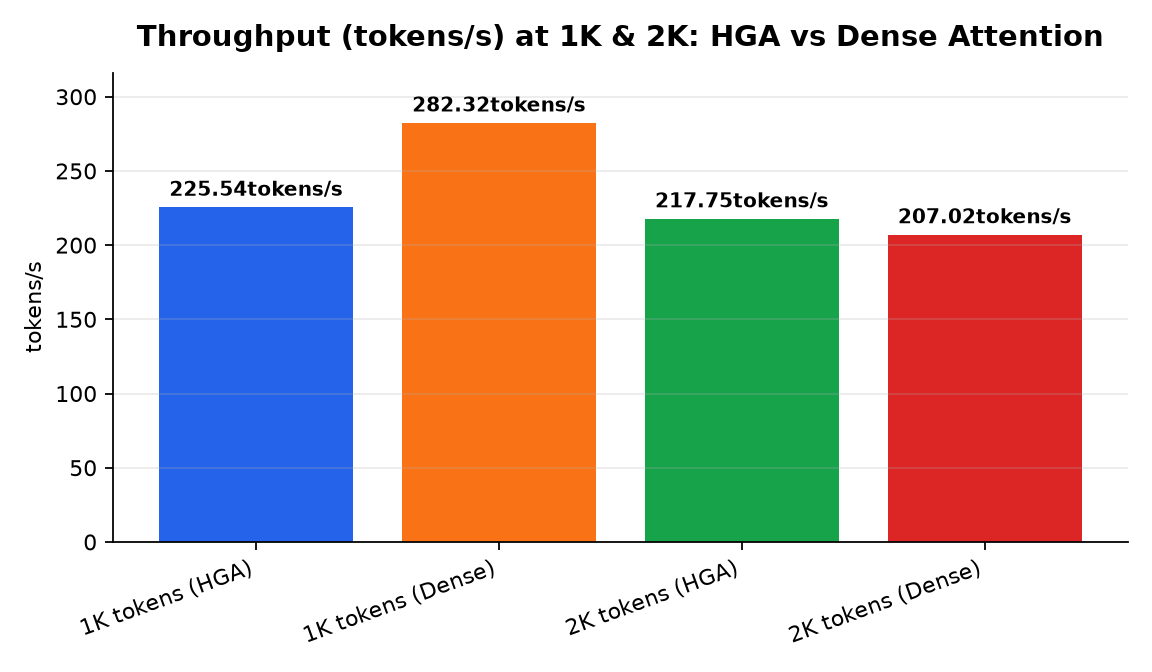
The numbers in the paper tell a clean story. At 1,024 tokens, HGA is about 20% slower than dense attention (225.54 vs 282.32 tokens/s) because the routing overhead is not yet amortized over a longer sequence, the selection still covers most of the history. But at 2,048 tokens, the crossover flips: HGA hits 217.75 tokens/s against dense's 207.02. That is a small margin, but the trend is clear. Because HGA's attention work per token stays approximately constant for a fixed routing budget, while dense work grows linearly with context, the gap widens as sequences get longer. This is similar to the efficiency crossover observed in Mistral AI's single-camera navigation model, where a lighter approach outperforms sensor-heavy systems at scale.
The paper cannot measure that directly beyond 2K, dense training OOMs at 4K, but the logic is sound and the sweep data supports it.
Adapter quality holds up
The researchers trained two QLoRA adapters on Qwen3-8B with 4-bit NF4 quantization and used PG19 for 100 optimizer steps, controlling for seed and data order. The only variable was the attention module during fine-tuning. At the shared 2K training context, the HGA-trained adapter scored 2.7405 nats under dense readout; the dense-trained adapter scored 2.7383 nats. Difference: 0.0022 nats. The stock model sits at 2.9541. Fine-tuning itself provides the larger effect, the adapters both drop loss by about 0.216 nats, and whether you use HGA or dense during training barely matters for the final weights. The idea that small adapters can match full fine-tuning quality echoes findings from Nvidia's embedding models that retain 99% quality at smaller sizes.
At 4K, where only HGA training is feasible, the gap is still tiny: 15.006 PPL for HGA-trained vs 14.966 for dense-trained under dense readout. For practical purposes, that's noise.
Retrieval: no degradation in the dense baseline
BMW also ran RULER-style passkey, multikey, and multivalue retrieval tests, using dense attention for the readout on both adapters. At 4,096 and 8,192 tokens, both adapters hit 100% recall on passkey and multikey. On multivalue, each adapter missed exactly one of 96 planted values, in different cells. That is not a signal of weakness. The robust retrieval performance is consistent with the HSCodeComp benchmark findings on the limits of hierarchical reasoning in agents, though here HGA handles hierarchy better.
The paper is careful here: they use dense readout because it isolates whether HGA-based fine-tuning changed the learned retrieval behavior, rather than mixing it with routed selection recall. HGA itself can also do retrieval and generation, but the production-grade serving engine, which the team says they're building, likely targeting integration with vLLM or SGLang, is still under development.
The one real caveat: causal leakage
The limitation worth flagging is a causal side channel that emerges under extended training. Because routing decisions within a chunk depend on scores from multiple query positions, an earlier token can get indirect information about later tokens, which chunks were selected or rejected. The signal is weak at first, but after 100 to 200 million training tokens the model starts exploiting it for next-token prediction. The paper is upfront about this: the method is fine for fine-tuning within that horizon, but you would not use it for pretraining from scratch. The authors mention a strictly causal variant in the works. This kind of subtle leak has parallels with the CIFAR-10 ablation that worked on one benchmark but not another, reminding researchers that clever shortcuts often hide in unexpected places.
What it means
The BMW group is not a high-profile AI lab, which might be why this paper reads more like an engineering memo than a breakthrough announcement. That is fine. The contribution is practical: a clear, reproducible way to push training context well past the VRAM barrier using a 16 GB card from 2018. For anyone fine-tuning on consumer or workstation hardware, that is immediately useful.
The NVMe-backed tier is implemented but not benchmarked in this preprint. The project repository on GitHub (under the name HierarchicalGlobalAttention) has the code. If the production-stage serving engine materializes and the causal leakage gets patched, this approach could be competitive with methods like LongLoRA, with the added advantage that HGA uses exact-token attention rather than shifted sparse patterns.
Get the tech essentials in 3 minutes every morning
One email, every weekday, with what actually matters in AI and tech.