Open source
Gemma 4 hit 300 million downloads. The math that broke the cloud model is why.
Google DeepMind's Gemma 4 reached 300 million downloads, a milestone signaling that the open-weight model's economic argument is finally beating the proprietary API pitch. Architectural efficiency and self-hosting costs are driving the shift.
Emmanuel Fabrice Omgbwa Yasse AI-assisted
2026-07-24 · 3 min read
Google DeepMind's Gemma 4 has crossed 300 million downloads, according to a post on X by the Gemma team. The number covers the entire model family, from the 2.3-billion-parameter entry point to the 31-billion-parameter mixture-of-experts variant.
The milestone comes roughly a month after Gemma 4's launch in early April 2025. For context, the previous version, Gemma 3, took far longer to reach comparable numbers, though Google has not released a direct timeline for comparison. The faster adoption suggests developers are gravitating toward the technical differentiators of this generation: native multimodal input, encoder-free vision processing, and a 1-million-token context window.
What 300 million downloads actually mean
Download counts on platforms like Hugging Face and Kaggle are a rough proxy for interest, not a direct measure of active usage. A single developer can download a model multiple times for different experiments. Still, 300 million is a rare number in open-weight AI. Meta's Llama 3.1 crossed 350 million cumulative downloads across its entire lifecycle, and that took most of 2024.
What makes Gemma 4's pace notable is the profile of the downloads. Early adopters in the open-source community tend to pull lightweight tier models (2.3B or 9B) for fine-tuning on domain-specific tasks, while larger organizations reach for the 31B MoE variant to deploy in production pipelines. The broad range means Gemma 4 is being used both for rapid prototyping and for serving real traffic. The flexibility echoes the same philosophy that makes Ai2's fully open Olmo 3 family attractive for teams that need complete transparency.
Why developers are switching
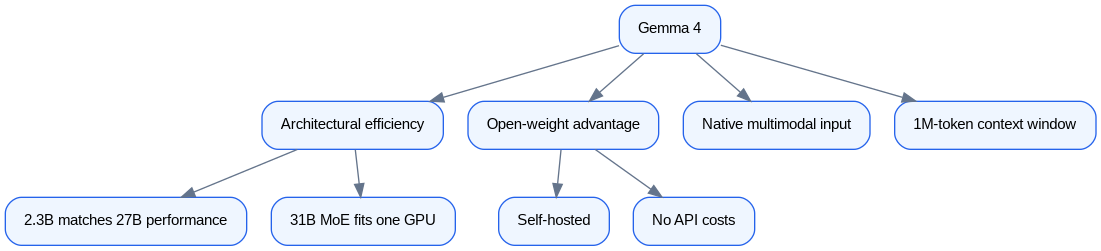
Gemma 4's strongest selling point is architectural efficiency. The 2.3B model matches or exceeds the performance of its predecessor Gemma 3 at 27B parameters on several standard benchmarks, a roughly tenfold improvement in compute-to-output ratio. The largest variant, with 31B parameters (16B activated per forward pass thanks to MoE routing), fits comfortably on a single NVIDIA A100 or H100 GPU with room to spare for serving infrastructure.
This changes the economics of self-hosting. A development team that would have needed a cluster to run a comparable proprietary model can now serve Gemma 4 from a single GPU instance, cutting cloud costs significantly. For organizations that require data sovereignty or have strict latency budgets, the math becomes compelling. The same cost logic drives projects like Unsloth's recent squeezing of a 975B-parameter model down to 270 GB, making self-hosting feasible where it once wasn't.
The open-weight advantage
Gemma 4's rise reflects a broader shift in how AI infrastructure is being built. Proprietary models like OpenAI's GPT-4o and Anthropic's Claude 4 Sonnet offer high raw performance but require API access with associated costs, latency, and data-sharing policies. Open-weight models let developers inspect, fine-tune, and deploy on their own hardware. xAI made a similar bet with Grok Build, open-sourcing its coding agent to run fully local, reinforcing that the open model is not just for small players.
The 300 million downloads milestone does not mean Gemma 4 is used more widely than GPT-4o. API calls are not counted as downloads. But it does mean that Gemma 4 has become the default open-weight choice for a significant portion of the self-hosted AI ecosystem. That is a position Google DeepMind clearly intends to hold, given the technical investment in the architecture. The question is whether the economics will shift further, as Moonshot AI's Kimi K3 already forced a global revaluation of AI spending assumptions.
The team's post on X thanked "the developers, researchers, and open-source community" for the milestone. The closing line, "Let's keep building", doubles as both an acknowledgment and a strategic signal.
- Source : Google Gemma on X
Get the tech essentials in 3 minutes every morning
One email, every weekday, with what actually matters in AI and tech.