AI Video Generation
MiniMax H3 prices video at a third of rivals, ranks No. 1 in editing
MiniMax H3 packs text, image, video and audio into one model, prices output at a third of mainstream per-second rates and ranks first in video editing on Artificial Analysis. The weights are promised within days. How the output holds up outside the company's own demos is the open question.
Emmanuel Fabrice Omgbwa Yasse AI-assisted
2026-08-06 · 4 min read
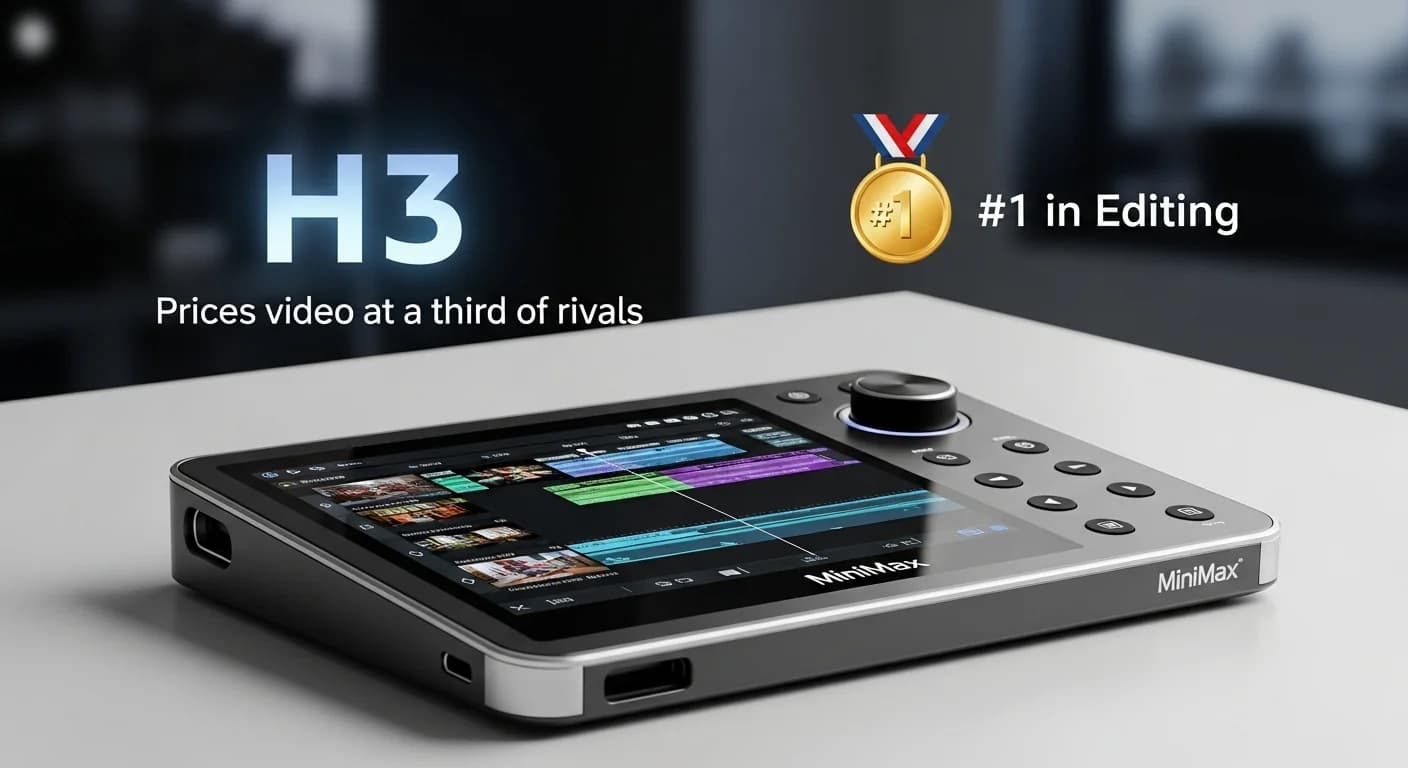
MiniMax released H3 on July 31, its first open-source full-modal generation model, and the list of what it claims is short and specific. The model takes a mixed context of text, images, video and sound, and answers with up to 15 seconds of 2K footage carrying native dual-channel audio. Output is priced at 0.8 yuan per second, which the company puts at a third of comparable flagships. On the Artificial Analysis leaderboard, H3 ranks first globally in video editing, a claim that carries commercial weight: blind human-preference leaderboards such as LMSYS Chatbot Arena have turned third-party rankings into a buying signal.
Those two claims belong together, because together they are the story. A price cut on its own is easy to wave off. A leaderboard top on its own is what a flagship launch is supposed to deliver. H3 is asking the market to accept both at once: a third of the price and ahead on the task commercial buyers actually pay for.
Investors seem willing. Shares rose 14% on the announcement, reversing a decline, as the market read the move as a cost-control strategy with teeth. MiniMax positions H3 for advertising, brand, e-commerce, product design, UI/UX and gaming, and says it lowers the bar for enterprises and developers to make commercial-grade video content.
The honest caveat, as with any vendor launch, is that the demos are MiniMax's own. How the output holds up in the wild is the question that decides whether the price point is a bargain or just cheap.
| H3 at a glance | |
|---|---|
| Release | July 31 |
| Output | Up to 15 seconds, 2K, native dual-channel audio |
| Input | Text, image, video, audio |
| Price | 0.8 yuan per second, about a third of comparable flagships |
| Video editing rank | No. 1 globally on Artificial Analysis |
| Weights | Planned within days, subject to regulatory compliance |
| Share move | +14% on the announcement |
The price cut is an engineering story
MiniMax says the low price comes from system-level optimization, not subsidized losses. A high-compression tokenizer cuts the number of tokens needed to generate a video segment. Tuning across heterogeneous training setups, load balancing, and better GPU utilization bring down both training and inference costs while, the company says, holding quality steady.
The technical differentiation is in three places: instruction following, rendering of text and brand information, and V2V motion transfer, which migrates motion from a source video onto a target video for controllable multi-modal editing. That last capability is what makes the model interesting for professionals, because it is the difference between generating a clip and directing one.
Open weights within days, and the Kimi K3 precedent
MiniMax plans to open the weights within days, subject to regulatory compliance. The enterprise pitch follows: deploy locally, tune with your own data, keep security and compliance in house. Chip makers and developers, the company says, can adapt the model to cut usage costs and widen its application range.
The precedent is Moonshot AI's Kimi K3, the largest open-weight model at 2.8 trillion parameters. K3 hit cluster capacity limits within 48 hours of release and suspended new consumer subscriptions on July 19 to reserve compute for paying customers. The episode shows the appetite open weights can create, and why China's open-weight gambit is splitting Silicon Valley.
This is also a repeat of MiniMax's own playbook. Its M2.5 coding model topped the Multi-SWE-Bench benchmark while costing a tenth to a twentieth of competitors, with open weights on HuggingFace. H3 applies that logic to video, a category MiniMax argues still runs on closed models, where iteration speed and ecosystem openness have lagged the large language model world. The playbook has precedent in media generation too: Qwen-Music, a 3-billion-parameter model, beat Suno on 13 metrics, per the melody-first trick behind it.
Unit economics as a moat
The 14% share move is the market signal. MiniMax is openly walking away from the parameter race that defines much of the Chinese AI industry. While head players face compute constraints and supply contraction, the company is betting on extreme cost-performance plus open-source distribution to build a commercial moat from unit economics rather than model scale. The bet has precedent: four small models just beat their bigger siblings, a pattern that is no longer a coincidence.
The local deployment pitch is central to that. Enterprises that want AI video without shipping footage to a hosted API are natural early buyers, especially where data control and regulation shape procurement. Open weights make it possible; the price makes it cheap to try. The politics around open weights are live too: 41 rival companies signed a letter calling open-weight AI America's best bet, a move that reads more like nerves than consensus.
What to watch next
Three things will tell whether the bet pays: how the community adapts the model once weights are out, whether commercial orders follow, and whether the price-for-volume strategy restores MiniMax to a leading position in the AI race.
The definition of "leading" is shifting too. H3's video editing rank suggests production quality for professional workflows may matter as much as raw generation ability, and MiniMax is staking out cost-effective, commercially deployable full-modal generation as the competitive frontier. If the model survives third-party testing, a two-thirds price cut paired with a No. 1 editing rank is expensive for competitors to answer. If it does not, the pricing was the easy part.
- Source : MiniMax H3 prices video at a third of rivals, ranks No. 1 in editing — 2026-07-31
Get the tech essentials in 3 minutes every morning
One email, every weekday, with what actually matters in AI and tech.