WWDC 2025
Apple's walled garden just got a gate with an AI-shaped key
Xcode 27 brings agentic coding with Anthropic, Google, and OpenAI models, plus new intelligence frameworks that let apps use models from Apple, Claude, Gemini, and others. Core AI lets developers run full-scale LLMs on-device.
Emmanuel Fabrice Omgbwa Yasse AI-assisted
2026-07-25 · 4 min read

For years, Apple's developer ecosystem was a carefully curated greenhouse. You built with Apple's tools, for Apple's hardware, and the outside world entered only through narrow, approved gates. Xcode 27, announced Monday at WWDC, suggests that era is ending, at least for AI.
The new release lets developers plug coding agents from Anthropic, Google, and OpenAI directly into their workflow. Conversations with those agents support interactive planning, multiturn Q&A, and a canvas that renders Markdown alongside code changes and previews. It is the first time Apple has explicitly invited third-party AI vendors into its flagship IDE as first-class citizens, a move that mirrors the broader industry shift toward multi-agent orchestration systems like Sakana AI's Fugu platform, which similarly bets on open models working as a swarm, as covered in Sakana AI's bet that open models win as a swarm, not alone.
What agents can do now
The agents in Xcode 27 are not just autocomplete on steroids. They can write and run tests, try ideas in isolation with Playgrounds, check visual changes with previews, and interact with the simulator in a new Device Hub. Apple calls this giving agents the tools to validate their own work, letting them run autonomously for longer stretches before asking for human review.
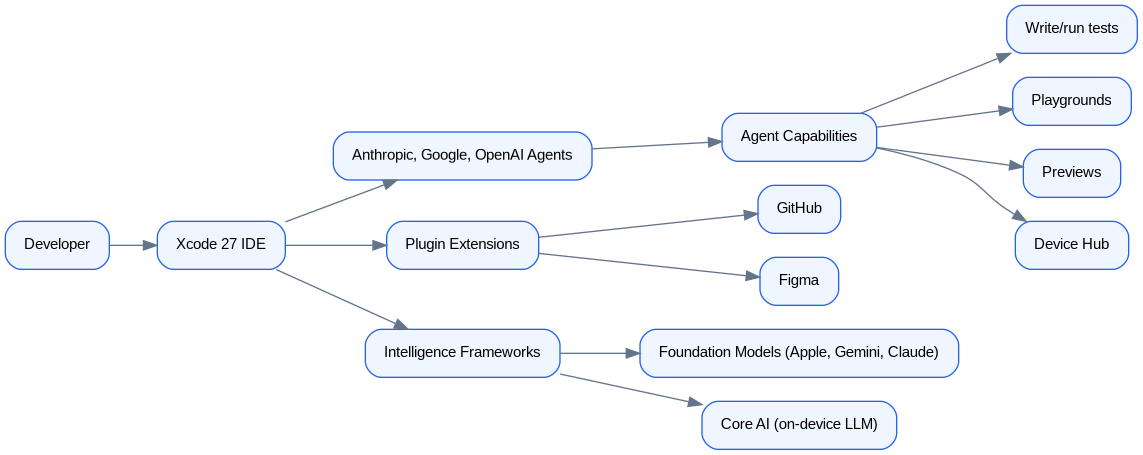
Xcode also opens up to plug-ins that extend the IDE with custom skills, tools brought in through the Model Context Protocol, and any agent compatible with the Agent Client Protocol. GitHub and Figma are the first to offer seamless installation between their tools and Xcode. This plug-in approach echoes the need for a unified skill management layer across multiple agents, something Alibaba's Nacos Skill Sync addresses by offering a central repository, as detailed in Nacos builds the Rosetta stone for AI agent skills.
The timing is interesting. Earlier this year, Cursor launched an iOS beta that turns the iPhone into a coding agent dispatcher, letting developers launch agents from anywhere, merge PRs, and review results without a full IDE. Apple's announcement reads partly as a response, fold third-party agents into the IDE before developers decide they don't need the IDE at all.
The intelligence framework play
Beyond Xcode, Apple overhauled its AI frameworks. The Foundation Models framework, introduced last year, now serves as a single native Swift API supporting on-device models with image input, server models, and custom skills. It taps into the next generation of Apple Foundation Models, built in collaboration with Google and its Gemini models.
But the notable shift is Apple's willingness to let developers bypass its own models entirely. Developers can leverage models like Claude and Gemini, or any provider that implements Apple's new language model protocol, through the same API. A new Dynamic Profiles capability lets developers update how models interact with their apps on the fly, without pushing a new app version. This flexibility comes at a time when vision-language models are also evolving to avoid hallucinations through structured attention redistribution, as explored in the visual relay window that stops AI hallucinations.
The cost structure is equally telling. Developers in the App Store Small Business Program, those with fewer than 2 million total first-time downloads, can access the next-gen Apple Foundation Models on Private Cloud Compute at no cloud API cost. That is Apple buying developer lock-in by subsidizing inference, the same play Google and Microsoft have used to build their cloud AI businesses. The economics of AI inference are shifting rapidly, with models like Kimi K3 and others rewiring AI cost assumptions, as analyzed in the $314 billion assumption that just broke.
Core AI: running LLMs on device
For developers who prefer to keep models local, Apple introduced Core AI, a framework optimized for the unified memory and Neural Engine of Apple silicon. The pitch is running full-scale LLMs on device, not just the on-device models Apple has been shipping since iOS 18. Whether those models are Apple's own or third-party checkpoints deployed through the same framework remains unclear, but the framework's architecture suggests Apple sees a future where developers ship models alongside apps the way they ship assets today. This on-device approach aligns with the trend of smaller models that punch above their weight, such as Alibaba's 7B Qwen2.5-Omni that handles multiple modalities, as shown in the 7B model that beats bigger ones and runs on a phone.
Xcode 27 itself is now Apple silicon only, 30 percent smaller, and faster. Xcode Cloud claims up to 2x speed improvements, with new support for Metal and visionOS builds. Swift 6.4 introduces targeted warning suppression, simplified availability attributes, and improved compiler diagnostics, small quality-of-life changes that add up.
The broader message from Cupertino is consistent: Apple will not try to win the AI model war through its own models alone. It will try to win by being the platform where every model works, on every device, under Apple's terms. The walled garden is getting a gate, with a very Apple-shaped key. For developers wondering how to make the most of these new capabilities, crafting effective prompts will be essential, as outlined in the practical guide for professional prompting.
Get the tech essentials in 3 minutes every morning
One email, every weekday, with what actually matters in AI and tech.