Generative AI
Pippa pays artists $0.005 per image. Its models still train on scraped art
Pippa promises artists a cut of every generation made in their style: $0.005 per image, $0.003 per video second, plus a share of a 5 percent royalty pool. With around 800 subscribers and four signed artists, and base models still trained on scraped content, the ethical pitch has a math problem.
Emmanuel Fabrice Omgbwa Yasse AI-assisted
2026-08-07 · 4 min read
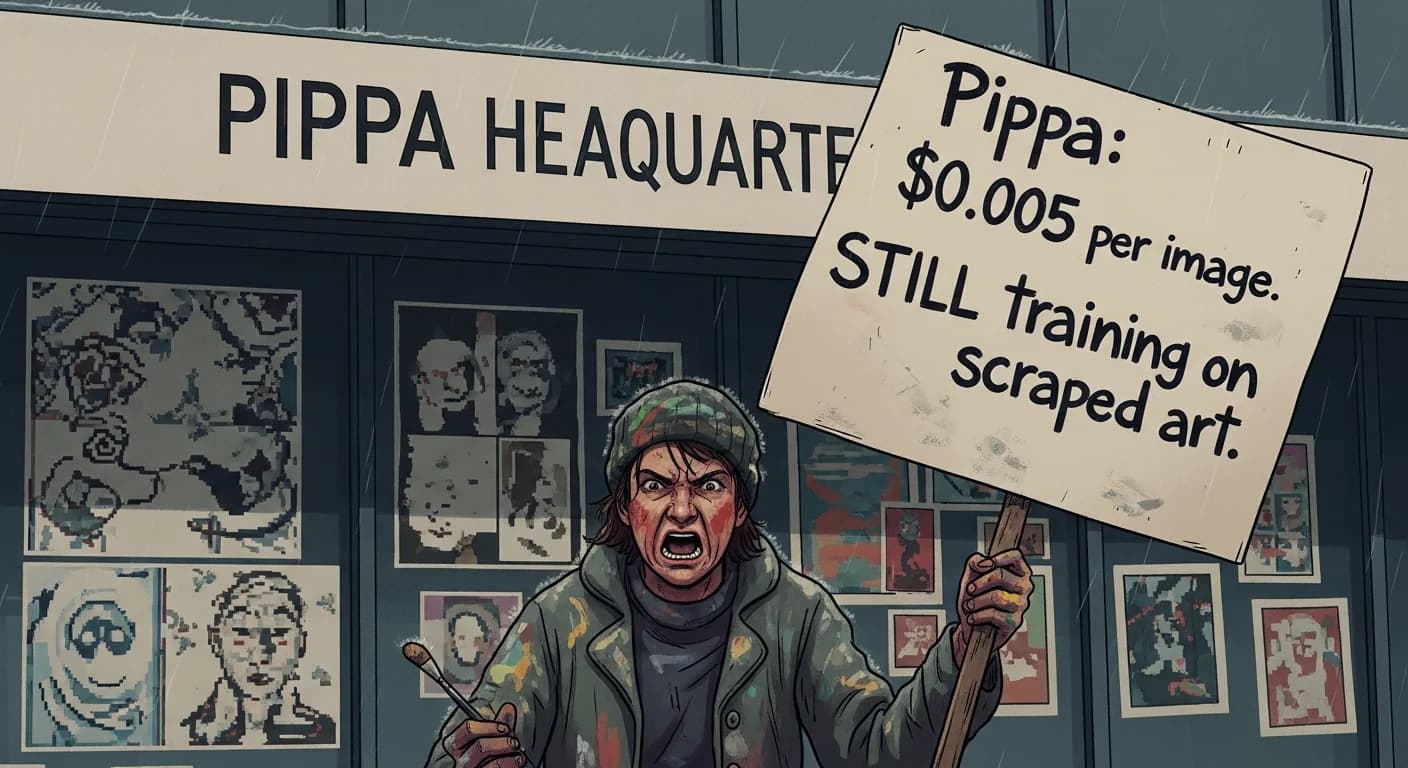
Pippa, a text-to-video startup that launched in May, is trying to prove that generative AI can pay the humans whose work it learns from. The company, profiled by The Verge, pays artists $0.005 per generated image and $0.003 per second of generated video, plus a cut of a 5 percent royalty pool funded by subscription revenue. Subscribers pay between $14.99 and $99.99 a month. The gap between those numbers is the story.
Cofounders Hogan Shrum and Sean Wright present the model as a way forward from what they call "the bloody history that the AI industry has been built on." Wright reaches for the Napster precedent: "All of these models from the past 18 months have been trained on real people's art without their permission. That's how it was built. I harken it back to when Napster was a thing and everybody was stealing music. But then, Apple came out with the 99-cent song, Napster got shut down, and we figured out a different way to get musical artists paid."
The payout math is easy to test
Pippa's own press materials compare the royalty structure to Spotify's. It is a curious benchmark, given how many musicians have spoken out about being shafted by the streamer. Read generously, the comparison promises artists they will earn through volume. Read literally, it describes a platform that keeps the growth, passes creators the residuals, then calls the residuals ethical. Stability AI's label deals rest on the same bet, per the rundown of what UMG and WMG actually get.
| Payout item | Amount |
|---|---|
| Per generated image | $0.005 |
| Per second of generated video | $0.003 |
| Royalty pool | 5% of subscription revenue |
| Subscriber pricing | $14.99-$99.99 per month |
The volume is not there yet. Pippa has around 800 paying subscribers and has signed model training and licensing agreements with four human artists, with talks underway for four more. Artists who apply must clear a multi-step vetting process meant to verify the illustrations are actually theirs. Once approved, models trained on their art go live for subscribers, and they get a profile page that directs people to their work outside the platform. The company also lets partners submit under pseudonyms. As Wright put it: "We've had so many conversations with artists where they're like, 'I love this, but I don't want to get ostracized by my community.'" Paying artists is the easy part; the scarcity is trust, and it is the same scarcity the agentic payments world keeps running into: the rails exist, the trust does not.
A scraped foundation under the ethical veneer
Here is the part the marketing soft-pedals. Pippa's technology is built with open models that the company says "have initial training on the broader set of content out there." In plainer terms, the ethical pitch sits on top of the same scraped-art foundation the cofounders say the rest of the field was built on. Pippa wants to switch fully to datasets provided by its in-house artists. That has not happened yet.
This is a structural problem for the category, not a Pippa-specific bug. A paper submitted in July found a similar gap between stated values and production AI across the industry: pluralistic alignment has no foothold in production AI. Ben Affleck's InterPositive tries to avoid it by developing wholly original proprietary datasets, but that takes upfront capital most startups do not have, and the result tends to be specialized tools rather than general consumer products. Pippa chose the cheaper route: open models with initial training on the broader internet, plus a promise to do better.
A scroll through Pippa's online portal shows mostly kid-oriented content doing a poor job of imitating Pixar's polished aesthetic, and nothing really looks like it was inspired by an independent artist's hand. In the near term, Pippa plans to add ByteDance's Seedance 2.5 model, which can generate up to 30 seconds of footage and lets users fine-tune a generation without starting from scratch. Rivals will offer Seedance 2.5 as well, in a video market where MiniMax H3 already prices output at under a third of the going rate. The only durable differentiation is the roster of in-house artists, and that depends on artists deciding a fraction of a cent per generation is worth the risk of being seen as crossing the picket line.
Shrum and Wright are betting that the economics become visible and artists come around. The bet requires public opinion on generative AI to swing back in the technology's favor. What sets Pippa apart from other players in the gen AI video space is that it pays artists at all. Whether the line is big enough to matter is another question. The Spotify comparison, offered by Pippa itself, is a decent hint at the answer.
Get the tech essentials in 3 minutes every morning
One email, every weekday, with what actually matters in AI and tech.