Deep Dive: AI Agents
Parallel agents aren't about speed. They fail when your architecture does.
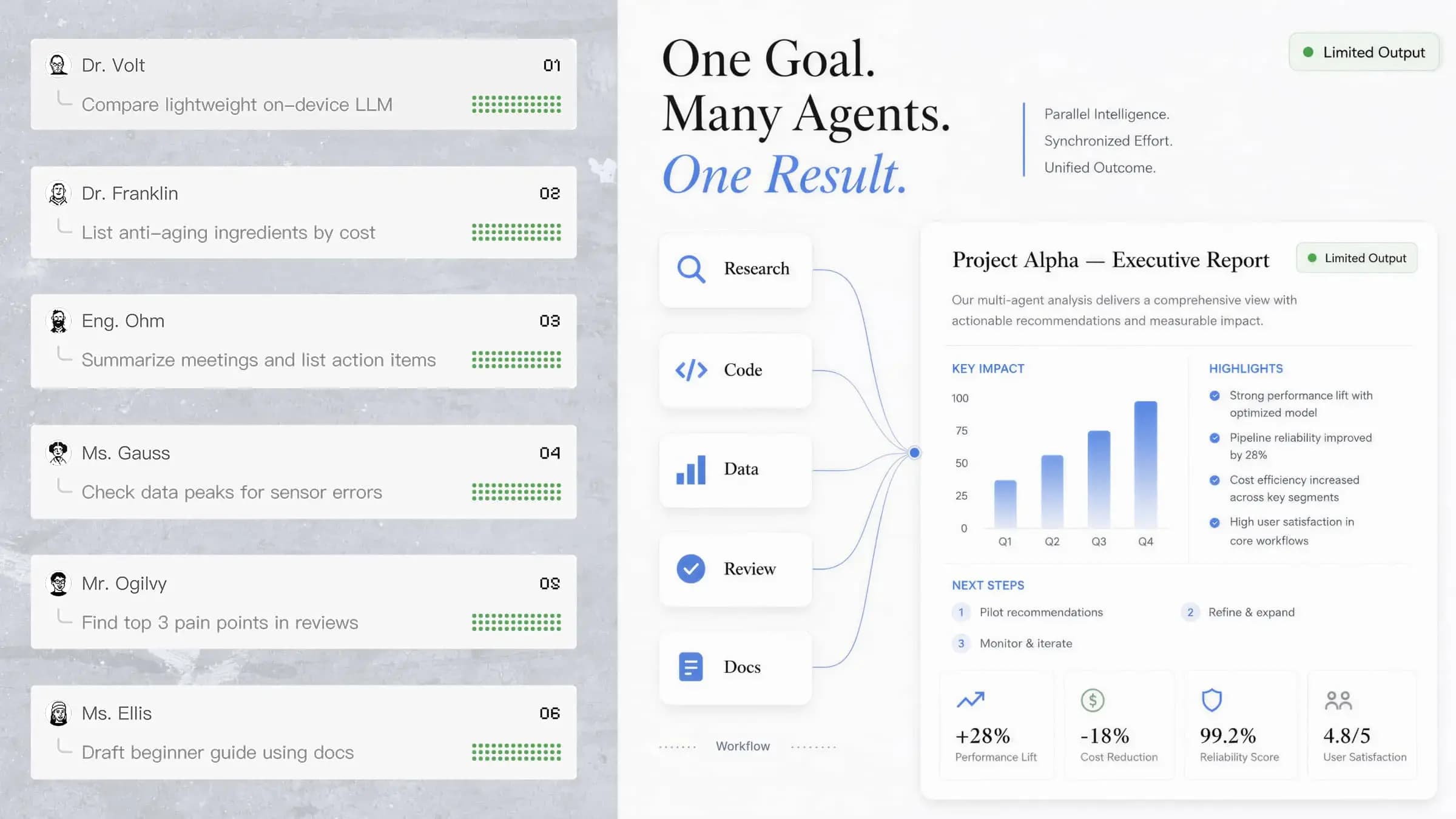
Parallel agents promise speed and specialization, but concurrency alone doesn't guarantee better results. This analysis explores the architecture, patterns, and practical orchestration that make parallel agents effective, using Kimi Agent Swarm as a case study.
Emmanuel Fabrice Omgbwa Yasse AI-assisted
2026-07-22 · 7 min read

The parallel agent promise and its hidden complexity
The pitch sounds tempting: instead of one AI agent grinding through a task start to finish, deploy multiple agents working concurrently on independent subtasks. Faster results, narrower roles, less context overload. The benefits listed in every product blog post are real, but they come with conditions. Parallelism without orchestration is chaos. The difference between a successful parallel workflow and a tangled mess often comes down to design decisions that have little to do with AI and everything to do with systems architecture, as noted in the specialization revolution analysis.
The source material, a guide published on June 9, 2026, walks through the mechanics of parallel agents with a practical example in Kimi Agent Swarm, a system that can coordinate up to 300 sub-agents and support over 4,000 tool calls per task. But buried beneath the enthusiasm for concurrency is a more nuanced story: how do you decide what to parallelize, and more importantly, when not to?
Why parallelism fails without good decomposition
The most common mistake in parallel agent design is assuming every task benefits from being split. The guide correctly identifies task decomposition as the critical first step, asking four questions: which subtasks are independent, which depend on earlier outputs, which need specialist agents, and which outputs must be checked before the next stage starts. In practice, many teams skip the dependency analysis and throw agents at a problem, hoping the orchestrator will sort it out. This is exactly the kind of trap discussed in the production agent trap.
Dependency-aware parallelism is the difference between a system that works and one that produces conflicting outputs. The guide's example of an enterprise dashboard build illustrates the point: database schema can start early, API implementation depends on the schema, frontend layout can begin in parallel with API planning, but data integration must wait until the API contract is stable. An orchestrator that ignores these dependencies will generate work that has to be thrown away. That wastes compute and context, undermining the speed promise, a reality that mirrors Microsoft's argument about orchestration.
A 2025 study from researchers at MIT's Computer Science and Artificial Intelligence Laboratory found that poorly decomposed parallel agent workflows actually took longer to complete than their sequential counterparts. The overhead of conflict resolution and output merging outweighed any concurrency gains. The lesson is clear: decomposition is a design skill, not a configuration parameter.
State isolation: the invisible infrastructure
The guide emphasizes independent state and branch isolation as a core principle of parallel agent architectures. Each agent needs its own working memory, context history, and output space. This is not merely a technical nicety. It prevents cross-contamination. If one agent's intermediate reasoning about a bug fix leaks into another agent's analysis of the same codebase, the resulting outputs will be inconsistent and unreliable.
In practice, state isolation requires more than separate memory spaces. It requires a design where agents share global constraints, accepted facts, key decisions, final outputs, without sharing the noise of their reasoning. The guide describes this as a balance between private memory (keeping each agent focused on its role) and shared memory (storing global context). Getting the balance wrong on either side produces either isolated agents that repeat work or over-connected agents that interfere with each other. This need for careful memory design echoes the findings in Nvidia's approach to expert parallelism.
Kimi Agent Swarm implements this through task queues and stage gates. These are checkpoints where the orchestrator verifies that outputs from different branches align before allowing deeper implementation. In the dashboard example, the orchestrator checks whether field names, data types, and route mappings match between branches before the second wave of agents starts building. This is where the system earns its reliability, not in the raw number of parallel agents it can coordinate.
Parallel patterns worth using, and one to be careful with
The guide catalogs four common patterns: fan-out/fan-in, specialist parallelism, competing solutions, and parallel coding agents. Each has a clear use case, but one stands out as both powerful and risky.
Fan-out/fan-in is the safest and most widely applicable pattern. Assign five agents to research five competitors simultaneously, then synthesize. The subtasks are genuinely independent, outputs are bounded, and synthesis is straightforward. This pattern works well for research, market scans, and source collection, tasks where breadth is the goal similar to Kimi Slides' research layer.
Specialist parallelism assigns different roles to different agents: one researches, one analyzes, one writes, one QA-checks. This pattern maps naturally onto human team structures and works well for content production and complex analysis. The risk is that weak synthesis creates a disjointed final product. Each specialist delivers a high-quality piece, but they don't fit together.
Competing solutions, where multiple agents solve the same problem independently and the system picks the best, is an underused but powerful pattern. It is especially valuable for architecture decisions, creative work, and strategy, where the greatest risk is not wrong execution but a single flawed assumption that no one questions. Three agents proposing different database schemas will surface hidden tradeoffs that a single agent would never consider.
Parallel coding agents, however, require the most caution. The guide notes that this pattern needs clear ownership boundaries, which files each agent can edit, which contracts must stay stable, how merge conflicts are resolved. Without these boundaries, two agents can easily make incompatible changes. In practice, parallel coding works best when the codebase has clear modular boundaries and the orchestrator can enforce contract stability. Monolithic codebases with tight coupling will generate more conflicts than benefits, a lesson reinforced by the hidden tax on vibe-coded projects.
When parallel agents add complexity without value
The guide is honest about the limits: parallel agents are not always better. For simple tasks, they add unnecessary complexity. For dependency-heavy sequences, they create overhead with little benefit. And for work where synthesis is difficult, open-ended creative tasks, emotionally nuanced writing, or problems requiring deep integration across domains, the cost of merging multiple parallel outputs can exceed the value of parallel execution.
The governance dimension is also worth noting. Parallel agents that interact with external systems, databases, APIs, file systems, need careful permission management. The guide touches on this briefly, noting that a research agent may need web access while a review agent may only need read-only access. In enterprise deployments, this is not a minor detail; it is a compliance requirement. Every tool call is a potential attack surface, and every agent's permissions must be scoped to the minimum necessary for its role, aligning with Anthropic's usage policy updates for high-risk AI.
Kimi Agent Swarm as a reference implementation
The guide's extended walkthrough of Kimi Agent Swarm is less a product pitch and more a practical illustration of the principles discussed. The system decomposes an enterprise dashboard build into stages, plan, build (two waves), review, with clear checkpoints between them. The orchestrator creates a dependency graph at the start, verifies contracts between waves, and routes issues back to the relevant agent for repair. This is architectural discipline, not just parallel execution.
What makes Kimi Agent Swarm interesting is not its ability to run 300 agents. That is a raw capacity number that will become less impressive as the field matures. The commitment to structured coordination matters more. The stage gates, the field-name checks, the role clarity: these are the design decisions that separate a production-grade parallel system from a demo.
What comes next
The future of parallel agents is not about more agents running at once. It is about better decomposition, more intelligent synthesis, and tighter integration with verification systems. The guide hints at this with its discussion of observability and verification, but the field is still early. Today, most parallel agent systems are built by orchestrating multiple LLM calls with hand-coded logic. Tomorrow, we may see systems where the orchestrator itself is an agent that learns to decompose tasks and resolve conflicts over time.
For practitioners: start with fan-out/fan-in for research tasks, add specialist parallelism for content workflows, and approach parallel coding with clear boundaries and strong module contracts. The architecture comes before the agents, and the orchestrator's design matters more than any single agent's capability, as reinforced by the benchmark gap analysis of open-source coding models.
Get the tech essentials in 3 minutes every morning
One email, every weekday, with what actually matters in AI and tech.