AI Development
Coding agents are leaving your local machine: Alibaba and Mistral go remote
Alibaba Cloud's Qoder introduces remote delegation for coding agents, letting developers offload long-running tasks to cloud sandboxes. The feature, paired with a new knowledge engine, pits Qoder directly against Mistral's remote agents in a race to decouple AI-assisted development from the local terminal.
Emmanuel Fabrice Omgbwa Yasse AI-assisted
2026-08-03 · 3 min read
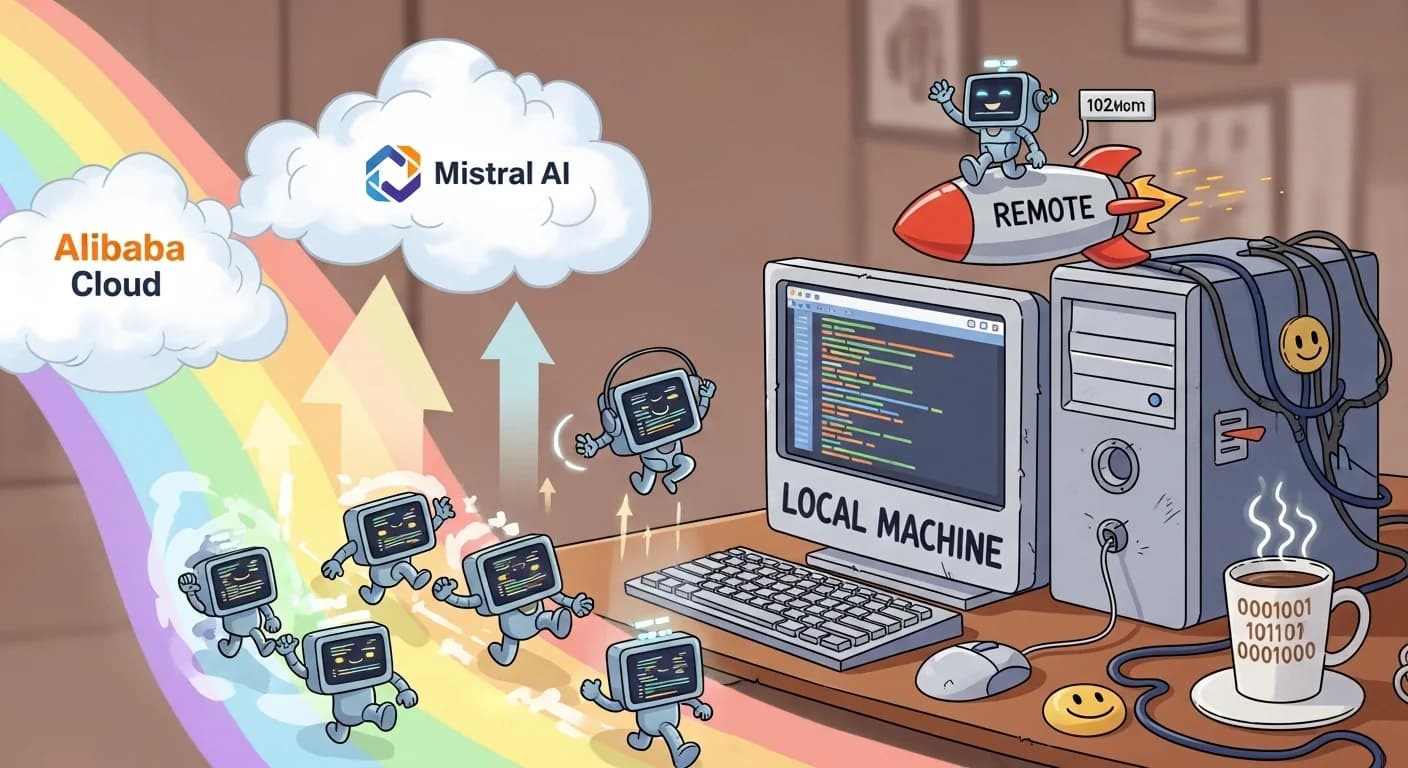
Alibaba Cloud has shipped two updates to its Qoder coding agent that shift the tool from a local assistant to a cloud-first engineering platform. Quest Mode now supports remote delegation: developers describe the task, generate a design document in natural language, and click a button to push the work to a secure cloud sandbox. The agent executes autonomously, and the developer gets a notification when it finishes.
The second update is the Engineering Knowledge Engine, a multi-source retrieval system that pulls together commit history, vector indexes, code graphs, and a self-maintaining RepoWiki. Alibaba says the engine cuts average indexing time by 5x compared to industry alternatives and reduces overall token consumption by 21% during agent retrieval, according to internal benchmarks on its Qoder Agent Bench suite.
From executor to commander
Qoder's Quest Mode was already designed around a spec-first workflow: developers write a detailed specification covering tech stack, architecture, and goals, and the agent executes. The new remote delegation extends that paradigm to the cloud, freeing local resources and allowing asynchronous, potentially parallel, task execution. This mirrors the broader industry push toward parallel agent orchestration, as discussed in the parallel agents orchestration battle.
Mistral took a similar step earlier this year, introducing remote agents in both its Vibe CLI and Le Chat interface, backed by Mistral Medium 3.5, a dense 128-billion-parameter model. Mistral's agents run in isolated cloud sandboxes, support parallel sessions, and notify developers when done.
The parallel launches suggest the coding agent market is converging on a model where the agent lives in the cloud, not on the developer's laptop. The reasoning is straightforward: long-running tasks like dependency upgrades, large-scale refactoring, or batch test generation tie up local resources and demand constant attention. Cloud sandboxes side-step environment setup issues, allow isolation, and can scale compute without draining the developer's machine.
The knowledge layer
While remote delegation handles the "where" of execution, the Engineering Knowledge Engine handles the "how well." Its multi-index approach combines vector retrieval, a Code Graph that models relationships like calls, inheritance, and references, a Commit Graph enhanced by language models for semantic summarization, and RepoWiki, which auto-generates architectural documents that evolve with the codebase. By combining these sources, the engine reduces the working memory limitations that often cripple agents in long-running tasks, a challenge highlighted in research on agent working memory.
The system also includes a Memory layer that persists insights across sessions, consolidates them, and deduplicates. Over time, the knowledge base becomes richer as the agent is used more, creating what Alibaba calls a "self-reinforcing knowledge flywheel."
An agent's capability ceiling is jointly determined by the engineering environment in which it operates.
The benchmark data from Qoder Agent Bench shows the engine's experimental group outperformed the baseline on correctness and reduced redundant reasoning. A/B experiments with real users showed higher code retention rates and lower conversation dissatisfaction.
Competitive implications
For developers, the choice between Qoder and Mistral's remote agents may come down to ecosystem and knowledge management depth. Qoder's strength is its integrated knowledge engine, which learns from both code changes and agent interactions. Mistral's advantage is its lighter, chat-first interface and the broader Mistral model family.
Both tools are still early. Remote delegation is a workflow shift that has yet to prove itself in production, especially for teams with strict data governance requirements that frown on sending full codebases to cloud sandboxes. Alibaba addresses this by emphasizing the security of its sandbox, but the tension between convenience and control remains unresolved. The cost side of that tension is equally murky: enterprises often have no clear picture of what their coding agents actually cost, as explored in the analysis of agent costs. The production pitfalls of AI agents, from planning failures to environmental mismatches, are well documented in the analysis of AI agent traps in production.
The coding agent landscape is moving away from the chat-window-on-the-terminal model toward a persistent, cloud-hosted agent that operates asynchronously. The companies that get the balance right, autonomy without loss of oversight, rich context without data exposure, will shape how developers write code in the next few years.
Get the tech essentials in 3 minutes every morning
One email, every weekday, with what actually matters in AI and tech.