Open-weight models
Kimi K3 is open, 2.8 trillion parameters strong, and still hunting for a win against the frontier
Kimi K3, the largest open-weight model at 2.8T parameters, lands with novel attention architectures and a 1M-token context. On benchmarks it competes in the upper tier but trails Claude Fable 5 and GPT 5.6 Sol, challenging the narrative that open models are closing the gap to proprietary frontiers.
Emmanuel Fabrice Omgbwa Yasse AI-assisted
2026-07-17 · Last updated: 2026-07-25 · 4 min read

On the surface, the numbers are staggering. Kimi K3 is a 2.8-trillion-parameter mixture-of-experts model that activates 16 of 896 experts per token. Its architecture includes Kimi Delta Attention (KDA) and Attention Residuals (AttnRes), two design innovations the lab says improve scaling efficiency by roughly 2.5× compared to its predecessor, Kimi K2. The model supports a 1-million-token context window and processes text, images, and video natively.
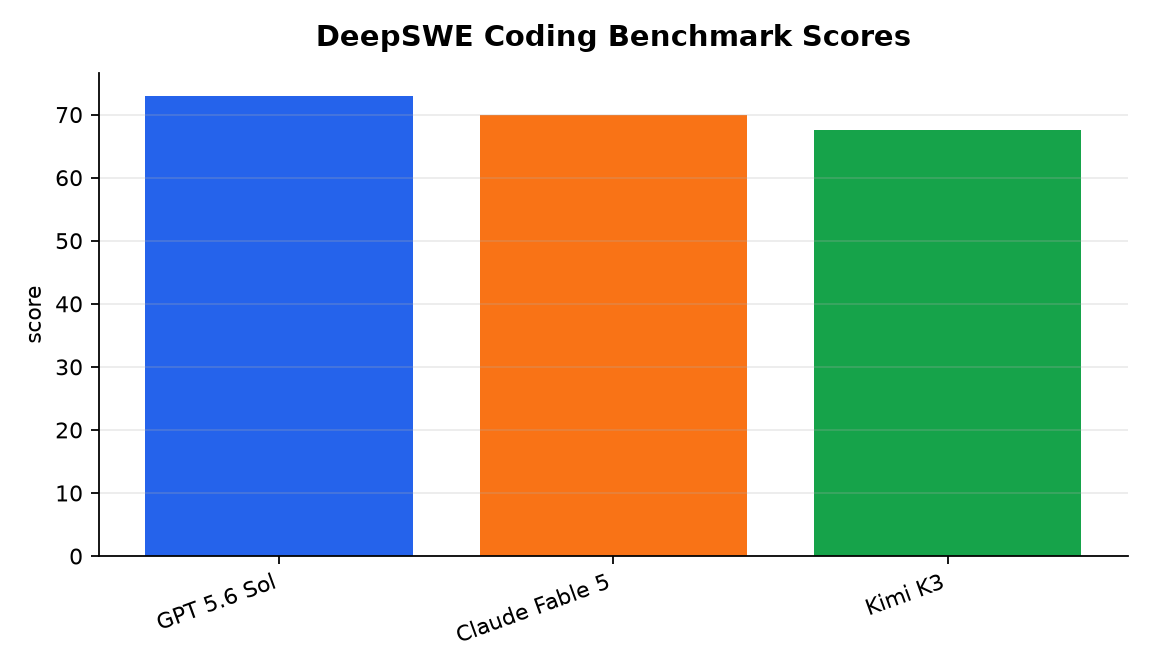
But the benchmark table tells a more nuanced story. Across more than 40 evaluations spanning coding, agentic tasks, reasoning, knowledge, and vision, Kimi K3 lands in the upper tier, but rarely at the top. On the flagship coding benchmark DeepSWE, it scores 67.5, behind GPT 5.6 Sol (73.0) and Claude Fable 5 (70.0). On the reasoning test GPQA-Diamond, its 93.5 trails GPT 5.6 Sol's 94.1. Only on Terminal Bench 2.1 (88.3) and BrowseComp (91.2) does it edge ahead of the proprietary leaders. For a deeper look at how those two leaders stack up on frontier coding tasks, see the analysis of M2.7's near-Claude-Opus performance.
An open model, but not a frontier one
Kimi's framing is careful: "While its overall performance still trails the most powerful proprietary models, Claude Fable 5 and GPT 5.6 Sol, Kimi K3 demonstrated frontier-level performance." That distinction matters. Kimi K3 is the largest open model ever released, but scale alone does not translate to dominance, and the gap on agentic benchmarks makes that clear.
On agentic benchmarks, the gap is more pronounced. On GDPval-AA v2, Kimi K3 scores an Elo of 1,668, compared to Claude Fable 5's 1,760 and GPT 5.6 Sol's 1,748. On DECK-Bench, its own internal evaluation, it scores 73.5, below GPT 5.6 Sol's 74.7. The pattern holds across vision benchmarks: on CharXiv with python, Kimi K3 reaches 91.3, but Claude Fable 5 hits 93.5. The persistent gap in agentic performance aligns with broader industry findings on how hard it is to scale agent reliability, as discussed in the analysis of human-hour metrics.
Kimi K3 does outperform on some niche tasks. It beats all proprietary models on SWE Marathon (42.0 vs. Fable 5's 35.0), on SpreadsheetBench 2 (34.8 vs. Fable 5's 34.7), and on Automation Bench (30.8 vs. Fable 5's 29.1). But these are not the benchmarks that define the frontier for most practitioners. The question is whether open models can close the gap on the benchmarks that matter, a question that newer fine-tuning techniques like Unsloth's kernels are starting to tackle from a different angle, as covered in the Unsloth report.
Architecture: the real story
More interesting than the benchmark ranking is what Kimi built under the hood. KDA is designed to improve information flow across long sequences, the team claims it handles a 1M-token context more efficiently than standard attention mechanisms. AttnRes, meanwhile, selectively retrieves representations from earlier layers instead of accumulating them uniformly, potentially reducing the depth penalty in very deep networks.
Together with Stable LatentMoE, which activates 16 experts out of 896, and a fully balanced expert-parallel training method, Kimi has solved several engineering problems that have plagued previous large-scale MoE models. The model also uses quantization-aware training from the SFT stage onward with MXFP4 weights and MXFP8 activations, ensuring broad hardware compatibility.
These innovations could prove more consequential than the benchmark numbers. If KDA and AttnRes generalize well, they represent a genuine architectural advance, one that smaller labs and open-source projects could adopt in their own models. This kind of architectural openness mirrors what other open-weight pioneers have done, as explored in Ollama's bet on open-model infrastructure.
Pricing and availability
Kimi K3 is available now on Kimi.com, Kimi Work (desktop app), Kimi Code (terminal), and the Kimi API. Pricing is aggressive: $0.30/MTok for cache-hit input, $3.00/MTok for cache-miss input, and $15.00/MTok for output, notably cheaper than Anthropic's and OpenAI's comparable tiers. The API claims a cache hit rate above 90% on coding workloads thanks to Mooncake's disaggregated inference architecture.
The full model weights will be released by July 27, 2026, though a technical report is not yet available. Kimi says it is "working closely with inference partners and open-source maintainers" to ensure a reliable rollout. For organizations comparing inference costs across providers, the aggressive pricing strategy recalls the dynamics seen in Anthropic's Sonnet 4.6 pricing play.
The bottom line
Kimi K3 is a serious engineering achievement and the largest open model ever released. But benchmarking against proprietary frontier models reveals it is not yet a leader; it competes with the second tier. For organizations that want a 2.8T-parameter model they can inspect, modify, and self-host, Kimi K3 represents a step change in open-model capability. For users who need the rawest benchmark-peak performance, Claude Fable 5 and GPT 5.6 Sol remain the reference points. The broader question of whether open models can eventually match the frontier depends on innovations both in architecture and in the training pipelines that underpin them, as detailed in Alibaba's open-source world model.
- Source : Kimi K3 official announcement
Get the tech essentials in 3 minutes every morning
One email, every weekday, with what actually matters in AI and tech.