Reinforcement learning for self-correcting vision models
Meta's new training trick teaches AI to catch its own mistakes without a teacher
Meta and UIUC researchers developed SVR-R1, a training framework that lets vision-language models check their own answers and rethink when they get them wrong, all within a reinforcement loop. No teacher. No external critic.
Emmanuel Fabrice Omgbwa Yasse AI-assisted
2026-07-25 · Last updated: 2026-08-03 · 3 min read
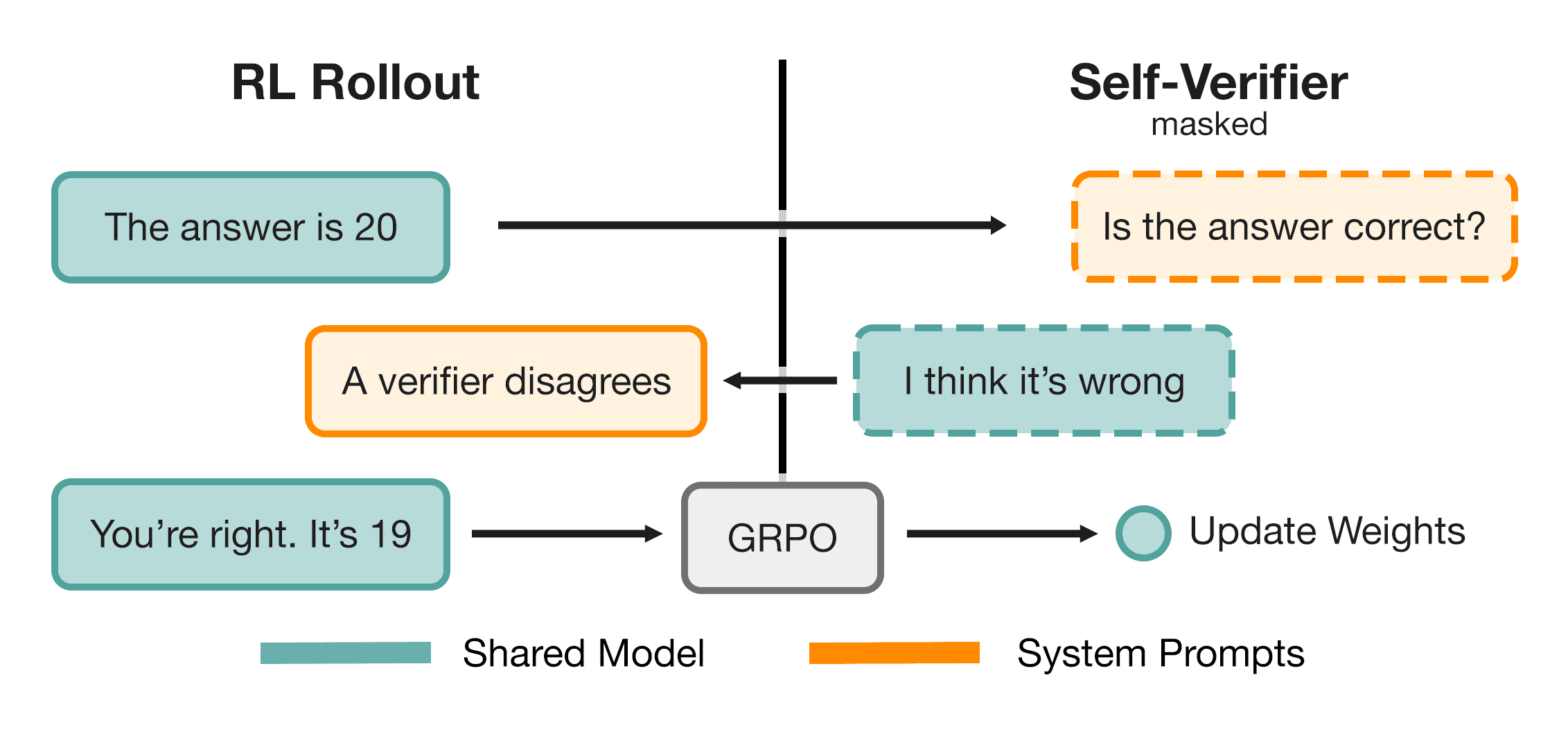
Left to standard training, a vision-language model answers a query once, right or wrong. A team from Meta and the University of Illinois Urbana-Champaign has shown it can do better when the training itself rewards it for checking its work and redoing answers it does not trust, with no human label and no second critic model in the loop. That removes what is usually the most expensive part of multimodal training: feedback somebody has to produce by hand. The tradeoff is that everything now rests on the model's own verdict, and separate research found self-review can be structurally blind to visual defects.
Plain GRPO trains a vision-language model to answer a query once and collect a reward. SVR-R1, short for Self-Verified Reasoner, gives it a second move. The training scheme, built on GRPO, is multi-turn: for each query the model generates an answer and, in the same pass, a binary self-verdict, Yes or No. A "No" sends it back for a rethink; a "Yes", or hitting the turn cap, ends the run and earns an outcome-based reward. The same weights act as generator and verifier, and the verification tokens are masked out of the loss so the two roles do not pull the optimization in opposite directions.
What the benchmarks show
On the two evaluation sets, SVR-R1 beats plain GRPO at both the 3B and 7B parameter scales. On ChartQA (826 test pairs), SVR-R1 at 3B scored 83.3% in pure-run mode, where no verification runs at inference, versus 80.5% for the baseline; with final verification enabled it matched 83.3%, while GRPO rose to 80.9%. On TableVQA (1,250 questions), the same model reached 72.4% in pure-run mode and 72.9% with verification, compared with 68.3% and 68.7% for GRPO. Within the same parameter budget, the self-check is what moves the numbers. It fits a broader pattern: four small models recently beat their larger siblings.
The 7B results follow the same shape. On ChartQA, SVR-R1 hit 82.9% in both pure-run and verified modes, where GRPO managed 80.4% and 81.1%. On TableVQA it logged 80.3% and 80.6%, against 78.7% and 78.5% for the baseline. On the general reasoning set ThinkLite-VL-70K, SVR-R1 beat the best GRPO baseline on MathVista (71.6% vs 70.8%), MathVision (19.1% vs 17.4%), and MMStar (49.3% vs 48.7%), and tied it on AI2D (81.4% vs 81.5%).
Fewer verification turns, higher confidence
The clearest signal during training is the steady drop in the average number of verification turns. As the model trains, it grows more confident in its initial answer and tends to affirm it immediately, settling into roughly one generation step followed by a single Yes. By the later training stages, accuracy in pure-run and final-verification modes is nearly identical, which suggests the model has internalized the correction and can recognize a right answer without actually performing the rethink at inference time. That is the opposite of what a new diagnostic benchmark found in ordinary chain-of-thought, where LLMs pad correct reasoning with valid but useless steps.
The authors attribute part of the gain to the framework locking in good answers on medium-difficulty questions over multiple rollout rounds. Endlessly rethinking questions that are simply too hard adds little, because the correct answer may stay out of reach no matter how many verification turns the model gets.
Open questions
SVR-R1 sits in a corner of AI research that has seen little work: inference-time self-refinement inside VLM reinforcement learning. Because the framework asks only for a Yes or No from the model itself, it needs no detailed rationales and no ground-truth labels, which keeps it data-efficient and easy to scale. The researchers plan to open-source it. A model that checks itself before committing also fits the wider push for safer agents, such as a cohort architecture that validates and brokers agent actions at runtime.
The paper leaves a question for the field: how to keep verification and generation improving together as self-verification gets stronger. For now, SVR-R1 is a simple recipe, bootstrapping multimodal reasoning out of nothing but the model's own Yes or No on its first attempt. Whether that simplicity scales to harder reasoning tasks is unresolved, and other labs are working on the same problem, including BAAI's AREX agents, which check their own steps in a recursive loop.
Get the tech essentials in 3 minutes every morning
One email, every weekday, with what actually matters in AI and tech.