AI Infrastructure
The hidden tax every AI agent pays just got a target painted on it
Nvidia's Nemotron 3 Embed models attack the cost of agentic loops. The 1B variants, not the 8B flagship, are the real story for production deployments that count every token.
Emmanuel Fabrice Omgbwa Yasse AI-assisted
2026-07-16 · Last updated: 2026-07-17 · 5 min read
Every extra turn an AI agent takes costs tokens, latency, and reasoning budget. Nvidia's new Nemotron 3 Embed family, three open-weight embedding models led by an 8B flagship that tops the Retrieval Transformer Evaluation Benchmark (RTEB), directly attacks that multiplier. The claim: better retrieval means fewer agent loops, and the numbers suggest the arithmetic is real. This dynamic is at the core of what Alibaba's AgentSight tool made painfully visible: agents burning through tokens without the user ever seeing where they went.
The agentic retrieval tax
In a conventional RAG pipeline, retrieval is a one-shot gate: get the top-k chunks, answer the question. In agentic systems, retrieval happens repeatedly, the agent searches, reasons, searches again, inspects context, and often re-ranks mid-stream. Each cycle compounds the token cost. Nvidia's internal evaluation, using a search agent powered by Nemotron 3 Ultra against ViDoRe V3, BRIGHT, and BrowseComp-Plus benchmarks, shows that stronger retrieval correlates with steeper reductions in downstream token spend. The 8B Nemotron-3-Embed model delivered both the highest average retrieval accuracy and the lowest estimated token cost per query across all three datasets. This is exactly the kind of systems-level problem that the NoisyAgent training method addresses: making agents robust to real-world noise rather than collapsing under the first unexpected input.
The mechanism is intuitive: if the first retrieval batch already contains the relevant evidence, the agent can skip the second search, the extra reasoning call, and the expensive context re-inspection. Nvidia's chart of accuracy versus agentic token cost draws a clear declining curve, a rare case where a vendor's benchmark narrative aligns with real deployment pressure.
Three models, three trade-offs
The collection spans three variants:
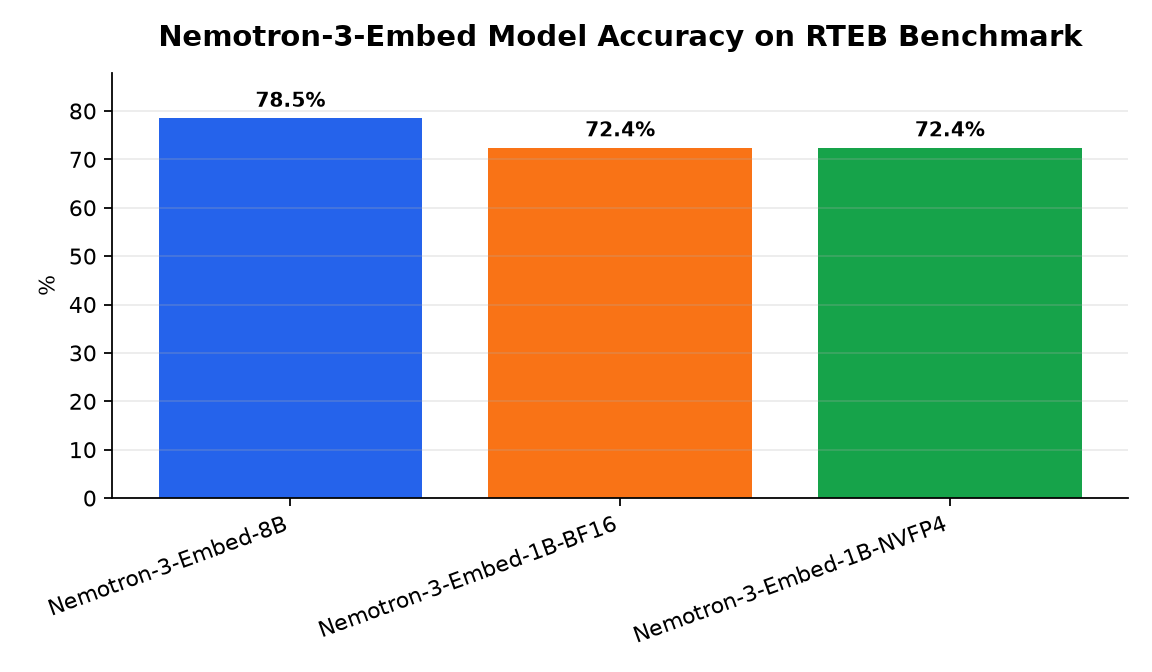
- Nemotron-3-Embed-8B-BF16, the flagship, embedding dimension 4096, 32k context window. Scores 78.5% on RTEB and 75.5% on MMTEB Retrieval (NDCG@10). Nvidia's own RTEB announcement claims the top spot against a field that includes Qwen3-Embedding and EmbeddingGemma.
- Nemotron-3-Embed-1B-BF16, pruned and distilled from the 8B via a two-stage ModelOpt NAS pipeline (3B to 2B to 1.14B). Scores 72.4% on RTEB, a 27% error reduction over its 1B predecessor (llama-nemotron-embed-vl-1b-v2).
- Nemotron-3-Embed-1B-NVFP4, a Blackwell-optimized 4-bit variant. Retains 99%+ of BF16 accuracy while claiming 2x higher throughput on Blackwell hardware through native NVFP4 acceleration. This kind of hardware-software co-optimization is reminiscent of what Unsloth's dynamic quantization did for the 1.9 TB Inkling model, but here it's baked into Nvidia's own hardware roadmap.
All three models share a 32k context window, mean pooling, and the same query:/document: input prefix convention, making them drop-in replacements for each other in a production pipeline.
Why the 1B models matter more than the 8B
Leaderboard headlines belong to the 8B flagship, but the pragmatic story sits in the 1B variants. Production embedding serving is a throughput game: every microsecond per query multiplies across millions of requests. Nvidia's Rust-based NIM microservice for the 1B model matches or beats the vLLM checkpoint on GB200 and RTX PRO 6000 GPUs at sequence lengths of 256 and 1024 tokens. That matters for teams that cannot justify the compute budget of an 8B embedding pass at scale.
The NVFP4 variant is the most interesting: it effectively turns a memory footprint problem into a hardware acceleration lever. On Blackwell GPUs, the native 4-bit path does not require runtime dequantization, so the throughput gain is structural, not a software trick. Companies like turbopuffer and Mem0 are already integrating the 1B models, with Mem0 reporting 80.38% against Qwen-3-0.6B's 78.71% on LongMemEval Retrieval@10, a narrow but consistent edge for agent memory retrieval.
Open recipes, closed-ish ecosystem
Nvidia released the model weights, fine-tuning recipes (via NeMo AutoModel), and distillation recipes under an open license. That puts Nemotron 3 Embed in a different category from proprietary embedding APIs. Teams can inspect, fine-tune, and self-host. Several enterprise partners, Automation Anywhere, Boomi, IBM, Palantir, ServiceNow, are evaluating the models for agentic retrieval, edge workloads, and documentation search. This full-stack approach echoes what Cursor achieved with its own ecosystem: providing not just a model but the infrastructure and deployment pipeline that makes it practical.
Yet the open ecosystem has a dependency: the NVFP4 variant runs best on Blackwell hardware. Teams on older GPU generations will default to the BF16 variant, which still requires significant serving infrastructure for the 8B model. The 1B models are the practical entry point for most deployments, but the performance ceiling remains tied to Nvidia's hardware roadmap.
Competitive landscape
The embedding market is crowded: Qwen3-Embedding-0.6B, EmbeddingGemma-300M, E5-Mistral-7B, and Voyage-2 all compete on accuracy-efficiency curves. Nvidia's value-add is the full-stack integration: models, NIM microservices, NeMo recipes, and hardware-optimized formats. A developer can start on Hugging Face, move to a NIM container for production, and later switch to NVFP4 on Blackwell for scale without changing the retrieval code. That ecosystem lock-in is subtle but powerful.
However, the 1B models' embedding dimension of 2048 (versus 4096 for the 8B) caps pairwise similarity resolution at scale. For large-deduplication, cross-encoder re-ranking, or dense retrieval over millions of documents, the dimensional reduction may create a ceiling Nvidia's own benchmarks do not expose. This is a reminder that better evaluation of retrieval quality is itself a frontier problem recent papers have started tackling.
Bottom line
Nemotron 3 Embed is not a revolutionary leap in retrieval science, it's an engineering synthesis: better benchmarks, efficient small variants, and a deployment story that ties accuracy to cost savings. For teams building agentic systems where token efficiency matters as much as recall, the 1B models offer a rare combination of open availability and production throughput. The 8B model wins the leaderboard; the 1B models may win the deploy.
- Source : Nvidia's Nemotron 3 Embed exposes the hidden tax every AI agent pays — 2026-07-16
Get the tech essentials in 3 minutes every morning
One email, every weekday, with what actually matters in AI and tech.