SpaceX takes on AT&T, T-Mobile and Verizon
SpaceX's carrier play: 65 MHz of spectrum and a dish on every roof
SpaceX says it will build a terrestrial mobile network to win customers from AT&T, T-Mobile and Verizon. The plan pairs 65 MHz of former EchoStar spectrum with small base stations mounted on Starlink dishes. Whether that adds up is the open question.
Emmanuel Fabrice Omgbwa Yasse AI-assisted
2026-08-09 · 4 min read
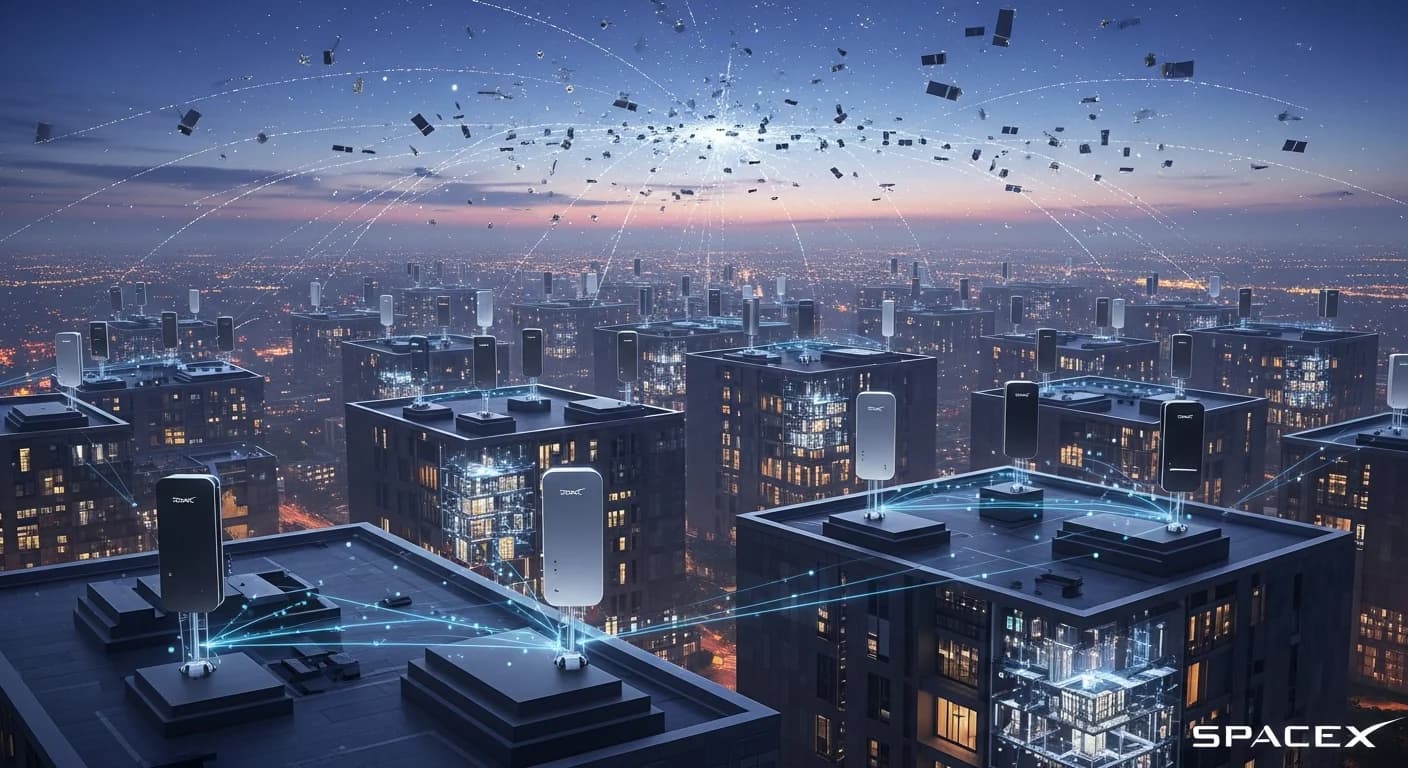
SpaceX built its satellite business on the places US carriers never bothered to cover. On the company's first earnings call, it went one step further: a terrestrial mobile network aimed directly at the customers of AT&T, T-Mobile and Verizon. Platforms have tried this before: Binance pushed into traditional finance on the strength of an existing user base.
"I anticipate us to be able to acquire quite a few of their customers because I think our service will be better," president Gwynne Shotwell said during the call's Q&A session, with CEO Elon Musk close behind to explain how the company might pull it off.
The ambition is easy to state. The hard part is the resource, and it's why the plan deserves some skepticism: SpaceX came out of its EchoStar deal with 65 megahertz of spectrum, a sliver of what each of the Big 3 wireless carriers holds in the US, as The Verge notes.
The spectrum gap at the center of the plan
Mobile networks run on spectrum, and the gap here is real. SpaceX acquired 65 MHz from EchoStar in a purchase that, per Shotwell, came with terrestrial rights attached: "The spectrum that we purchased from EchoStar does have terrestrial components, so we definitely intend to build out the terrestrial component."
That quote is the easy part. The rest of her answer described a full network build, including "the hardware and systems necessary to make a true mobile service exactly what you want it to be."
Running a nationwide network on 65 MHz leaves two paths, and the company's own executives named them: acquire more spectrum, or get creative.
Femtocells bolted onto Starlink dishes
The creative answer, teased by Shotwell and expanded by Musk, amounts to turning the company's existing hardware into a cellular grid. "You could put a base station, a cellular base station on the gear that holds a Starlink broadband dish," Shotwell said. "So you can have kind of these little femtocells around the country, and you deploy that as you need it."
Musk made the same point with more force. "Instead of having to deploy these very expensive and difficult to locate, large cellular base stations, we feel reasonably confident that we can deploy a large number of small stations. Essentially, they're really just Starlink dishes that also provide connectivity in the mobile spectrum bands, and have them be all over the place."
There is a tidy logic to it: Starlink antennas already sit on the roofs of houses and businesses with a clear view of the ground, and attaching a small cell to each one sidesteps one of the costliest parts of building a mobile network from scratch, finding and paying for sites. Musk argues the result could be "better and higher bandwidth than what is currently available from cellular providers."
What has not been explained yet is how the service behaves indoors, where a rooftop dish has no path to the phone, and how a sprawling grid of small cells gets coordinated at scale. The vision is clear. The engineering details are not, at least not yet. It would not be the first big promise to outrun its engineering details; Samsung's health assistant beta did the same.
A 100x claim against a $600 billion market
Starlink Mobile already offers a preview. It currently augments carrier networks, working with T-Mobile in the US to provide limited messaging and data in cellular dead zones. Shotwell says the service will be "100 times better" once the EchoStar bandwidth comes online and the next-generation Starlink Mobile (V2) satellites start flying next year.
Shotwell put the prize in plain terms: the US wireless market, dominated by AT&T, T-Mobile and Verizon, is worth around $600 billion annually. Rumors of wider ambitions had followed SpaceX through the run-up to its IPO, with Shotwell telling investors the company planned to sell mobile contracts directly to individuals.
| Element | The plan so far |
|---|---|
| Spectrum acquired from EchoStar | 65 MHz |
| US wireless market value | Around $600 billion annually, per Shotwell |
| Current Starlink Mobile service | Limited messaging and data in cellular dead zones |
| Next milestone | Starlink Mobile V2 satellites flying next year |
If the bet is that a new carrier can be built on a fraction of the spectrum the incumbents hold, propped up by small cells hung on consumer hardware, that's a test the industry has rarely seen run at this scale. The spectrum math does not change just because the hardware is clever.
SpaceX's answer to that is confidence. "I anticipate us to be able to acquire quite a few of their customers because I think our service will be better," Shotwell said. Whether better service can overcome a long-held spectrum advantage is the part the earnings call could not answer.
Get the tech essentials in 3 minutes every morning
One email, every weekday, with what actually matters in AI and tech.