K12-Bench: New Test of AI Curriculum Understanding
Why your AI tutor can't see how math builds on itself
Peking University's K12-Bench reveals that even the best language models barely understand how school concepts connect. Scores of 57% and 46% show a blind spot in AI's ability to handle prerequisite chains, concept taxonomies, and visual grounding, skills that real tutors use every day.
Emmanuel Fabrice Omgbwa Yasse AI-assisted
2026-08-02 · Last updated: 2026-08-03 · 2 min read
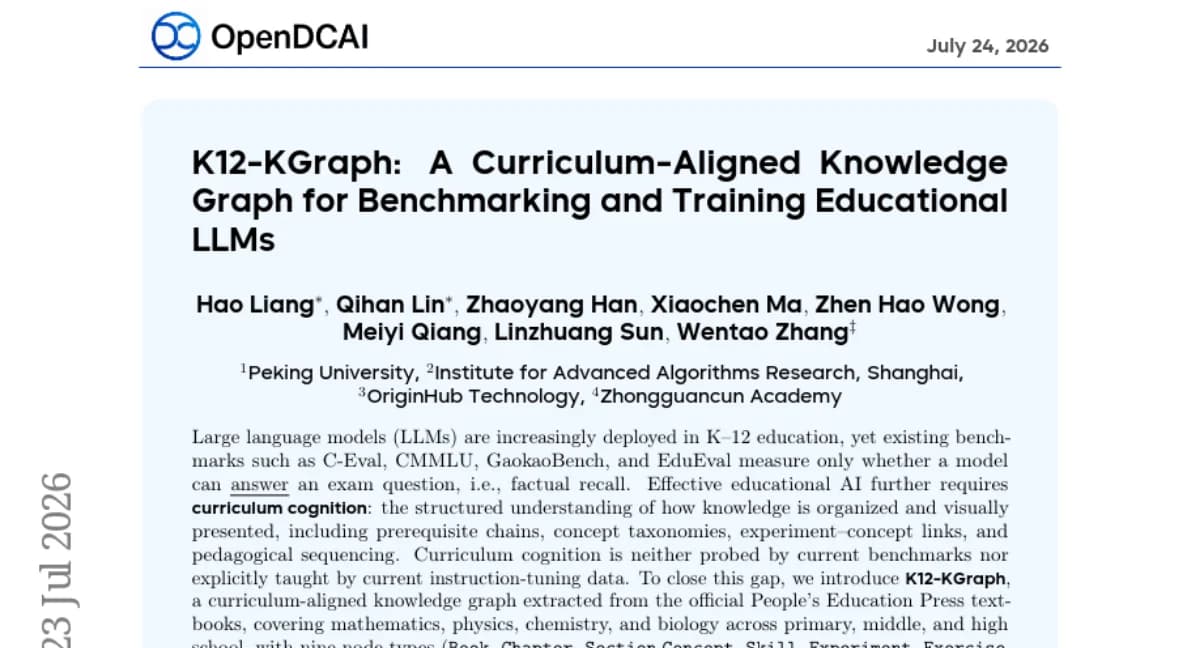
A new benchmark from Peking University reveals that even the best AI models barely grasp how school subjects connect. Gemini-3-Flash manages 57 percent. Gemma-4-31B-IT gets 46 percent. The test, K12-Bench, contains 23,640 questions.
The researchers argue that existing education benchmarks focus on exam question answering, not on whether a model grasps the relationships between concepts over a student's learning path. They call this capability "curriculum cognition." A model that can solve a quadratic equation might have no idea that factoring trinomials is a prerequisite, or that the concept shows up in both algebra and physics. Knowledge graphs tailored to student learning paths help map these dependencies, as shown in recent work on knowledge graph-based learner models.
To create the benchmark, the team first built K12-KGraph, a knowledge graph extracted from official People's Education Press textbooks covering math, physics, chemistry, and biology from primary to high school. The graph uses nine node types and fourteen relation types to capture curriculum structure and visual grounding: which concepts are prerequisites for which, how experiments link to theory, and where diagrams or equations appear in the official materials.
From that graph they derived K12-Bench, which has five task families: Ground (visual grounding of concepts in textbook images), Prereq (prerequisite identification), Neighbor (concept neighborhood matching), Evidence (connecting experimental evidence to claims), and Locate (positioning concepts in the curriculum timeline). The hardest tasks are Prereq and Neighbor, which both require reasoning about concept relationships instead of just retrieving facts. That is likely why even strong models struggle with them, echoing a broader pattern where AI systems fail at hierarchical rule application.
The researchers also built K12-Train, a supervised fine-tuning corpus of 7,335 samples mixing text-only QA pairs and multimodal visual QA pairs. When they trained models on a matched 2,300-sample budget, the K12-Train-Text subset consistently outperformed equally sized subsets from eight other mainstream instruction-tuning corpora on two downstream benchmarks, GaokaoBench and EduEval.
For vision-language models, the full multimodal K12-Train set scored highest on Gaokao-MM, MDK12-medium, and K12Vista, using fewer training samples than full baselines like DataFlow and WizardLM. It beat both text-only and vision-only variants, showing that textual concept structure and visual diagrams are complementary. This aligns with findings about
- Source : Why your AI tutor can't see how math builds on itself — 2026-07-23
Get the tech essentials in 3 minutes every morning
One email, every weekday, with what actually matters in AI and tech.