AI & Neuroscience
An AI model's scrambled neurons just recreated a stroke's exact damage to speech
Researchers perturbed LLaVA 1.6 to simulate aphasic picture-naming errors and matched individual patient profiles in up to seven error categories for 79.5% of cases. Six out of seven error types emerged naturally across different perturbation configurations, suggesting general-purpose multimodal models can function as digital twins for post-stroke language deficits.
Emmanuel Fabrice Omgbwa Yasse AI-assisted
2026-07-24 · Last updated: 2026-08-03 · 6 min read
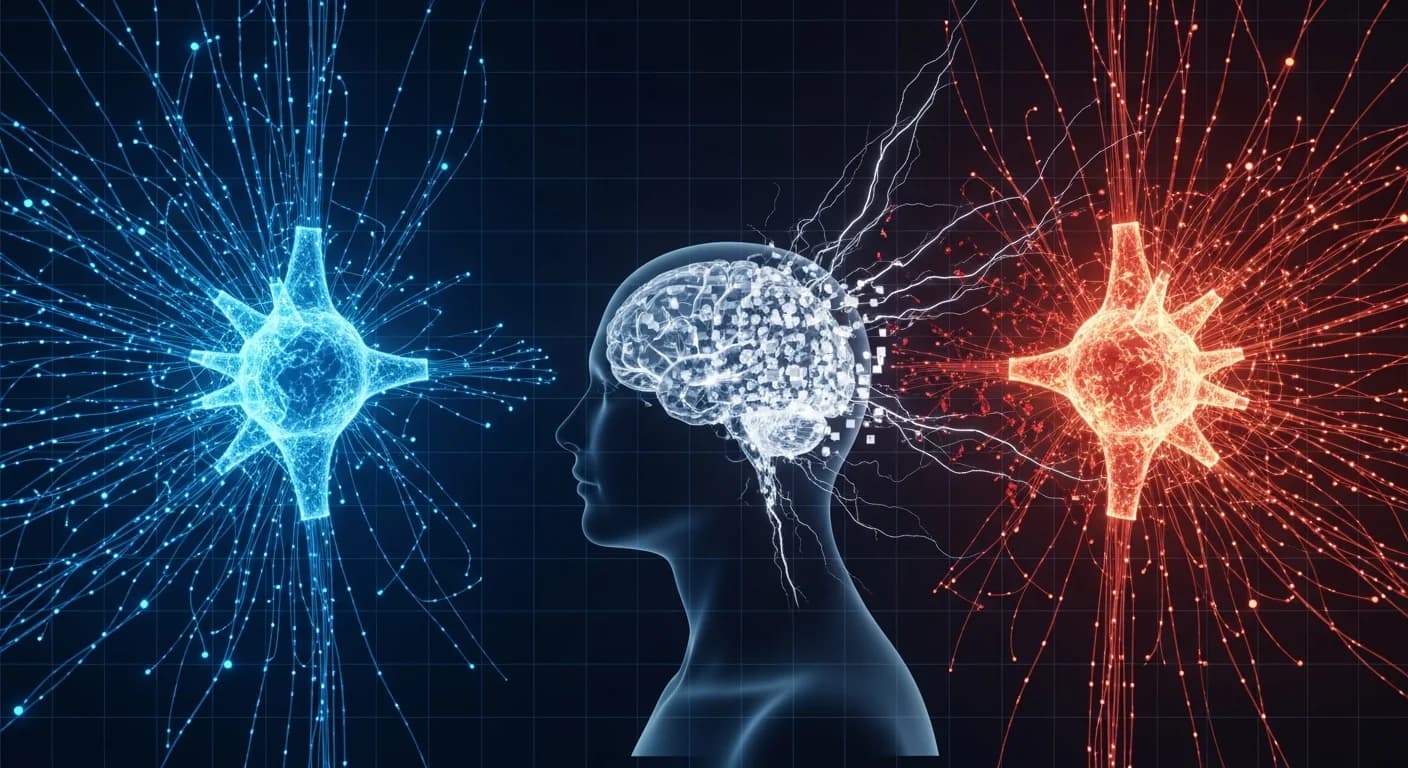
For decades, the only way to study the language deficits caused by stroke was through human patients, their scans, their tests, their slow recovery. A new preprint from researchers at the University of South Carolina and collaborators flips that script entirely: they have shown that deliberately damaging a general-purpose multimodal language model produces the same systematic naming errors seen in people with aphasia.
The paper, Lesioned Multimodal Language Models Reproduce Aphasic Picture-Naming Patterns, posted on arXiv in July 2026, moves beyond the usual benchmark obsession of AI research. Instead of asking whether a model can score higher on a test, the authors ask whether it can fail like a human fails. And the answer, across nearly 300 patients, is a resounding yes. See also: how benchmarks like GLUE redefined AI evaluation.
Six out of seven error categories reproduced
The research team, led by Yong Yang, used LLaVA 1.6, an open-source multimodal model that processes both images and text, and systematically perturbed its internal units by varying the layer, proportion, and amount of noise applied. They then fed the model images from the Philadelphia Naming Test and classified its responses into seven categories using a validated neural classifier. The categories included correct responses, semantic errors, mixed errors, unrelated errors, neologisms, no-responses, and formal paraphasias (phonologically similar but incorrect words).
Six of these seven emerged at clinically comparable proportions across distinct regions of the perturbation parameter space. The lone holdout was formal paraphasia, which the model failed to produce at rates matching clinical data. This gap is itself informative: it suggests that the cognitive architecture underlying sound-based word retrieval may rely on mechanisms that current multimodal models do not fully capture.
"Searching the perturbation space revealed configurations that reproduced the individual error profile in at least six of seven categories for 97.8% of persons with aphasia (PWAs) and in all seven categories for 79.5% of PWAs," the authors write.
These results are not a fluke of random overlap. The team ran Monte Carlo baselines to confirm that the matching reflected joint inter-category structure, the way errors co-occur in human patients, rather than simple marginal overlap. The model's errors showed the same statistical fingerprint as human errors, not just the same overall rates. For context on how structured benchmarks reveal deeper capabilities, see GPT-5.5's benchmark dominance in self-improving agents.
From benchmark scores to behavioral realism
The shift in perspective is significant. For years, AI researchers have treated language models as tools to maximize accuracy on standardized tests. This paper takes a fundamentally different approach: treating the model as a simulacrum of the human cognitive system, complete with its failure modes.
The idea of using LLMs as cognitive models is not entirely new. Earlier work has used models like GPT to simulate aspects of human memory and reasoning. But this study is among the first to apply lesions, deliberate controlled damage, to a multimodal model and compare the resulting errors against a large clinical dataset of real patients. The scale is notable: 278 individuals with aphasia, each with a detailed error profile across hundreds of naming trials.
The framework resembles classic neuropsychology, where researchers infer brain function from the behavior of patients with localized lesions. Here, the lesion is virtual, a vector of noise applied to specific layers of a neural network, but the behavioral output maps onto real clinical data with high fidelity. For a glimpse of how models encode knowledge, see Gemma 4's internal physics representations.
Digital twins for aphasia rehabilitation
The clinical implications are the most striking part of the paper's contributions. If a single perturbation configuration can replicate the complete error profile of an individual patient, then the model becomes, in effect, a digital twin of that patient's language system.
For clinicians, such a digital twin would be a sandbox: a place to test different therapeutic interventions without requiring the patient's presence. A speech-language pathologist could simulate how a given error pattern might respond to different cueing strategies, or how recovery might progress as the underlying neural architecture repairs itself. The model offers a controlled environment where hypotheses about language processing can be tested without the ethical and logistical constraints of human subjects research.
The authors explicitly acknowledge this potential: "These results establish a quantitative framework for reproducing individual aphasic error patterns in picture naming. They suggest the potential for language models to serve as digital twins of individuals with post-stroke aphasia."
But the path from a research result to a clinical tool is long. The paper tested only picture naming, one narrow task among many that aphasia patients struggle with. Real rehabilitation involves conversation, reading, writing, and gesture. And the model used, LLaVA 1.6, is far from the state of the art; how well the results generalize to newer models remains unknown. For similar challenges in translating AI research into practice, see the gap between benchmark scores and real-world performance.
Why formal paraphasia proved elusive
The one missing category, formal paraphasia, deserves scrutiny. In clinical practice, formal paraphasias involve producing a word that sounds like the target but is wrong, such as saying "table" instead of "cable." These errors are thought to reflect disrupted phonological processing rather than purely semantic or visual confusion.
The current architecture of LLaVA 1.6 may not handle the sound structure of language in a way that captures this vulnerability. If so, the gap points directly to a specific cognitive process, phonological retrieval, that the model's representations do not fully replicate. That, in itself, is a finding with neuroscientific value.
What this means for the field
The paper sits at the intersection of AI, computational neuroscience, and clinical practice, three fields that rarely overlap with this level of rigor. For AI researchers, it offers a new benchmark: behavioral fidelity, not just test accuracy. For neuroscientists, it provides a hypothesis-generating machine: if a model makes the same errors as a patient, what does that say about the patient's underlying processing? And for clinicians, it opens the door to a future where patient-specific simulations are part of the standard toolkit.
The authors' reliance on Monte Carlo baselines to confirm the structure of error profiles adds rigor to a field that can be prone to overclaiming. The matching is not just one-to-one at the coarse level but captures the joint distribution of error types, a much harder test to pass.
Still, the paper is a preprint, not a peer-reviewed publication. The clinical significance of the results awaits replication with other models, other tasks, and other patient populations. And the ethical dimensions of using AI as a proxy for human patients, with all the potential for misinterpretation and overreliance, are barely touched.
What is clear is that the question has shifted. It is no longer whether a language model can mimic human performance. It is whether, by mimicking human failure, the model can teach us something new about the human brain. This paper suggests the answer may be yes. For how AI is transforming healthcare beyond diagnostics, see how health AI claims are being scrutinized.
- Source : arXiv preprint 2607.11621 — 2026-07-13
Get the tech essentials in 3 minutes every morning
One email, every weekday, with what actually matters in AI and tech.