Crypto payments
Binance Pay's QR code push is paying off: 200% growth in Argentina
Binance Pay's integration with national QR standards in seven countries is showing traction. Argentina saw 200% transaction growth and 70% user retention within 30 days, suggesting the service is becoming an everyday payment habit. Fiat balance payments are now available to bridge beyond crypto natives.
Emmanuel Fabrice Omgbwa Yasse AI-assisted
2026-08-05 · 4 min read
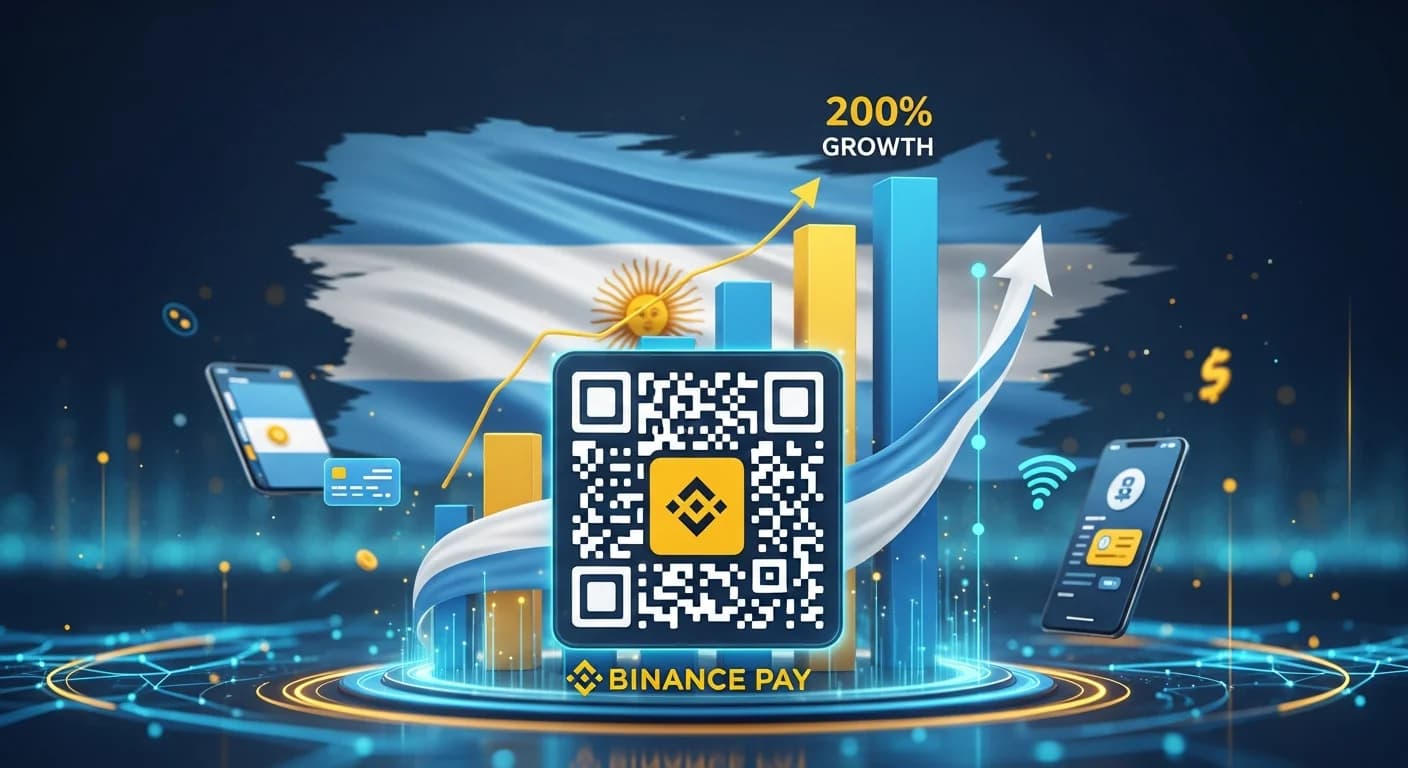
Between May and June 2026, Binance Pay's national QR code payments grew 11% in transaction count and 2% in volume overall. Argentina told a different story: transaction count jumped more than 200% and volume rose 150%. More tellingly, over 70% of users who tried it came back within a month. These are Binance's own numbers, which is reason enough to read them with some skepticism, but they point the same way: this is not a one-off curiosity, it is a habit forming.
The data behind Binance Pay's Argentine boom
Persistent inflation and capital controls have pushed people toward alternatives to the peso, and QR payments tap into that need directly. A user scans a merchant's national interoperable QR code and pays in USDT, USDC, BTC, ETH, or more than a hundred other cryptocurrencies, with no gas fees, no exchange counter, and no requirement to hold a local bank account.
The retention figure, 70% within 30 days, says more than the raw growth number. People are coming back to pay for groceries, coffee, or street food, not just testing the feature once. Binance attributes the jump to demand and calls the return rate evidence of sustained, repeat use. The payments push is part of a wider attempt to turn the Binance app into a daily finance hub; the company's bStocks product crossed $500 million in assets within seven weeks of launch, with most trading happening while Wall Street sleeps, according to the bStocks report.
How interoperable QR codes fixed fragmented payments
QR payments are everywhere in Latin America and parts of Asia, but they were not always interoperable. Banks and wallets ran their own codes, so merchants had to display several labels and customers had to hope their app matched. National interoperable QR standards, backed by central banks, fixed that with a single code that any participating wallet can read. It is not an exciting fix, but this kind of plumbing is what makes a payment habit possible.
Binance Pay plugged into this infrastructure instead of building its own. As a result, the Binance app works at any merchant that already accepts national QR payments, with no new hardware for stores and no separate sign-up.
Fiat balances: a bridge for people who never held crypto
In Argentina, Binance Pay started as crypto-only. The introduction of fiat balance payments changed that. Eligible users can now pay merchants from an Argentine Peso (ARS) balance instead of converting to crypto first. Binance says it is now possible to deposit, grow, and spend money without leaving the app.
Since the ARS payment launch, crypto still accounts for most transactions, but fiat payments have grown steadily. Binance frames the feature as a bridge to mainstream adoption: people who never held crypto can use the app for everyday spending, and the crypto option stays available for those who want it. Other exchanges are chasing the same audience from a different angle. Coinbase launched regulated futures and perpetuals with a 60/40 tax advantage, a structure examined in this breakdown of the Coinbase loophole.
Seven countries, one scan: the traveler use case
The cross-border QR network now covers Argentina, Bolivia, Brazil, Colombia, Peru, the Philippines, and Vietnam. Colombia joined in July 2026. A traveler from outside those countries can open the Binance app, scan a merchant's QR code, and pay in a supported cryptocurrency; the merchant receives local currency through the national payment system. The traveler skips currency exchange fees and the hassle of carrying cash.
Payments run in USDT, USDC, BTC, ETH, and the rest of the supported assets. For local users, the fiat balance adds the same flexibility: same app, same merchants, two ways to pay.
The road ahead: Binance's borderless payment ambition
Binance wants to take this beyond the seven countries and into more travel hotspots. Its stated ambition is for Binance Pay to become a global payment method: one app, one scan, anywhere. No specific next markets have been announced, but the pattern is consistent: integrate with existing national payment infrastructure wherever it exists.
Argentina's early returns suggest the approach works. Growth in transactions and volume, plus high retention, point to a product that meets a real need. Whether it can be replicated elsewhere depends on regulators and on central banks' willingness to let crypto touch national payment rails. That is not a purely theoretical risk. When crypto rides a wave of retail enthusiasm without guardrails, the fallout can be brutal: nearly a million people lost $3.8 billion on the $TRUMP memecoin after it crashed 98%, according to Nansen's analysis. For now, Argentina's numbers are the strongest evidence yet that a crypto QR payment system can move past early adopters and into everyday use.
- Source : Binance Pay's QR code push is paying off: 200% growth in Argentina — 2026-07-29
Get the tech essentials in 3 minutes every morning
One email, every weekday, with what actually matters in AI and tech.