Tokenized Equities
Binance's bStocks hit $500M in 7 weeks, and most trading happens while Wall Street sleeps
Seven weeks after launch, Binance's bStocks tokenized-equity product has surged to $500M in AUM from $5.6M. With 58% of volume flowing after-hours and 44% of trades from Gen Z, the product is rewriting how a new generation accesses traditional equities.
Emmanuel Fabrice Omgbwa Yasse AI-assisted
2026-07-31 · 3 min read
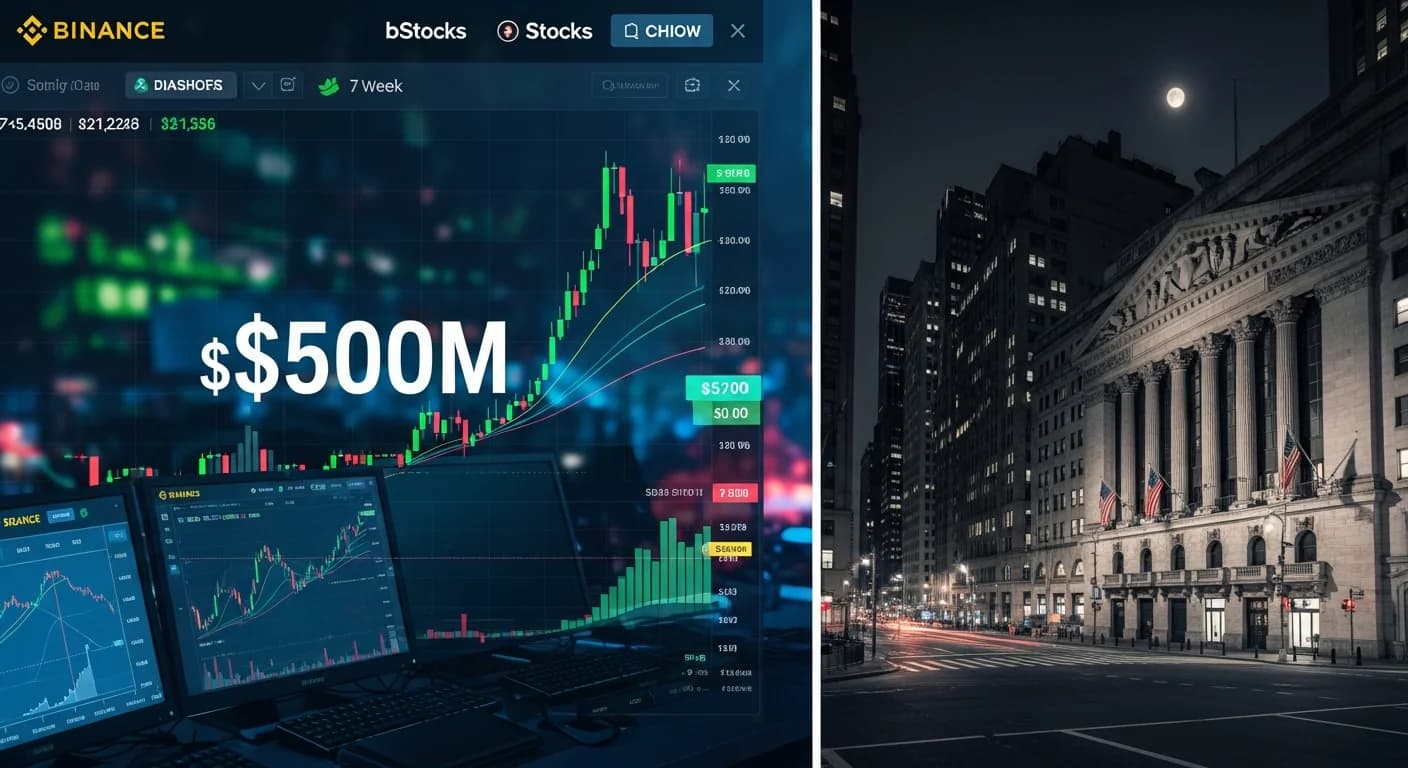
Seven weeks after launch, Binance's bStocks product has hit $500 million in assets under management, 89 times its first-day AUM of $5.6 million. But the details beyond the headline matter more.
From $5.6M to $500M: How Fast Did bStocks Grow?
Binance expanded bStocks from five tickers on day one to more than 46 by late July. The initial lineup leaned on large-cap names like Nvidia and Apple. Later batches added AI infrastructure and semiconductor plays: Broadcom, IBM, Marvell, TSMC. A July 29 batch pushed further into consumer tech, clean energy, and sector ETFs, including the VanEck Semiconductor ETF and a leveraged bear fund. Growing from $100 million in its first 15 days to $500 million in seven weeks, bStocks outpaced most new asset products, especially those limited to a single exchange and a restricted jurisdiction.
The Crypto-Native On-Ramp: Who Is Using bStocks?
The user base looks nothing like a typical retail brokerage. According to Binance's data, 41.5% of bStocks users started their traditional finance journey on Binance through tokenized securities. For many, bStocks is their first exposure to equities at all. Gen Z represents 44% of bStocks trading activity, making it the largest age cohort. These are crypto-native users who already hold and move digital assets, often in emerging markets. Traditional brokerages often require large minimum deposits or clunky overseas account setups. Binance lets someone go from crypto to stocks to tokenized securities in the same account in seconds.
Trading Around the Clock: The 'Night Shift' Effect
Wall Street closes at 4 p.m. Eastern, but bStocks activity peaks after that. After U.S. markets shut, bStocks accounts for 58% of all equity-linked volume on Binance. Over the weekend of July 25-26, bStocks recorded $2 billion in trading volume. Users trade when news breaks, not when the bell rings. The product's free, instant two-way conversion between a bStock and its underlying equity means a user can react to an overnight earnings report without waiting for the open or paying multiple fees. On other platforms, converting a tokenized security to a share takes several transactions. Binance does it instantly at no cost.
Integrated Portfolios: How bStocks Fits Into the Binance Ecosystem
bStocks lives alongside spot, perpetual futures, and direct equities in the same interface. The data shows that 58.5% of bStocks holders also trade perpetual futures, equities, or both. The split: 25% trade perpetual futures and bStocks, 20.7% trade all three, and 12.7% trade equities and bStocks. This cross-product behavior means users treat bStocks as one layer in a multi-asset strategy, not a standalone product. Someone building a long-term position can hold a direct stock, while someone actively managing exposure can use bStocks with crypto-style flexibility, all in one account.
Trades on Binance Spot carry a flat $0.35 platform fee or a 0.1% spread on orders above $340. There is no extra charge for converting between a bStock and its underlying share. Fees apply only when buying or selling, not on the conversion itself.
Regulatory Hoops and International Reach
bStocks is not a stock. Binance's own disclaimer calls them certificates representing certain financial instruments under ADGM law. The offering is available only in the Abu Dhabi Global Market, and Binance explicitly prohibits access from the United States. The product's legal structure keeps it in a narrow lane: offered through an approved prospectus in the ADGM and nowhere else. For now, growth depends on users in permitted jurisdictions. Expanding beyond that would require either a different legal structure or regulatory approvals in other markets. The current data shows strong demand from the regions where it is legal, but the product's ceiling may be set by how far Binance can take the ADGM framework before regulators elsewhere push back. The risks of crypto products operating outside clear regulation were underlined by the 98% crash of the Trump memecoin, which cost investors $3.8 billion, according to Nansen's analysis.
Get the tech essentials in 3 minutes every morning
One email, every weekday, with what actually matters in AI and tech.