Benchmarking
Frontier AI vision models fail at basic perception, new benchmark shows
PerceptionBench tests ten atomic visual capabilities across 3,000 questions. No frontier model cracked 60 percent, and similar overall scores mask wildly different weakness profiles.
Emmanuel Fabrice Omgbwa Yasse AI-assisted
2026-08-03 · 3 min read
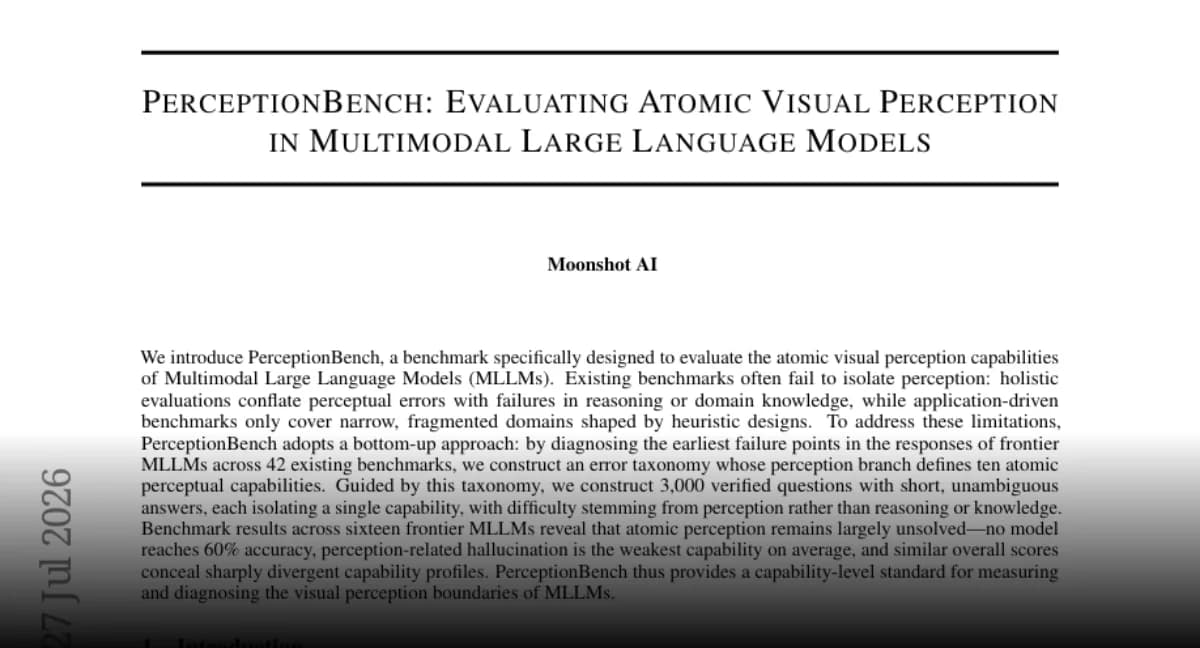
A new benchmark called PerceptionBench suggests that the gap between what multimodal AI models appear to understand and what they actually perceive is wider than many assume. In tests across sixteen frontier models, none cracked 60 percent accuracy on questions designed to measure atomic visual perception: the ability to see a single, unambiguous visual fact without leaning on reasoning or background knowledge. This echoes the limitations found in other benchmarks, as documented in an analysis of how three AI benchmarks misrepresent real-world performance.
Existing benchmarks often mix perception with reasoning, making it hard to tell whether an error happened because the model did not see the object or because it could not reason about it. The PerceptionBench team, whose 33-page preprint landed on arXiv, set out to isolate the perception problem. They analyzed the earliest failure points in model responses across 42 existing benchmarks and built an error taxonomy. The team examined where models first went wrong on a diverse set of tasks, ensuring that the taxonomy reflected real errors. From that taxonomy they derived ten atomic perceptual capabilities, each one a minimal skill needed to interpret a visual scene. This approach is a deliberate departure from benchmarks like MMLU, which have been criticized for conflating distinct abilities, as detailed in a critical review of MMLU's answer key.
The benchmark contains 3,000 verified questions, each designed to test a single capability. The difficulty comes from the perceptual demand itself, not from complex instructions or domain knowledge. The answers are short and unambiguous: a number, a color word, or a yes or no. This removes grading ambiguity and makes the test reproducible across research groups.
The results are sobering. No model reached 60 percent accuracy overall. Perception-related hallucination was the weakest capability across the board. More tellingly, models with similar overall scores often had sharply different capability profiles. One model might excel at color detection but fail at counting. Another might be strong at spatial relationships but weak at texture. A model that performs well on visual question answering datasets may still be unable to count items in a cluttered scene. The aggregate score hides the real distribution of failures, a problem also observed in other benchmarks where overall scores masked underlying errors, such as GSM8K's flawed question set.
This diagnostic granularity is what sets PerceptionBench apart from earlier holistic benchmarks. Rather than ranking models on a single number, it lets researchers see which perceptual skills are missing and target training or architecture changes accordingly. The authors note a strong correlation between perception accuracy and hallucination frequency, suggesting that fixing fundamental perception could reduce hallucinations across the board. The benchmark's design addresses the kind of score inflation seen in other evaluation frameworks, as highlighted in an audit that found 67% of agent runs were contaminated.
The benchmark also highlights a deeper issue: current training methods do not explicitly teach models to perceive before reasoning. These models learn perception as a byproduct of language-aligned objectives, and the results suggest this indirect approach leaves fundamental gaps. Direct perception pre-training or specialized vision encoder modules may be needed to bridge the gap.
The research community has reacted with cautious interest. Initial discussions on preprint channels highlight the thoroughness of the methodology and the breadth of models tested. One commenter called the paper a must-read for anyone working on next-generation multimodal systems, while noting that the benchmark design deserves close scrutiny before wider adoption.
PerceptionBench does not claim to solve any perception problem. It provides a way to measure it. For teams working on multimodal models, the benchmark offers a diagnostic toolkit that reveals blind spots that reasoning benchmarks miss. The implication is clear: before fixing what a model cannot think about, researchers need to know what it cannot see. The full dataset and evaluation code are available with the preprint, allowing other teams to run their own models through the same granular tests.
- Source : Frontier AI vision models fail at basic perception, new benchmark shows — 2026-07-29
Get the tech essentials in 3 minutes every morning
One email, every weekday, with what actually matters in AI and tech.