MemTensor's Memory Foundation Models
AI agents kept memory outside the model. Metis puts it inside
MemTensor's Metis is the first prototype of memory foundation models: history compressed into the backbone, read back through memory attention, updated in one forward pass. It challenges the vector-store era of agent memory. The limits are acknowledged but not yet quantified.
Emmanuel Fabrice Omgbwa Yasse AI-assisted
2026-07-30 · Last updated: 2026-08-03 · 4 min read
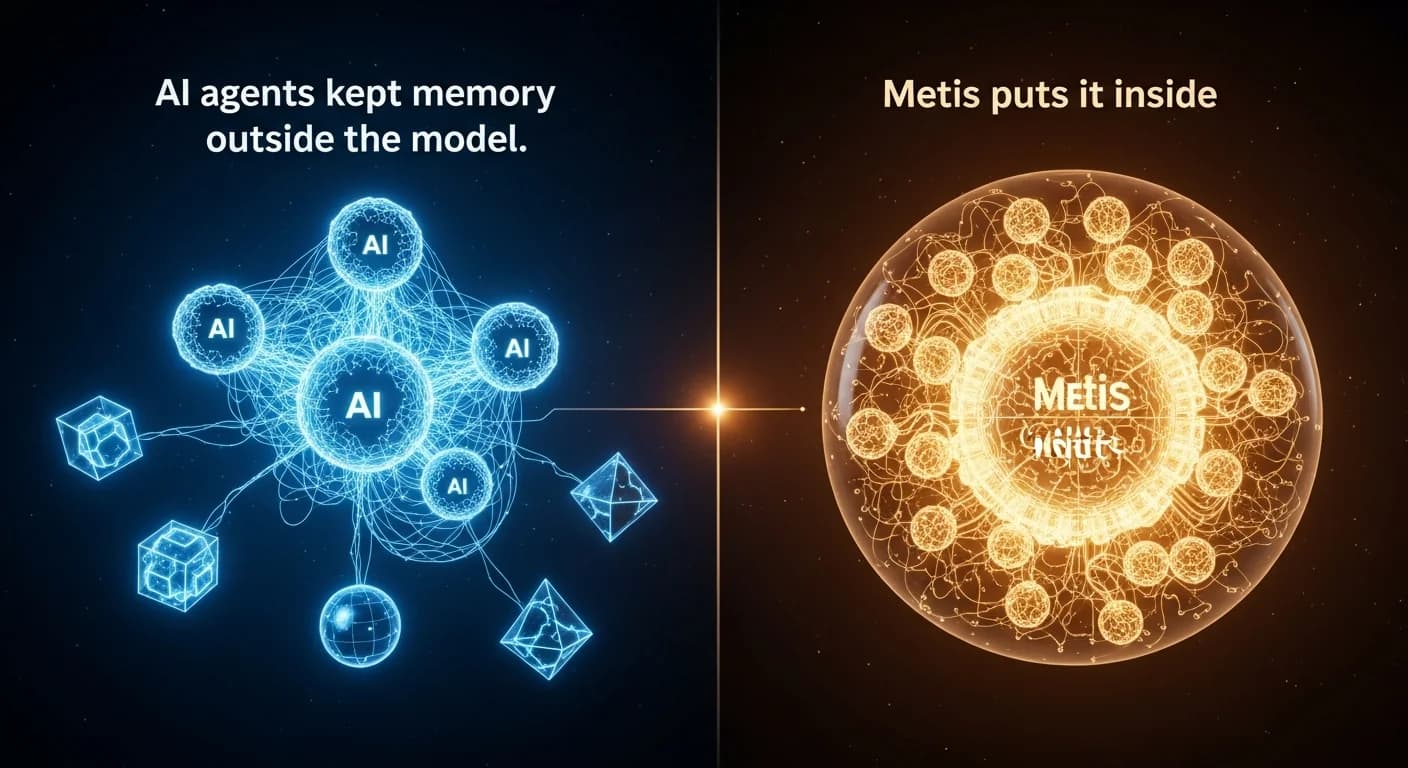
Reasoning is internal to AI models now, and so is multimodality. Memory is the capability agents still outsource. It lives in external modules, and in practice that usually means a vector database the model queries on demand.
Why memory stayed outside the model
An earlier roundup on this site of thirty repositories powering the AI stack called vector databases the memory layer. Almost every RAG stack needs a vector store, the roundup found, and five databases made the list. The storage layer is not frozen either: newer engines keep adding fusion algorithms such as Reciprocal Rank Fusion, the scale-insensitive industry standard. Memory is the missing piece beyond RAG as well: Alibaba Cloud's new framework for coding assistants, the AI coding partner that finally remembers, gives them long-term recall of preferences and history.
In the authors' telling, all this progress sits at the periphery. Keeping memory outside means the model cannot optimize how history is compressed, stored, and retrieved, because the machinery doing that work is bolted on rather than part of the model. That is the gap Metis targets.
Metis: a memory state inside the backbone
Metis, from a group publishing as MemTensor, appeared on arXiv on July 29, 2026, and the authors present it as the first prototype of what they call memory foundation models. The formulation has two halves. A persistent and dynamically evolving memory state lives inside the model's backbone. And the model acquires native memory procedures: it stores and uses information through its own computation, instead of leaning on an external module.
Architecturally, historical information is compressed into the model and read back through what the authors call memory attention. The compression instinct is not new in agent research: BAAI's AREX agents, the research agents that check their own homework, run a recursive self-improvement loop that compresses long research histories. Metis moves that compression inside the model itself.
They built large-scale memory-specific training data and use several optimization objectives in a mid-training phase to teach those procedures. Then comes the operational detail that makes the project more than a slogan: online memory maintenance is gradient-free. Updating memory takes a single forward pass, and at inference the learned weights stay frozen while the memory state itself is transformed through standard forward computation.
In plain terms, the model is not retrained to remember and does not go looking for its memories in a store. Forward computation is both the thinking and the remembering.
That reverses the division of labor the agent stack settled on:
| Today's agent memory | Metis | |
|---|---|---|
| Where history lives | External modules, typically a vector store | A persistent state inside the backbone |
| How it is updated | Indexed and managed outside the model | Gradient-free; a single forward pass |
| How it is read | Queried on demand, RAG style | Memory attention over compressed history |
| How it is learned | Built separately from the model | Mid-training objectives, end to end |
The unproven part
Be precise about what the release does and does not claim. The abstract says experiments show native memory capabilities and promises "a detailed analysis of its strengths, limitations, and behaviors." The numbers are not there, at least not in the summary released: no benchmark scores, no head-to-head with RAG pipelines. How much history a memory state can hold, the summary does not say. The limitations are acknowledged but not enumerated.
None of this is a strike against a first prototype. The authors release the project and model checkpoints, which is what makes independent verification possible.
What changes if memory goes native
The shape of the bet is clear. The agent stack has treated memory as plumbing: records go into a store, and the model retrieves them on demand. Metis proposes treating memory as a model capability, learned end to end. The authors claim three advantages for the native approach: architecture, end-to-end optimization, and efficiency. The case is structural, not a set of benchmark wins. The stack's layout is contested beyond memory: flat tool registries are a known bottleneck, and a hierarchical skill-based architecture is one proposed fix.
If it holds, the retrieval step disappears from the agent loop, along with the vector store, the embedding pipeline, and the index work that keeps them consistent. Storage and recall become part of the same forward pass that does the reasoning. That would be a genuinely different architecture. The agent loop has been the scene of uneven progress: the 957,253-record Messier audit found agents surging in coding but stalling where enterprises need them.
The counterweight is that the external layer is improving rather than decaying, and the unknowns inside Metis are real: how much history compresses into a memory state, how the frozen-weight setup holds over long horizons, and what the authors' own list of limitations contains. Separately, the learning-loop route has its own momentum: Hermes Agent's closed learning loop, from Nous Research, makes the agent smarter the longer it runs. The abstract says the limits exist without showing them. That is the honest gap in an otherwise bold first step.
Metis is a paper and a set of checkpoints, not a shipped product. First prototypes routinely oversell, and this one has the unusual discipline to acknowledge its limits even without detailing them. The direction is the story: agents internalized reasoning and multimodality, and memory is the capability still bolted to the outside. If Metis is right, the vector database becomes the next part of the AI stack pulled inside the model, one forward pass at a time.
- Source : AI agents kept memory outside the model. Metis puts it inside — 2026-07-29
Get the tech essentials in 3 minutes every morning
One email, every weekday, with what actually matters in AI and tech.