Label leakage in GNNs
Your fraud detection model may be cheating. A new paper proves it.
The PREF-Gate paper formalizes a label-provenance contract for relational evidence in graph fraud detection. On two of three datasets, the best model is one that avoids training-label-derived evidence entirely, a result that challenges common assumptions in graph neural network research.
Emmanuel Fabrice Omgbwa Yasse AI-assisted
2026-07-26 · 4 min read
Graph neural networks (GNNs) have become the go-to tool for fraud detection in relational systems, platforms where fraudulent users share devices, products, or payment methods. The logic seems straightforward: if most of a node's neighbors are fraudulent, the node itself is probably suspect. But a new paper forces the field to confront an uncomfortable question: what if the signal we are using is tainted? The problem echoes a broader pattern in AI research, where benchmark results can mislead more than they inform, much like Ollama's Fortune 500 stat that sounds like saturation but proves almost nothing.
The paper, "PREF-Gate: Provenance-Constrained Relational Evidence Fusion with Validation-Gated Selection for Graph Fraud Detection," comes from researchers at Central South University and the University of Technology Sydney. It presents a framework that treats neighborhood statistics not as ordinary features but as provenance-typed knowledge: each statistic's label source must be traced and validated before it gets used.
The label-provenance problem
The core issue PREF-Gate tackles is something many practitioners know about but rarely enforce: transductive graph pipelines typically load all nodes and edges together. When a model computes neighborhood fraud rates as features, it has to ensure that no validation or test label leaks into that computation, not through a neighbor, not through a global prior, and not through a self-loop on a training node. This is the kind of subtle data contamination that other benchmarks have also tried to flag, such as VitaBench 2.0's tests on preference leakage from fragmented interactions.
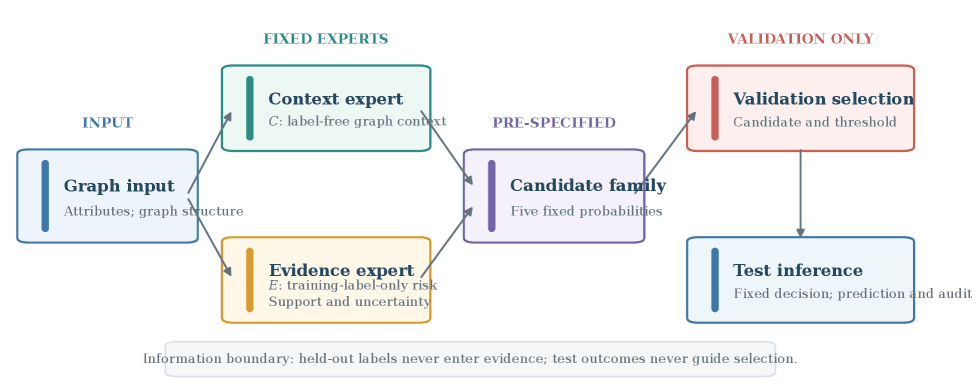
PREF-Gate formalizes this as a three-tier knowledge boundary: attribute knowledge (label-free), training-derived relational knowledge (statistics built only from training labels with self-exclusion), and decision knowledge (validation scores and thresholds that control routing but not evidence construction). Test labels belong to none of these categories.
When evidence hurts more than it helps
The framework pits two fixed experts against each other: a label-free context expert that uses node attributes, one-hop neighbor means, feature residuals, and degree descriptors, and an evidence context expert that augments that representation with neighborhood risk computed from training labels only, plus empirical-Bayes posterior summaries. This controlled comparison is reminiscent of how the M3 team stopped AI math verifiers from cheating by enforcing strict boundaries between proof generation and verification.
The gate then selects among five candidates, the two experts and three pre-specified convex mixtures, based on validation Macro-F1 and AUPRC. On the Amazon and YelpChi datasets, the gate uniformly picks the label-free expert across all five splits. The evidence expert actually performs worse, dragging AUPRC down by 0.137 on Amazon and 0.217 on YelpChi.
Only on TFinance, a dense transaction graph with 4.58% fraud prevalence, does a 75/25 mixture of label-free and evidence experts improve AUPRC by 0.0053 over the label-free baseline alone. The result is statistically significant at the paired t-test level (p=0.003) but marginal in magnitude.
What this means for the field
The paper's implicit critique of standard GNN evaluation is pointed: many published results may reflect undisclosed label leakage rather than genuine relational learning. When the authors reran 14 methods, including CARE-GNN, PC-GNN, BWGNN, and ICLR 2024 methods PMP and ConsisGAD, under identical stratified 40/40/20 splits, PREF-Gate's adaptive gate outperformed the best completed external baseline by 0.0389 AUPRC on Amazon, 0.0764 on YelpChi, and 0.0245 on TFinance.
But the more important number may be that the label-free expert alone beats every external GNN baseline on Amazon and YelpChi. A boosted tree trained on one-hop feature means and residuals, with no neural message passing, achieves AUPRC 0.9085 and 0.8104 respectively, against best external scores of 0.8696 and 0.7340.
This suggests that for many fraud detection benchmarks, the discriminative signal lives in the attributes and their local disagreement, not in the complex topology that GNNs are designed to model. The insight that simpler methods can rival complex architectures has parallels in other domains, such as Leanstral 1.5 proving that small models can saturate formal verification benchmarks with the right data strategy.
An auditable decision pipeline
PREF-Gate's authors emphasize that their contribution is not a new universal architecture but a decision framework with three properties: an explicit label-provenance contract, finite validation-gated routing, and interpretable fallback behavior. When the evidence expert fails to improve validation scores, the framework does not hide behind a fixed ensemble: it reports the fallback and the reason.
For operational deployment, this transparency matters. Fraud teams working under finite review budgets can audit the evidence construction: the framework records the training split hash, graph snapshot, evidence concentration parameter, candidate score trace, and selected threshold. If the graph drifts or label delay shifts prevalence, the audit trail supports root-cause analysis. This kind of auditable pipeline is what allows vibe coding to move from prototype to production without accumulating hidden technical debt.
The bigger question
The paper raises a question that extends beyond fraud detection: how much of what we attribute to relational learning is actually memorization of leaked labels? PREF-Gate does not claim to answer that definitively, but it provides a tool for asking the question with rigor.
Its authors are careful to note limitations: the evaluation uses only five splits per dataset, the reduced gate's stability improvement over the exploratory 35-candidate gate is not statistically decisive, and calibration, measured by Brier score and ECE, is mixed, particularly on YelpChi where ECE reaches 0.1077.
What the paper offers is a template for knowledge-based decision systems that treat evidence provenance as a first-class concern. In a research field where state-of-the-art claims often depend on unexamined assumptions about data splitting, that template is overdue.
Get the tech essentials in 3 minutes every morning
One email, every weekday, with what actually matters in AI and tech.