Artificial Intelligence
The fraud detector that got better by ignoring what it was told
PREF-Gate separates fraud detection into a label-free context expert and a label-derived evidence expert, then lets a validation gate decide which to deploy. On Amazon and YelpChi, it drops the evidence entirely; only on TFinance does it accept a small mixture. The paper forces the field to confront whether label leakage, not model architecture, drives many published GNN gains.
Emmanuel Fabrice Omgbwa Yasse AI-assisted
2026-07-29 · Last updated: 2026-08-03 · 6 min read
Graph neural networks for fraud detection share an unspoken assumption: more information is always better. If a node's neighbors carry labels, the reasoning goes, feeding those labels into the model should improve its predictions. A team from Central South University and the University of Technology Sydney built a system that tests that assumption, and on two out of three standard benchmarks, rejects it. The finding echoes a broader lesson in AI agent design: the hardest bottleneck is often knowing what to leave out, the same insight that emerged from research on when AI reasoning should stop.
Their framework, called PREF-Gate (Provenance-Constrained Relational Evidence Fusion with Validation-Gated Selection), achieves mean AUPRC values of 0.9085 on Amazon, 0.8104 on YelpChi, and 0.8913 on TFinance under a strict same-protocol evaluation. These numbers beat every completed external baseline, including two ICLR 2024 methods, PMP and ConsisGAD, by margins ranging from 0.0245 to 0.4291. The surprise is not that PREF-Gate wins. The surprise is that its winning configuration on Amazon and YelpChi is identical to a simpler, label-free expert.
Two experts, one gate
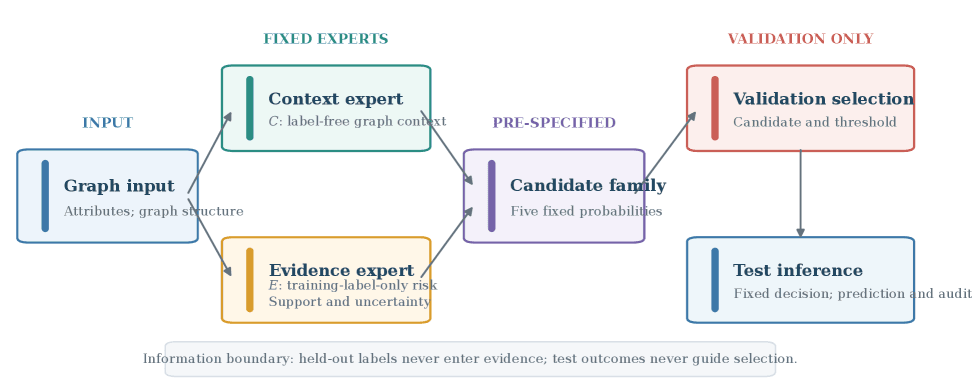
PREF-Gate decomposes fraud detection into two fixed experts. The label-free context expert relies only on raw node attributes, one-hop neighbor means, absolute feature residuals, log degree, and an isolation indicator. It trains a histogram gradient-boosting classifier on this representation and produces a fraud probability p(C).
The evidence context expert adds seven columns of training-label-derived evidence: raw neighborhood risk, empirical-Bayes posterior mean and variance, support count, availability flag, shrinkage displacement, and training prevalence. Crucially, every label in that evidence vector is drawn exclusively from the training set, with self-exclusion and leave-one-out priors that prevent any node from leaking its own target. An Extra-Trees classifier trains on the concatenated representation and produces p(E).
The finite validation-adaptive gate then chooses among five candidates: the two experts and three convex mixtures (75/25, 50/50, 25/75). Selection is based on a combined validation score of Macro-F1 and AUPRC, and the chosen candidate's decision threshold is frozen before test inference. The entire pipeline is specified and recorded before any test label is seen. This audit-driven design shares DNA with frameworks that prioritize visibility over magic in AI systems, as seen in Mistral Studio's system of record for AI prompts.
When evidence hurts
On Amazon and YelpChi, the adaptive gate selects the label-free context expert in all five splits, every time. Adding training-label evidence produced a worse validation score than leaving it out. The evidence context expert alone scored 0.7715 AUPRC on Amazon and 0.5932 on YelpChi, far below the label-free expert's 0.9085 and 0.8104.
The authors' conclusion is blunt: on Amazon and YelpChi, the gate rejects unsupported label-derived evidence. The framework's robustness comes from its willingness to say no.
Only on TFinance did the gate accept evidence, selecting a 75/25 context/evidence mixture in four splits and a 25/75 mixture in one. The resulting AUPRC of 0.8913 exceeded the label-free expert's 0.8860 by a modest but statistically consistent margin (paired t-test p = 0.0030).
Why does evidence fail on two datasets and help on one? The paper offers three explanations. First, eligible training-label support may be sparse, making local risk a noisy reflection of the global prior. Second, fraud may exhibit heterophilic connections, where neighbors' labels are misleading. Third, the label-free representation may already encode the discriminative signal, while the seven evidence columns add variance without signal. TFinance's low fraud prevalence (4.58%) and dense normalized graph make support-aware neighborhood risk genuinely complementary.
What the comparison roster reveals
The evaluation uses five identical stratified 40/20/40 splits across every method, with exact split indices and SHA256 hashes published. The 14-method roster includes feature- and graph-level baselines, ablation components, established GNN baselines (CARE-GNN, PC-GNN, BWGNN), and two ICLR 2024 methods (PMP, ConsisGAD).
The results are unambiguous: across every completed comparison, PREF-Gate has positive mean-AUPRC margins and five paired-split wins. The largest margins occur on YelpChi, where the label-free expert alone beats CARE-GNN by 0.4291 AUPRC and PC-GNN by 0.3180. Even the closest completed baseline, ConsisGAD on Amazon, trails by 0.0389 AUPRC.
The paper is also transparent about failures. PC-GNN could not complete TFinance due to method incompatibility, and PMP could not complete TFinance due to infrastructure constraints (14 GiB host-memory envelope). No numbers are imputed. This kind of honest reporting is rare, but essential for reproducible science, much like the approach taken in analyses of what AI benchmarks get wrong about real-world performance.
Calibration: the hidden trade-off
While PREF-Gate leads on ranking and review-budget metrics, its calibration is mixed. Brier scores are low on Amazon (0.0165) and TFinance (0.0182), but expected calibration error reaches 0.1077 on YelpChi, worse than ConsisGAD's 0.0515. The gate optimizes for discrimination, not calibration; no post-hoc calibrator is fitted. Similar calibration concerns have surfaced in other domains, such as audits of distributional RL heads that fabricate risk trade-offs.
These results motivate separate deployment calibration, the authors note. A platform could fit a validation-only calibrator after the ranking model is fixed, but that constitutes an additional method component not evaluated in this benchmark.
Auditability as a design principle
PREF-Gate's design prioritizes auditability over end-to-end optimization. The evidence vector records not just the neighborhood risk rate, but also its support count, posterior variance, and shrinkage displacement, explicit descriptors of reliability. The candidate set is finite and prespecified. The fallback to the label-free expert is not an emergency exception but a defined outcome.
A reviewer may reasonably ask whether a method that falls back to an internal expert is still a single method, the authors acknowledge. Their answer is yes: the routing rule is specified before test evaluation, just as a validation-selected checkpoint or regularization value is an output of the learning protocol.
For operational workflows, the framework requires six artifacts: training split hash, graph snapshot, evidence concentration, candidate score trace, threshold, and review-budget policy. These must all accompany the selected model. The artifacts permit later audits under label delay or graph drift. This principled stance on provenance echoes the thinking behind Mistral Studio's system of record for AI prompts.
Implications for graph fraud research
The paper's strongest contribution may be methodological. By separating label-free context from label-derived evidence and exposing the gate's decisions, PREF-Gate forces the field to confront a question many papers avoid: is the performance gain from graph neural networks actually coming from the architecture, or from label leakage that more careful baselines would reveal?
The one-hop mean and absolute residual transformation turns out to be a remarkably strong comparator. The result does not imply that learned GNNs are unnecessary in general, the authors write. It shows that a transparent graph-context representation is a strong comparator on these three benchmarks and supervision ratios. A fair graph-fraud study should include such a baseline rather than attributing all graph gains to a neural architecture.
With the full framework, split files, and execution accounting publicly documented, PREF-Gate offers both a competitive method and a template for evidence-auditable decision pipelines. Whether the community adopts the template, or continues to treat label-derived neighborhood risk as an unexamined free lunch, remains an open question. The tension between what works on a benchmark and what generalizes in the wild is a recurring theme in AI research, as highlighted by studies on why harness evolution fails on held-out tasks.
Get the tech essentials in 3 minutes every morning
One email, every weekday, with what actually matters in AI and tech.