Automated Playtesting
Candy Crush just proved grid-based AI is the wrong approach for complex games
King Digital researchers compared GAT, BERT, and CNN models for automated playtesting in Candy Crush Saga. GAT models matched or outperformed CNNs in move prediction and difficulty estimation, especially on hard levels, while also handling new game mechanics without feature engineering.
Emmanuel Fabrice Omgbwa Yasse AI-assisted
2026-07-31 · 4 min read
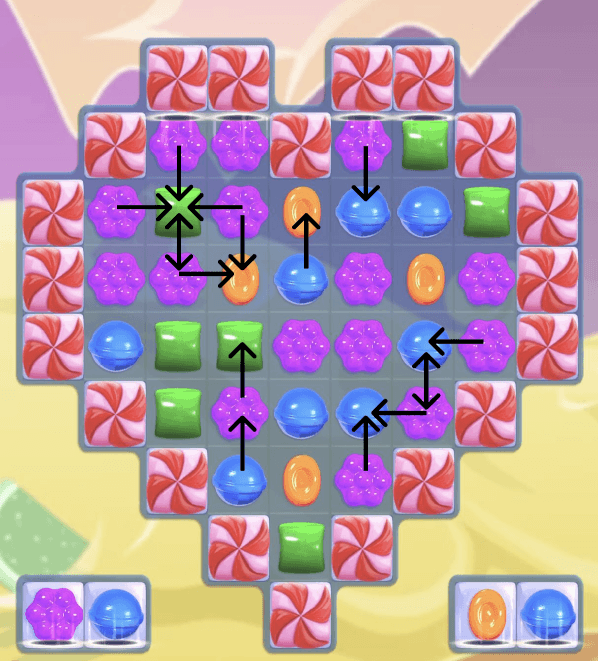
For years, automated playtesting of grid-based puzzle games has leaned on convolutional neural networks. Their knack for pulling spatial patterns out of board states made them a natural fit. But a new comparative study from researchers at King Digital Entertainment, the studio behind Candy Crush Saga, suggests the most common architecture may not be the best one for the job.
The paper, led by Kleio Fragkedaki and colleagues, pits CNNs against two alternatives: a BERT-based transformer model and a Graph Attention Network (GAT). The goal is to see which can most accurately predict player moves and estimate level difficulty across Candy Crush Saga's 18,000-plus levels, many of which introduce mechanics that break the assumptions of grid-based models.
Why grids fall short
CNNs treat the game board as a fixed-size image, encoding each tile's content into separate channel layers. This works fine for static boards, but Candy Crush's designers keep adding new elements: portals that teleport candies across the board, special tiles that interact non-locally, and objectives that vary from level to level. Each new feature forces a re-engineering of the CNN's input representation, adding channels, adjusting kernel sizes, retraining from scratch. This tension between static architecture and evolving game design mirrors the broader challenge of adapting AI systems to changing environments, as seen in vibe coding's production pitfalls.
The GAT model sidesteps this by representing the board as a graph. Tiles become nodes, and relationships, adjacency, portal connections, become edges. The attention mechanism then learns to weigh these connections dynamically, capturing long-range dependencies that CNNs struggle with.
Numbers that tell a story
The study's headline finding: GAT achieves a top-1 move prediction accuracy of 54.37 percent, slightly ahead of CNN's 53.33 percent, and outperforms it on top-2, top-3, and top-6 metrics. But the real gap shows up in difficulty estimation, where the full GAT model posts a median absolute error of 1.61 across all levels versus CNN's 1.98. On hard levels, GAT's error drops to 10.03 compared to CNN's 14.00. The ability of GAT to handle non-local dependencies without manual feature engineering echoes the flexibility of proactive agent frameworks that adapt to real-world tasks.
Perhaps more telling: when portal connections are included in the graph input, GAT's performance on levels with portals improves, achieving a median error of 10.69 on hard portal levels versus 15.24 for CNN. This is a capability CNNs simply cannot replicate, since portals connect non-adjacent tiles in ways that break the local spatial assumption of convolutional filters.
BERT struggles to fit the board
BERT-based models, adapted to encode board states as text sequences or matrix tokens, fared poorly. The text-based variant achieved only 22.20 percent top-1 accuracy, and the board-based version reached 35.84 percent. Both trail the CNN and GAT by a wide margin. The researchers note that the transformer architecture's lack of spatial priors likely hurts performance on such a structured problem, despite its strengths in language tasks. This failure of a general-purpose architecture on a domain-specific problem reinforces a lesson from fully open model development: architectural choices rooted in domain structure matter more than raw scale.
These results suggest that GAT offers a middle path: it retains CNNs' ability to capture local patterns while gaining the flexibility to model arbitrary relationships, all without requiring manual feature engineering for each new game mechanic.
What this means for automated playtesting
Automated playtesting is a critical tool for game studios, allowing them to test hundreds of levels at scale before release. The standard workflow involves training a model on historical player data, then using that model to simulate playthroughs and estimate difficulty metrics like Attempts Per Success (APS). Accurate difficulty estimation lets designers tune levels before they frustrate real players.
The study's key insight: choosing the right input representation matters more than picking the latest architecture. GAT's graph-based approach naturally maps to the relational structure of game boards, while CNNs impose a grid-centric view that breaks as games evolve. For studios handling titles with 10,000-plus levels and regular content updates, the switch from CNNs to GAT could mean fewer retraining cycles and more consistent playtesting quality. The efficiency gains from smarter representations align with the broader trend of smarter token use reducing compute costs.
Future work could explore hybrid architectures, combining GAT's relational strengths with transformer-based sequential processing for more nuanced player modeling, but for now, the graph has proven its edge.
Get the tech essentials in 3 minutes every morning
One email, every weekday, with what actually matters in AI and tech.