Artificial Intelligence
A neural network that learns to like and dislike things, just like you
Researchers built a CNN that learns to associate visual scenes with pleasant or unpleasant valence using a Pavlovian learning paradigm. The model forms associations, generalizes them, and aligns neural representations of conditioned and unconditioned stimuli, just as human brains do.
Emmanuel Fabrice Omgbwa Yasse AI-assisted
2026-07-24 · 5 min read
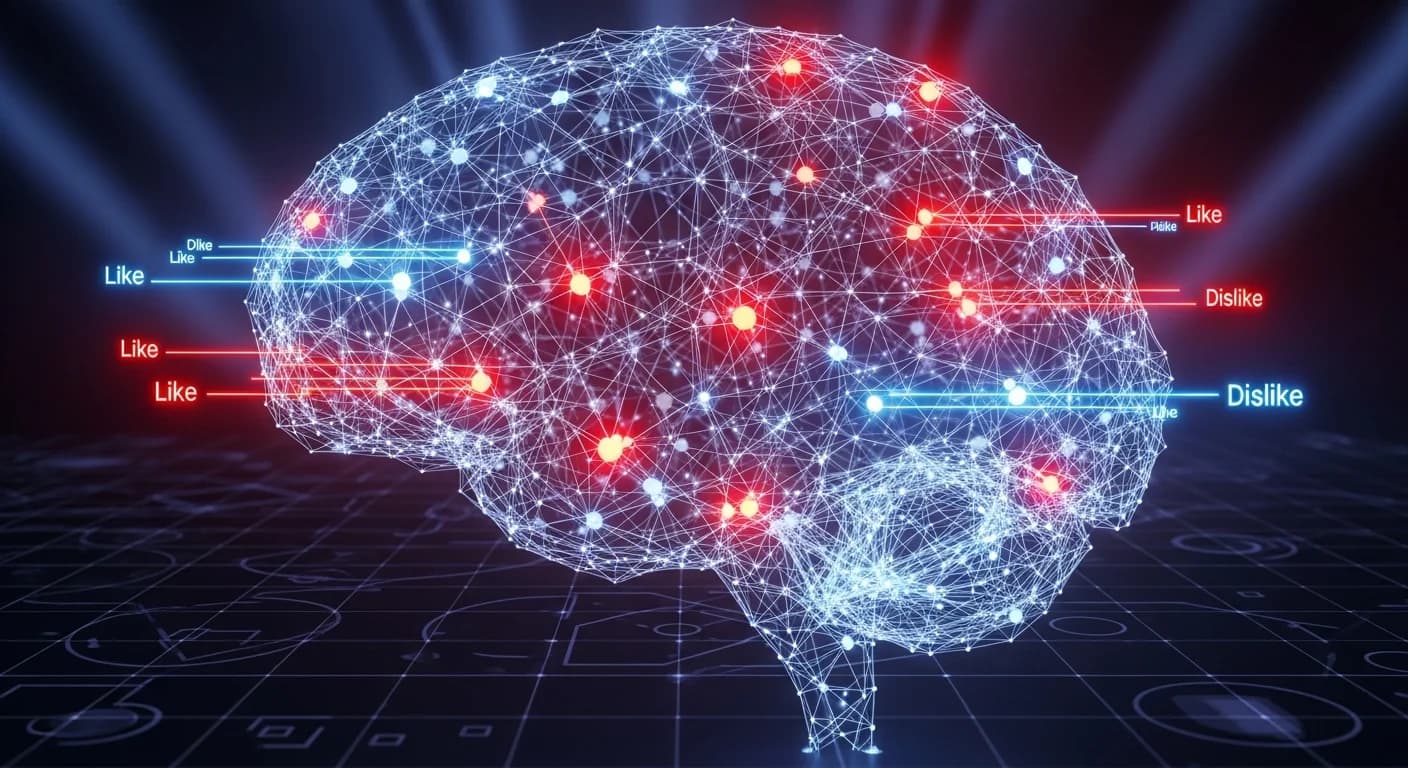
Deep neural networks already beat humans at object recognition, generate convincing speech, and play grandmaster-level chess. What they have not done, at least not convincingly, is learn to feel, or at least simulate how feelings get attached to sights. A new paper posted on arXiv on July 21, 2026, proposes exactly that: a convolutional neural network that learns to associate visual scenes with positive or negative valence through a classic Pavlovian conditioning loop. The gap between pattern recognition and anything resembling emotion is narrowing, see the emerging frameworks for machine consciousness.
The paper, titled "Associative Emotional Learning in Convolutional Neural Networks," comes from researchers who combined a visual encoding module with a second module trained to recognize emotional significance along the valence dimension, the pleasant-to-unpleasant axis that is a cornerstone of affective neuroscience. The team then tested a novel Pavlovian learning paradigm on the combined architecture. The results show that the network can form associations, generalize them to novel stimuli, and shift its internal representations so that conditioned and unconditioned stimuli become more aligned over time, a pattern that mirrors what happens in the human brain during associative learning.
From Rescorla-Wagner to deep learning
Associative learning has a well-established computational model: the Rescorla-Wagner rule, which updates the predicted value of a conditioned stimulus based on the difference between what was expected and what actually occurred. The model works well for simple conditioning experiments but struggles to scale to complex, high-dimensional inputs like natural images. Deep neural networks, the authors argue, offer a way past that limitation by learning rich feature representations directly from pixels.
Their architecture uses a pretrained CNN as a visual backbone to encode scenes, followed by a small network that learns a valence prediction for each encoded representation. During training, the model is shown a neutral stimulus, an image of a geometric shape, say, followed by a naturally valenced stimulus, like a pleasant or unpleasant scene. Over trials, it learns to predict the valence of the second stimulus from the first alone, a standard conditioned response. The twist is that the entire pipeline is end-to-end differentiable, so the association forms through gradient descent rather than through a hand-crafted update rule.
What the model does that matters
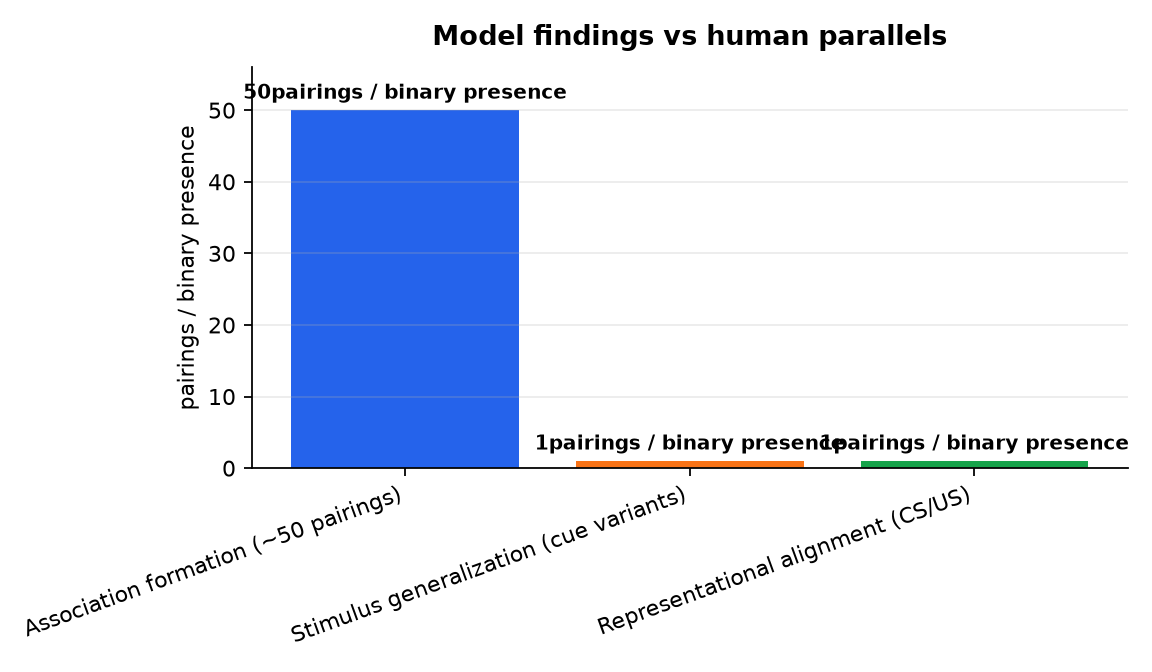
The paper reports three findings that move beyond existing work. First, the model forms associations after a modest number of pairings, consistent with human learning curves. Second, it generalizes: a shape conditioned to predict a pleasant outcome triggers a similar valence prediction when presented in a new color or orientation, a phenomenon known as stimulus generalization in psychology. Third, the neural representations of the conditioned stimulus and the unconditioned stimulus become more similar over the course of learning, both at the level of individual units and across the population, something that has been observed in primate electrophysiology but rarely in artificial networks. This kind of representational alignment has become a key test for whether AI is merely mimicking or genuinely learning, as explored in DeepMind's framework for conceptual rigor.
| Finding | Model behavior | Human parallel |
|---|---|---|
| Association formation | Learns to predict valence from neutral cue after ~50 pairings | Standard Pavlovian conditioning |
| Stimulus generalization | Responds to cue variants (new color, orientation) | Generalization gradient in human studies |
| Representational alignment | CS and US representations converge in latent space | Neural population coding in amygdala/PFC |
The authors also compared model outputs to human behavioral data from a separate valence-rating experiment. They report that the model's valence predictions correlate with human ratings, though the paper doesn't specify the exact correlation coefficient, leaving that as a gap for future work or supplementary materials.
What is still missing
For all its elegance, the model has clear limits. Valence is one dimension of emotion, and a relatively simple one, essentially a sign (+/−) with a magnitude. It does not capture arousal, dominance, or the differentiated emotional states like fear, disgust, or joy that valence alone cannot distinguish. The paper does not claim to model full emotional experience; it models the learning of valence associations. That is a meaningful but narrow slice of what the brain does during emotional learning. The gap between a model that learns these associations and a system that can be said to feel remains large, but it's narrower than before. For an idea of how far the field still has to go, check why voice AI still can't grasp the emotional weight behind words.
The model also uses supervised learning; the valence labels come from human annotations of the training images. That is reasonable for a proof of concept, but real emotional learning is unsupervised: organisms discover what is pleasant or unpleasant through interaction, not from a labeled dataset. An agent that learns valence by exploring its environment, rather than by reading a pre-labeled corpus, remains an open problem. Some researchers are moving in that direction with techniques like reinforcement learning, as shown in how RL is teaching AI models to learn from outcomes rather than labels.
Still, the work adds to a growing stack of evidence that deep networks can reproduce behavioral and neural signatures of cognitive processes once considered too messy or subjective for artificial systems. The gap between a model that learns to associate shapes with valence and a system that can be said to have anything like a feeling remains large, but it is narrower than it was before this paper.
For broader context on how these associative learning experiments fit into the debate about machine consciousness, see the new framework proposing a test for machine consciousness.
Get the tech essentials in 3 minutes every morning
One email, every weekday, with what actually matters in AI and tech.