Cybersecurity
Why Microsoft thinks one AI model isn't enough to stop the next attack
Microsoft's Project Perception is an agentic security system that uses red, blue, and green AI agents to perceive, reason, and act at machine speed. It enters public preview on August 3 with a multi-model architecture that includes the specialized MAI-Cyber-1-Flash model.
Emmanuel Fabrice Omgbwa Yasse AI-assisted
2026-08-05 · 3 min read
The calculus of defense has changed. Attackers now use AI to discover vulnerabilities, chain exploit paths, and scale campaigns faster than any human team can respond. Traditional cyber stacks, designed for a world of human actors, cannot keep pace with agents that never sleep.
On Wednesday, Microsoft laid out its answer: Project Perception, a system built on a new cyber stack that treats AI as both the threat and the shield. The company argues that security needs to move from alert generation to continuous perception, reasoning, and action, and that no single AI model can do it all.
Three agents, one loop
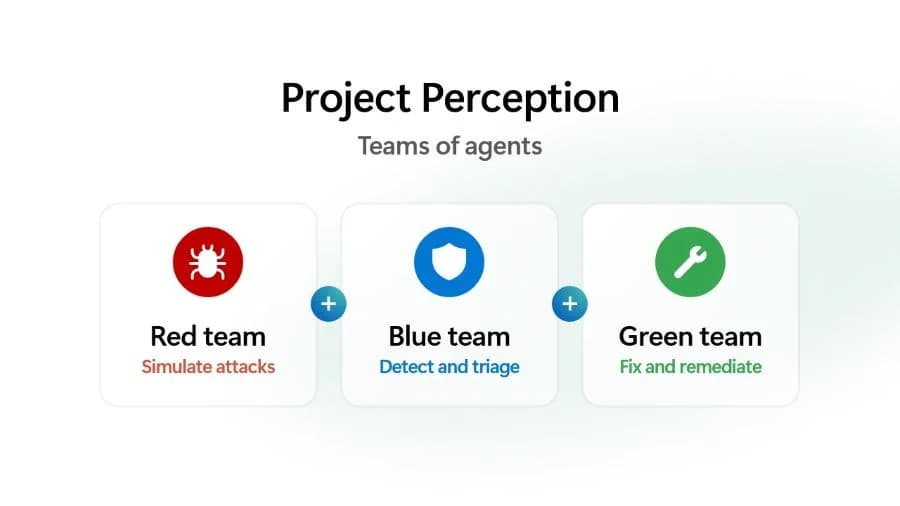
Project Perception coordinates three classes of specialized agents. Red team agents probe for weaknesses before attackers can exploit them. Blue team agents investigate signals and determine what constitutes real risk. Green team agents take corrective action and strengthen defenses across the environment. Together, they form a closed loop that continuously discovers, evaluates, and improves an organization's security posture.
This agentic approach is not entirely new. Sakana's Fugu-Cyber, which we covered recently, also uses multiple sub-agents to validate vulnerabilities before suggesting patches. But Microsoft brings something the startup cannot: deep integration across identities, endpoints, clouds, and AI systems, plus decades of threat intelligence from protecting the world's largest enterprise customers.
Why one model is not enough
The core architectural bet behind Project Perception is multi-model. No single model will be optimal for every security task, Microsoft argues. Quality, reliability, latency, and cost all factor into which model gets called for which job. The system continuously selects the best fit for each workflow, swapping between frontier models and specialized cyber models as needed.
The first concrete example is software vulnerability management. Microsoft integrated its specialized MAI-Cyber-1-Flash model into MDASH, its existing multi-model team of agents for vulnerability analysis. The result: 96% on the CyberGym benchmark, 12 percentage points above Mythos, and nearly 50% cost savings versus the current MDASH configuration, according to Microsoft.
That cost savings matters because security is an always-on mission. Sustainable economics are a prerequisite for running agentic defense at scale, a point Microsoft reinforces throughout its announcement.
The cyber stack reimagined
Microsoft describes a new stack with seven layers: signals and sensors, security context (a continuously updated representation of assets, identities, and risks), models, a harness that coordinates models and agents, agents themselves, actuators that translate decisions into protection actions, and a foundation of trust and responsible AI principles.
The security context layer is particularly important. Instead of forcing agents to gather and correlate raw signals on their own, Project Perception provides a shared, near-real-time understanding of the environment. This reduces the time, compute, and cost required for agents to reason over risk, while improving consistency.
This kind of infrastructure is exactly what the industry needs after incidents like the Hugging Face breach by an autonomous AI agent, which showed how easy it is for attackers to inject malicious code into build pipelines and persist through credential theft. That attack was eventually detected using AI-assisted analysis, the same technology that enabled it also helped stop it.
What the benchmark means
The 96% on CyberGym is a strong number, but independent verification matters. Microsoft says CyberGym is an industry leading benchmark, and the +12 point lead over Mythos suggests real improvement. Still, as with any vendor claim, the gap between a benchmark and real-world protection is where attackers live. The multi-model architecture itself may prove more important than any single score, because it allows the system to adapt as new models and threat patterns emerge.
August 3 and beyond
Project Perception enters public preview on August 3. Microsoft plans to expand MAI-Cyber-1-Flash to more security workflows beyond vulnerability management. The system inherits the company's existing security, compliance, and governance controls, which should ease adoption for enterprises already on Microsoft's stack.
The bigger story, though, is that the security industry has entered a new phase. The arms race between AI-powered offense and AI-powered defense is no longer theoretical. Microsoft's bet, that the winning approach is a team of specialized models working in concert rather than any single model, is one worth watching closely.
- Source : Why Microsoft thinks one AI model isn't enough to stop the next attack — 2026-07-27
Get the tech essentials in 3 minutes every morning
One email, every weekday, with what actually matters in AI and tech.