Cybersecurity
Microsoft's AI bug hunters are about to make Patch Tuesday bigger
The July 2026 Secure Future Initiative report shows MDASH, Microsoft's agentic scanner, moving from benchmarks into Windows, Azure, and identity workflows, with AI-found fixes set to make each Patch Tuesday heavier.
Emmanuel Fabrice Omgbwa Yasse AI-assisted
2026-08-15 · 4 min read
Microsoft's Secure Future Initiative is two years old, and the company still calls it the largest cybersecurity engineering project in history. That is Microsoft's phrasing, from an earlier progress report, and the July 2026 edition does not set out to prove it. What the update shows is how the project shifted from promise to pipeline: AI doing more of the finding, humans doing more of the deciding.
The July report organizes its progress into three themes: secure foundations, AI-powered defense, and future-ready cybersecurity. The first two are measurable now. The third looks past today's threats entirely, toward scalable quantum computing. And the clearest sign that the first two are real is a system called MDASH, which this month's updates say has left the benchmark stage. Security teams that treat the initiative as a slide deck tend to underestimate that last part, which is why Microsoft's own argument, that a multi-model setup beats any single scanner, matters: one model isn't enough to stop the next attack.
Two years in, the Secure Future Initiative is an AI bet
The report opens on a conviction Microsoft states outright: "Security is never finished." It was the founding idea behind the initiative two years ago, and the July 2026 edition leans on it heavily, because AI has changed the math on both sides. The report's argument is that attackers can now discover vulnerabilities, chain attack paths, and scale exploitation faster than manual approaches allow, and that defenders have to use the same advances just to keep pace.
The report also landed inside a broader July roundup, and that roundup carried a fresh set of external validations. Microsoft was named a Leader in four separate analyst evaluations:
| Evaluation | Microsoft's result |
|---|---|
| 2026 Gartner Magic Quadrant for Endpoint Protection | Leader |
| Forrester Wave: Workforce Identity Security Platforms, Q2 2026 | Leader, highest scores in current offering and strategy |
| 2026 IDC MarketScape for MDR/MXDR for the Enterprise | Leader |
| KuppingerCole Leadership Compass for CNAPP | Leader |
Those four recognitions cover endpoint, identity, managed detection, and cloud-native protection, which tracks the SFI agenda closely. They are the kind of scorecards Microsoft can point to when a phrase like "largest in history" needs an outside second opinion.
MDASH: agentic scanning hits production
The most concrete item in the July update is the progress note on MDASH, Microsoft Security's multi-model agentic scanning system. The post, titled "Beyond the benchmark," says the system now integrates into real-world workflows across Windows, Azure, and identity systems. Microsoft describes MDASH as scanning source code to identify vulnerabilities, and the description is deliberately compound: the system is multi-model and agentic, not a lone scanner running a single pass.
Microsoft is not alone in betting on teams of agents for this job. Sakana's Fugu-Cyber also uses multiple sub-agents to validate vulnerabilities before acting on them: it catches what broader models were designed to miss. The difference is where MDASH's code runs. It sits inside Microsoft's own product lines, which means the company's security releases double as its case study.
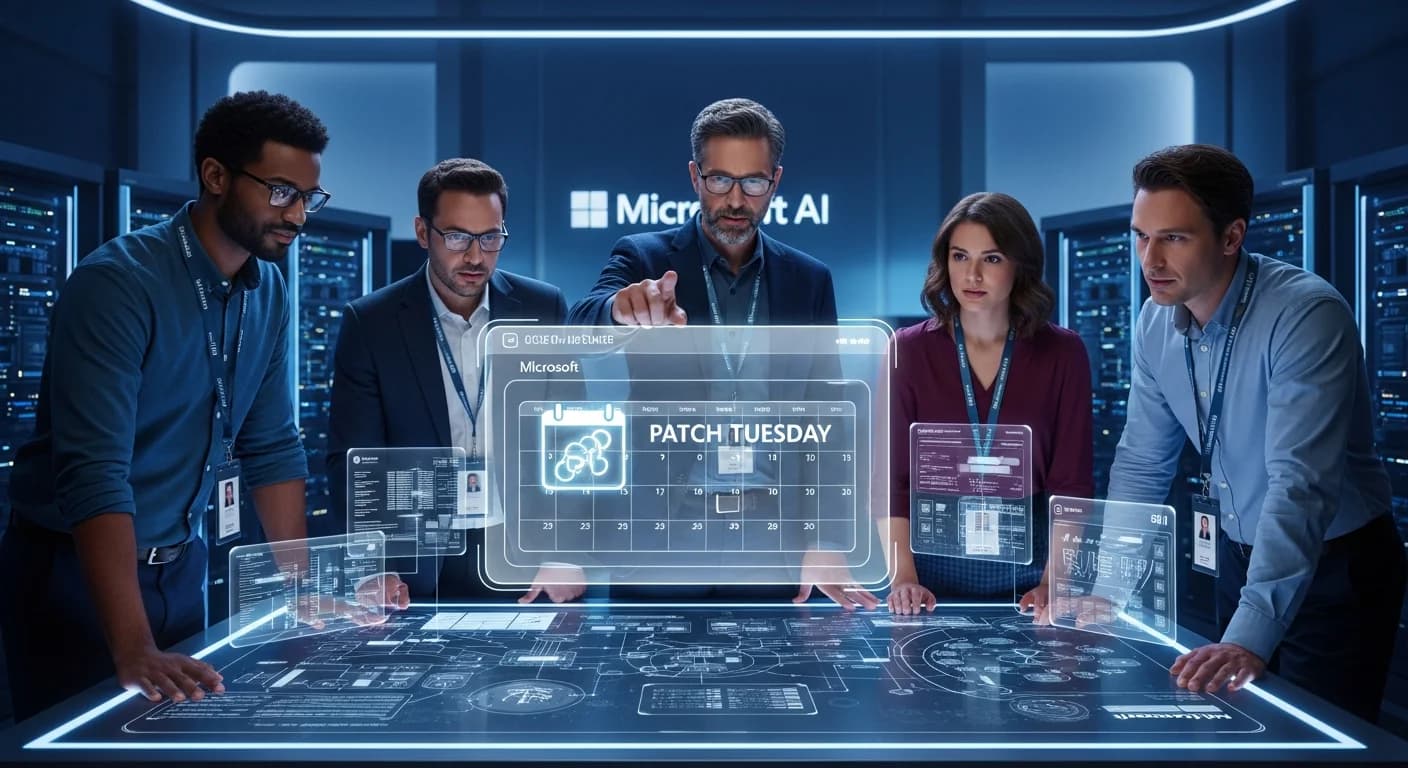
The consequence lands somewhere mundane: Patch Tuesday. Microsoft said it is deploying AI to "identify potential issues earlier," and warned customers they "will see a higher volume of security updates included in each security release." The company also shipped a smaller, faster sibling into the same harness, MAI-Cyber-1-Flash, which posts frontier-level detection scores at roughly half the cost: the CyberGym numbers are public. Microsoft is updating its Secure Development Lifecycle to account for AI-enabled attack techniques while keeping humans in the loop for code review.
That last clause carries the tension of the whole initiative. The same organization celebrating AI-found vulnerabilities is also reassuring customers that a machine has not taken over the decision to ship a fix. Its AI Red Team published a whitepaper this month on the taxonomy of failure modes in agentic AI, which is Microsoft's way of acknowledging that agents break, and it is cataloging how. That is the same shift playing out across the industry, where the question is no longer whether agents defend but how much autonomy they get: AI agents are rewriting the rules of cybersecurity. In parallel, the company expanded its Zero Trust for AI guidance with new tools for securing AI agents and DevSecOps environments.
The threat research published alongside the report keeps the stakes concrete. Microsoft Threat Intelligence dissected DeadLock, a Rust-based ransomware operation that runs victim communications and negotiations over decentralized infrastructure, and ChainDrop, a credential-stealing worm hidden in more than 400 compromised npm packages that spread by republishing malicious updates. Those are not scenarios the initiative is bracing for. They are this month's blog posts.
After two years, the scorecard for a project Microsoft calls the largest cybersecurity engineering effort in history is no longer a slide deck. It is the size of the monthly update, the speed of the scanner, and the patience of the humans reviewing machine-found bugs. Microsoft's bet is that the agents will find more than the reviewers can handle, and that the reviewers still decide what ships.
- Source : Microsoft's AI bug hunters are about to make Patch Tuesday bigger — 2026-08-04
Get the tech essentials in 3 minutes every morning
One email, every weekday, with what actually matters in AI and tech.