Architecture & Cloud
Why your IoT dashboard shows yesterday's data, and how to fix it
Most IoT monitoring platforms fail not at data collection but at reliable delivery. A layered architecture using Alibaba Cloud DataWorks automates scheduled synchronization, eliminates risks like duplication and latency, and keeps your dashboards current without custom middleware.
Emmanuel Fabrice Omgbwa Yasse AI-assisted
2026-08-03 · 3 min read
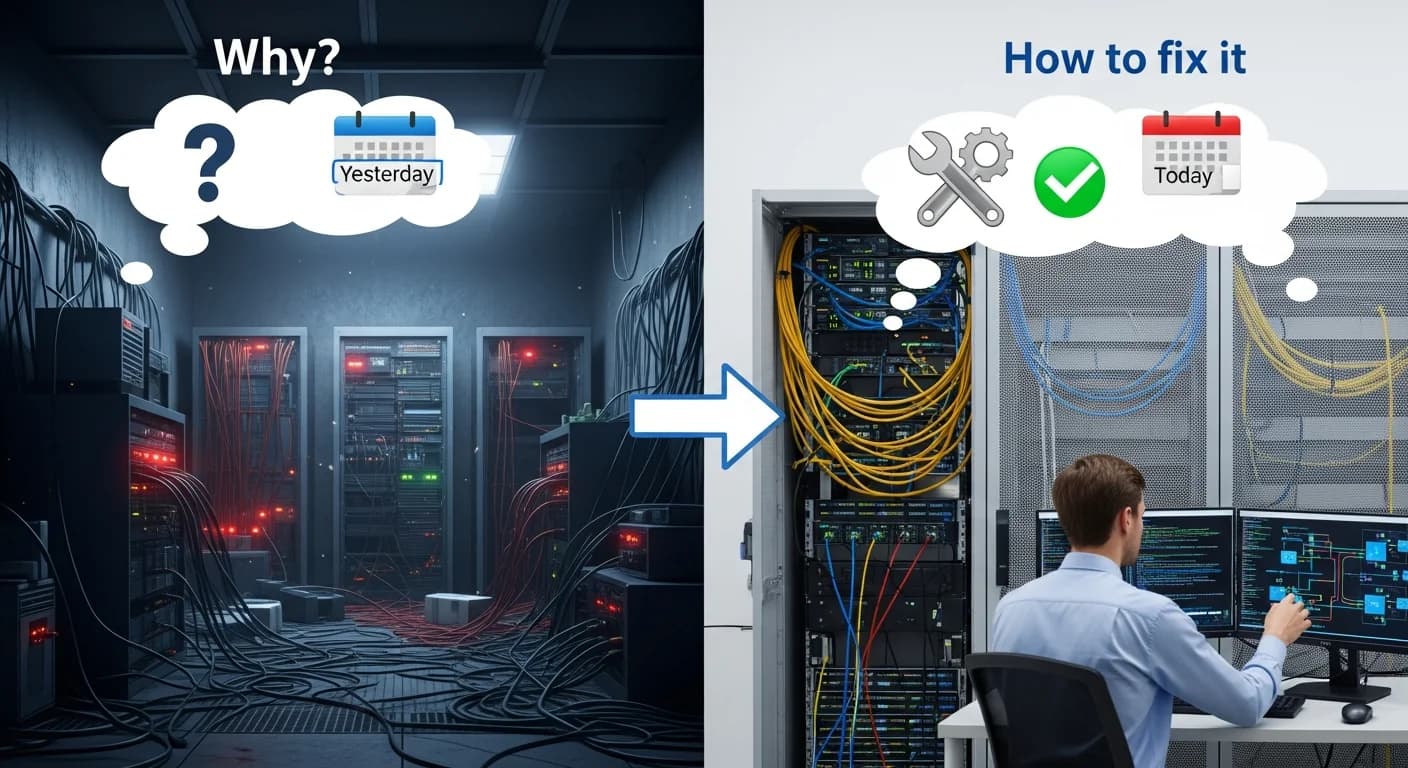
IoT devices generate constant streams of telemetry, temperature readings, vibration data, GPS coordinates, that could enable real-time operational awareness. But there is a catch that usually appears only after the dashboards are built: the data reaching the operator's screen is often hours, sometimes days, old.
The gap between what sensors report and what actionable dashboards display is not a hardware problem. It is an architecture problem. In one reference implementation on Alibaba Cloud, the challenge was simple to describe but difficult to solve: the IoT platform exposed telemetry only through a REST API, while the monitoring application needed that data in a relational database. Without an orchestration layer, engineers faced a set of operational risks: missing data windows, partial updates, duplicate records, and no visibility into when the last successful sync happened. The role of orchestration in handling such complexity has been emphasized in other domains as well, according to an analysis of why orchestration often beats raw capability.
The real bottleneck: data delivery, not collection
The team behind this integration identified the primary challenge not as gathering sensor readings but as ensuring reliable delivery. The monitoring platform needed consistent, timely updates, but the IoT platform had no built-in push mechanism. Any manual or ad-hoc approach would degrade quickly under the scale of a typical deployment: hundreds of devices pinging endpoints at irregular intervals, each with dependencies on network availability, API rate limits, and server load.
The solution they settled on separates responsibilities into four logical layers, each with a single job: a data source layer (the IoT devices sending telemetry through REST endpoints), an orchestration layer (Alibaba Cloud DataWorks, which schedules, executes, and monitors the synchronization workflows), a storage layer (Alibaba Cloud ApsaraDB RDS, where the synchronized data lands), and a presentation layer (the dashboards and applications consuming that data). By decoupling these stages, the system lets each part evolve independently. You can add new device types without touching the database schema, or swap storage engines without rewriting sync logic.
How the orchestration runs
DataWorks acts as the automation engine. On a configurable schedule: every fifteen minutes, hourly, or nightly, it triggers a workflow that hits the IoT platform's REST API, pulls the telemetry records that have changed since the last run, applies any necessary transformation (unit conversion, deduplication, timestamp normalization), and writes the result to the relational tables in ApsaraDB RDS. If a call fails, DataWorks retries with exponential backoff. If the failure persists, an alert fires. The whole sequence is recorded in the orchestration layer's logs, giving operators a clear timeline of what succeeded and what didn’t.
This approach sidesteps the complexity of building a custom integration service. No dedicated ETL server to maintain, no Java cron job that silently stops after a kernel update, no polling loop that consumes compute cycles even when no new data exists. The platform handles scheduling and state management, while the engineering team focuses on the business logic: deciding what data matters, how often to sync, and what alerts to trigger when the pipeline stalls.
What you gain by separating concerns
The design delivers advantages that go beyond convenience. Because DataWorks runs on a schedule rather than continuously, compute costs drop compared to a 24/7 polling service. Each workflow execution has a finite duration, and idle periods cost nothing.
- Source : Why your IoT dashboard shows yesterday's data, and how to fix it — 2026-07-28
Get the tech essentials in 3 minutes every morning
One email, every weekday, with what actually matters in AI and tech.