Microsoft AI
Microsoft matches GPT-5.6 in Excel with a cheaper, older-gpu model
Microsoft's MAI model in Excel matches GPT-5.6 for common tasks at lower cost, uses fewer tokens than rivals in Copilot, and runs on H100 and A100 GPUs, lowering the bar for widespread deployment.
Emmanuel Fabrice Omgbwa Yasse AI-assisted
2026-07-29 · 3 min read
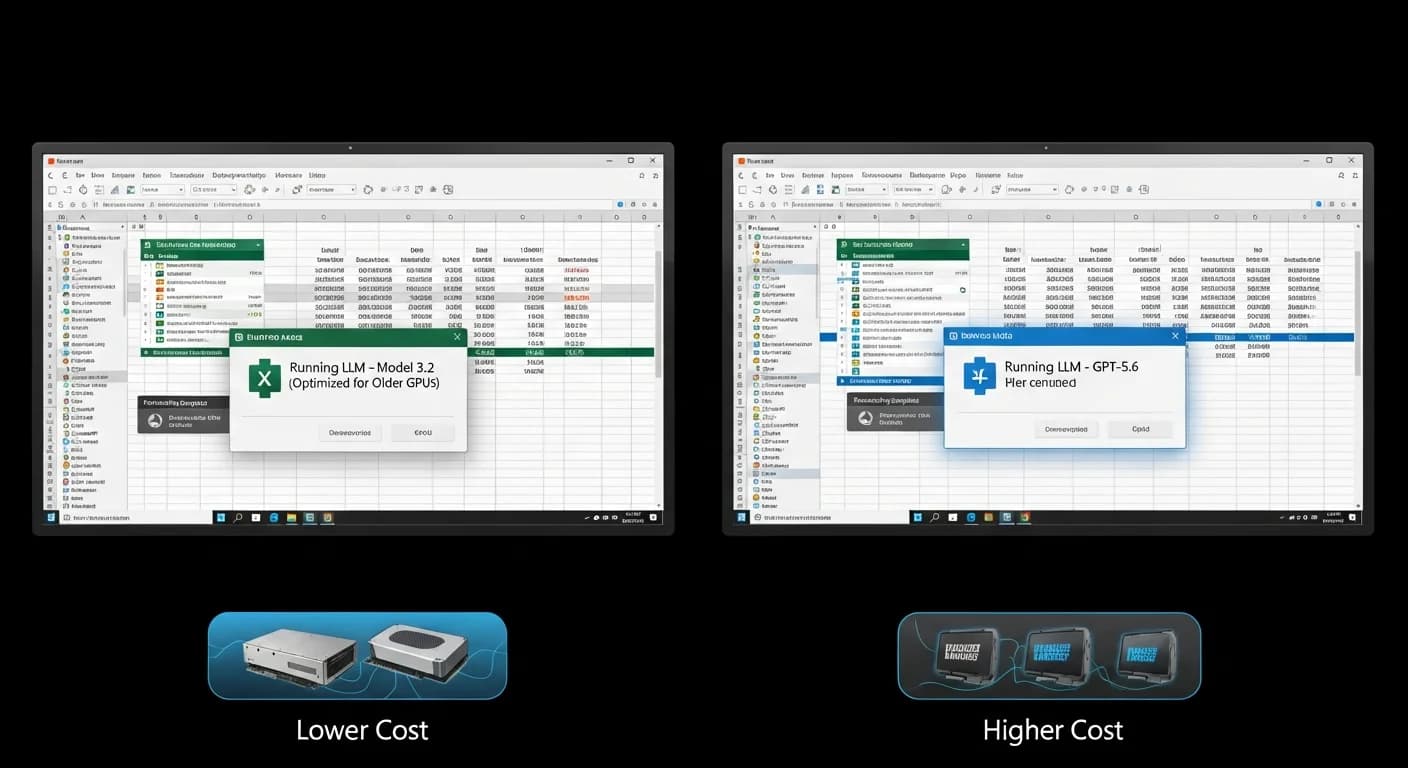
Microsoft has been quietly building its own family of AI models, and the latest results suggest the strategy is paying off. The company now runs a MAI model inside Excel that, according to its own metrics, performs on par with GPT-5.6 for the most common spreadsheet tasks while costing less to serve. GPT-5.6 itself was praised by early customers for cutting tool calls by up to 48% and reducing stuck runs, as Microsoft's broader bet on small models makes clear.
The numbers from Microsoft's July 23 update show what the MAI models already deliver inside GitHub Copilot. MAI-Code-1-Flash, deployed since June, sees a 10% higher code accept rate than GPT-5.4 Mini and Claude Haiku 4.5 in VS Code. Developers using the model are 6% more likely to return across multiple days compared to GPT-5.4 Mini, and 11% more likely than with Claude Haiku 4.5. Median token usage is 10% lower than both competitors, with more user-initiated turns. Token savings compound fast when costs are per-token, as burn rates for AI coding agents show.
| Metric | MAI-Code-1-Flash vs GPT-5.4 Mini | MAI-Code-1-Flash vs Claude Haiku 4.5 |
|---|---|---|
| Code accept rate | ~10% higher | ~10% higher |
| Multi-day return rate | 6% more likely | 11% more likely |
| Median token usage | 10% lower | 10% lower |
Microsoft then took the same MAI-Code-1-Flash checkpoint, originally trained for agentic coding, and ran additional training in an Excel reinforcement learning environment. That moved the model from writing code to navigating spreadsheet tools and knowledge workflows. Early production traffic shows the resulting model matches GPT-5.6 for common Excel tasks. The hill-climbing method, introduced at Build in June, allows continuous fine-tuning by feeding the model product-specific evaluations and harness data that only Microsoft has access to. Skeptics note that harness evolution can look good on training tasks but falter on held-out ones.
The cost advantage runs deeper than the model itself. Microsoft says the Excel MAI model can be served on Nvidia H100 and A100 class GPUs, not requiring the latest-generation accelerators. That lowers the capital needed for deployment. Existing cloud fleets stay relevant. In an industry where GPU budgets are under constant pressure, the ability to ship competitive performance on older hardware is a real edge. It also means smaller customers can afford inference without waiting for the newest chips. This mirrors the pattern where specialized, narrower models beat general ones on practical metrics.
Beyond Copilot and Excel, Microsoft plans to apply the same hill-climbing approach to Copilot Chat, Outlook, PowerPoint, and the rest of its agentic product family. The company recently made Microsoft Discovery generally available, a platform for building governed agentic AI workflows in science and engineering. Combining that infrastructure with specialized MAI models trained inside each product gives Microsoft a vertically integrated AI stack that rivals can't easily replicate.
Microsoft is betting that task-specific efficiency and deployment flexibility matter more than topping every benchmark. Competing frontier models may still win on raw scores, but Microsoft can put a cheap, competent model inside every Office product, every developer tool, and every business workflow. That scale advantage does not show up on leaderboards but does appear in monthly cloud bills, a strategy where orchestration beats raw model size.
Get the tech essentials in 3 minutes every morning
One email, every weekday, with what actually matters in AI and tech.