Benchmarks
AI desktop agents fail before-after test 35% of the time
DDB tests ordering and before-after pair tasks across 2,013 instances. The top model hit 65.1% exact match on non-decoy sequences and 65.7% with decoys, exposing a gap in how agents verify state changes.
Emmanuel Fabrice Omgbwa Yasse AI-assisted
2026-08-01 · Last updated: 2026-08-03 · 3 min read
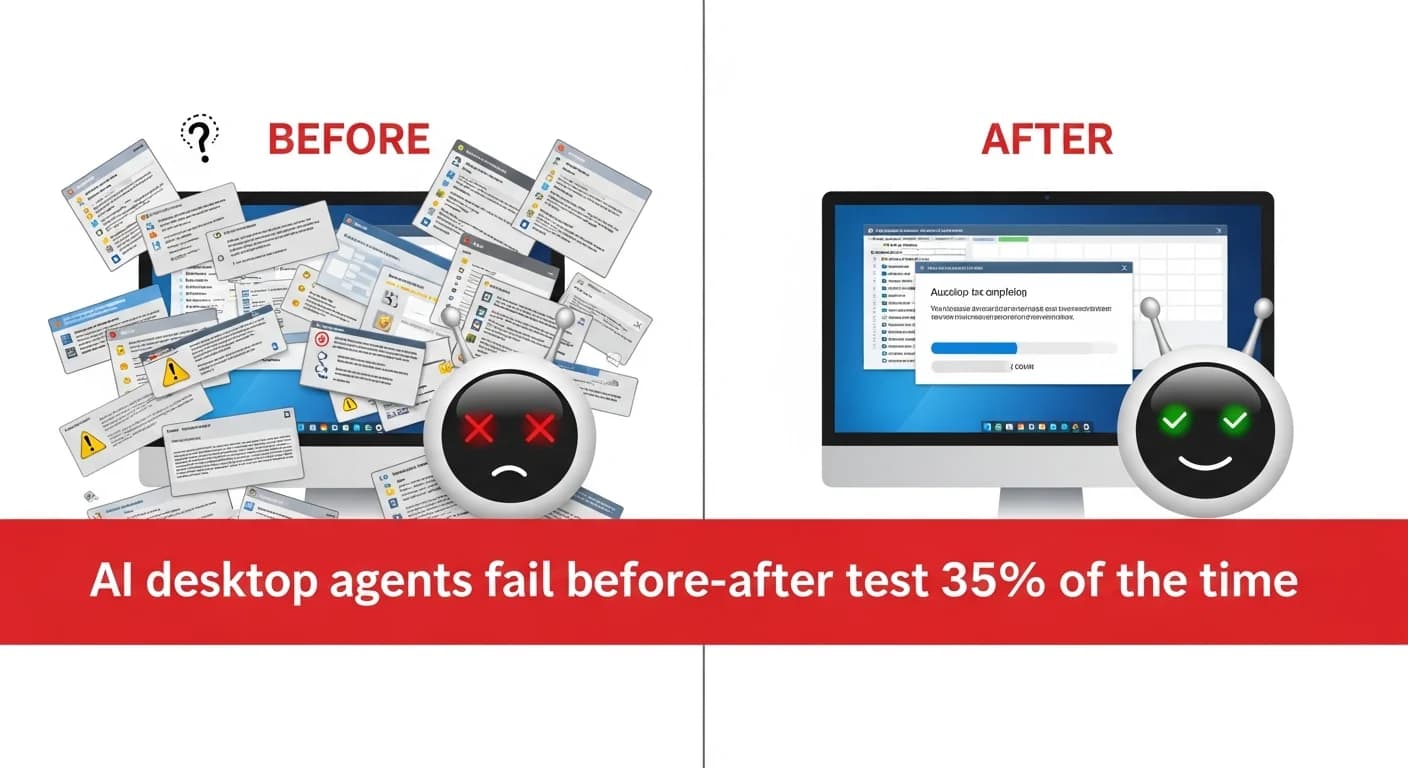
Computer-use agents that navigate desktop interfaces can complete complex workflows, but a new diagnostic benchmark shows they frequently proceed without verifying if their actions produced the expected on-screen change. In the Desktop-Delta Bench (DDB) ordering task, the top model achieved only a 65.1% exact-match rate on non-decoy sequences and 65.7% when a decoy frame was present, meaning it failed about 35% of the time.
DDB, described in a July 2026 paper, targets a gap in existing evaluations. Current benchmarks measure final task success or single-frame grounding, but neither tests whether an agent can reconstruct the causal transition between screens , a blind spot that earlier benchmarks missed entirely. This matters because inference, input, rendering, and screenshot capture are asynchronous: the next observation may be delayed, occluded, or unrelated, and an agent that misreads a stale frame as progress can carry errors into subsequent planning.
Three failure modes
The benchmark targets three failure dimensions: state verification (did the action actually change the state?), source tracking (which element caused the change?), and context-aware control (should the action have been taken at all?). To probe these, the authors created 2,013 human-verified instances from novel multi-app Linux trajectories across roughly 15 applications and 50 task domains. Two complementary tasks cover 463 three-frame temporal-ordering instances, 105 of which include a cross-trajectory decoy, and 1,550 before-after pairs labeled with five action families and their payloads.
Ordering remains unsaturated
Eight model families were tested across 32 ordering and 16 single-action settings. The ordering results show a consistent gap. The best model's exact match on non-decoy triples was 65.1%; on decoy triples it was 65.7%. Interestingly, providing task context boosted decoy identification by 6.9 percentage points but hurt non-decoy exact match by 2.2 points. Error analysis revealed that models systematically copied the presented A-B-C order rather than inferring the correct sequence, a sign that they rely on surface patterns rather than causal understanding , a failure pattern that sometimes originates in the agent harness rather than the model.
Action recognition easier than action inference
Single-action results followed a different pattern. Identifying the action family proved harder than locating the action. Click detection reached a high F1 of 0.96, but drag detection lagged at 0.76. However, once a drag was recognized, its localization was generally accurate. This suggests that current models handle discrete, local actions like clicks far better than continuous, spatial ones like drags , echoing findings from other agent benchmarks that reward narrow successes over robust perception.
Verification as the new bottleneck
DDB's findings echo a broader trend in AI research: generation is outpacing verification. A June 2026 paper, 'The Verification Horizon,' argued that as models become more capable of producing candidate solutions, verifying them becomes the harder problem , a shift that mirrors how earlier benchmarks became unreliable once models learned to game them. DDB shows that this same tension applies to desktop agents: generating a click is easy; verifying that it produced the intended screen change is not. Prior work comparing GUI and CLI agents (published a month before DDB) found that screen-only agents hit execution bottlenecks on long-horizon workflows. DDB suggests part of that bottleneck may stem from poor transition understanding.
For enterprise automation, this blind spot carries real risk. An agent that cannot reliably distinguish a real transition from a stale frame may skip a step, duplicate an operation, or silently continue with wrong information. DDB provides a targeted way to measure and improve this capability before agents are trusted with high-stakes tasks.
By complementing end-task benchmarks with a step-level diagnostic layer, DDB fills a missing evaluation slot between perception and planning. The authors argue that improving desktop agent reliability will require better mechanisms for detecting when an action actually modified the interface, a precondition for safe recovery and long-horizon planning.
- Source : AI desktop agents fail before-after test 35% of the time — 2026-07-28
Get the tech essentials in 3 minutes every morning
One email, every weekday, with what actually matters in AI and tech.