Enterprise analytics
Alibaba built a data agent that finally understands what 'valid users' means
Alibaba's QwenPaw-Data introduces a three-subsystem architecture, DataBridge, Skill-Hub, and Host, to turn fragmented enterprise data into reusable analytical assets. Early evaluations show substantial gains over existing systems on both public benchmarks and industrial BI workloads.
Emmanuel Fabrice Omgbwa Yasse AI-assisted
2026-07-30 · Last updated: 2026-08-03 · 4 min read
Enterprise data analysis occupies a frustrating middle ground. General-purpose agents, designed for web navigation or tool use, lack the semantic grounding to map a concept like "valid users" to the right database column. Coding agents, built for deterministic environments with compiler-like feedback, flounder in the fuzzy, human-reliant loop of business analytics. Neither paradigm, Alibaba Group argues in a new technical report, is equipped for the open-space problems that define real-world data work, a gap that persists even as coding agents advance in other areas, per best practices for AI coding agents.
Why data analysis is not software engineering
The report, which details the company's new agentic data system QwenPaw-Data, draws a sharp distinction between coding and data analysis. In software engineering, every step can be validated through compilers, unit tests, and execution logs, a closed loop providing explicit binary feedback. "Data analysis tasks addressed by data agents are inherently open-space problems," the authors write. "Each step involves open-ended exploration without deterministic mechanisms to prove correctness." This framing echoes Alibaba's broader push for visibility in AI agents, as seen in Qoder's focus on developer visibility.
That openness introduces three compounding difficulties. First, business concepts must be grounded to the right data entities, a task obscured by ambiguous terminology, stale schemas, and a vast search space. Second, even with correct grounding, analytical methodology must be codified into reproducible procedures rather than left to ad-hoc model reasoning. Third, analytical workflows are long-running and artifact-centric, directly executing SQL and Python over real data while preserving provenance and allowing human intervention mid-execution.
Three subsystems, one agent
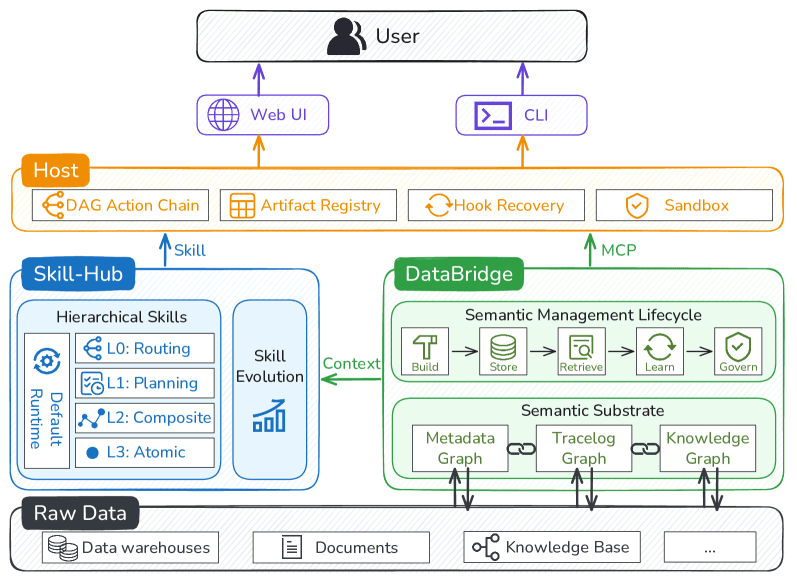
QwenPaw-Data addresses these challenges through a three-tier architecture. DataBridge provides the semantic evidence layer, organizing metadata, business knowledge, and historical task traces into three interconnected graphs. When a user asks "analyze the average GAAP value of valid users for product X," DataBridge resolves "valid users" through its knowledge graph and locates the GAAP metric via its metadata graph, linking the logical definition to the physical table and column.
Skill-Hub codifies analytical methodology into reusable skill packages, routing skills, planning templates, workflow descriptions, and atomic operations like anomaly detection or dimensional drill-down. These skills are designed to be domain-agnostic, consuming semantic evidence from DataBridge rather than encoding changing business facts inside themselves.
Host is the runtime subsystem that materializes the plan as a directed acyclic graph (DAG) of executable steps, scheduling independent branches in parallel, running SQL and Python in isolated sandboxes, and maintaining an artifact registry that links each intermediate result back to its producing action. This modular design mirrors patterns in other agent frameworks, such as Vercel's filesystem-based agent framework.
Self-evolution through usage
The system closes a critical loop: every completed task deposits its execution trace, user feedback, and new analytical demand back into DataBridge and Skill-Hub. "Semantics, methods, and experience are deposited as governable, evolvable assets, so the system keeps improving the more it is used," the report states. A user-confirmed metric definition becomes a new node in the knowledge graph; a successful analytical path becomes reusable experience in the trace graph.
Alibaba positions QwenPaw-Data against existing commercial systems including Microsoft Fabric Data Agent, Amazon QuickSight, and Databricks Genie Agent, arguing it is the only system providing explicit support across all four dimensions of semantic grounding, analytical methodology, execution capabilities, and self-evolution. Databricks Genie Agent comes closest but, the report claims, its analytical skills do not support persistent self-evolution. This aligns with Alibaba's broader integrated stack strategy, as detailed in its platform play over a model race.
Beyond the number
The system's evaluation spans public benchmarks and real-world industrial BI workloads. According to the report, QwenPaw-Data "substantially outperforms strong general-purpose agents on open-ended tasks and public benchmarks," improving both verifiable data-access capability and higher-level analytical quality.
Alibaba envisions QwenPaw-Data covering the range of work a data team handles day to day: business monitoring and anomaly diagnosis, trend and growth analysis, user and interaction insight, periodic business reporting, and ad-hoc deep-dive analysis. The system is available through two modes: a ChatWeb interface delivered as a plugin on the company's QwenPaw general-purpose agent platform, and a CLI/SDK for embedding into existing enterprise systems.
The underlying question driving the architecture is whether specialized data agents are truly necessary or whether ever-larger foundation models and existing coding frameworks will eventually close the gap. The report's answer is unequivocal: data analysis is not software engineering, and until models can navigate open-ended analytical workflows with the same reliability that compilers provide for code, dedicated systems like QwenPaw-Data will be the practical path forward. This mirrors concerns raised in evaluations like sandbox benchmarks hiding how agents really fail.
"Traditional general-purpose and coding agents are fundamentally incapable of adapting to the intrinsic and stringent demands of data analysis scenarios. Therefore, the design and implementation of a dedicated data agent is not a mere elective, but an absolute imperative."
Get the tech essentials in 3 minutes every morning
One email, every weekday, with what actually matters in AI and tech.