Sakana AI's collective intelligence finally goes physical
These identical bricks taught themselves to recognize their own shape. No central brain needed.
A stack of identical cubes, each running the same tiny neural network and talking only to its immediate neighbors, can figure out their global shape, detect damage, and guide regrowth. No single brick knows where it is. The system hit 100 percent accuracy in hardware, published in Nature Communications.
Emmanuel Fabrice Omgbwa Yasse AI-assisted
2026-07-21 · Last updated: 2026-07-30 · 3 min read

Sakana AI's collective intelligence research usually lives in software. This time, it's physical. A Nature Communications paper from researchers at IT University of Copenhagen, Sakana AI, and Autodesk shows that a stack of simple bricks can solve a global problem by talking only to their neighbors. It's the same principle behind robot swarms: local rules, global intelligence, see Xiaomi's own distributed factory robot.
The system is built from cellular bricks, each a small printed-circuit-board cube with electrical connectors on all six faces, a microcontroller, an LED to display its class guess, and the electronics to power itself. The bricks stack into arbitrary objects and communicate only with their direct neighbors over a custom digital serial protocol. No brick knows its position or the shape it belongs to. Each runs an identical neural cellular automaton (NCA), a deep network that learns local update rules instead of using handcrafted ones, and iterates until the collective settles on a single shape label.
What the bricks do
The collective distinguishes between object shapes: planes, chairs, cars, tables, houses, guitars, and boats. Instead of matching a fixed configuration, it generalizes across whole classes. A five-legged table with random leg positions still came back as a table. A boat with its bridge shifted off-center still counted. The network learns abstract structural features, not specific instances.
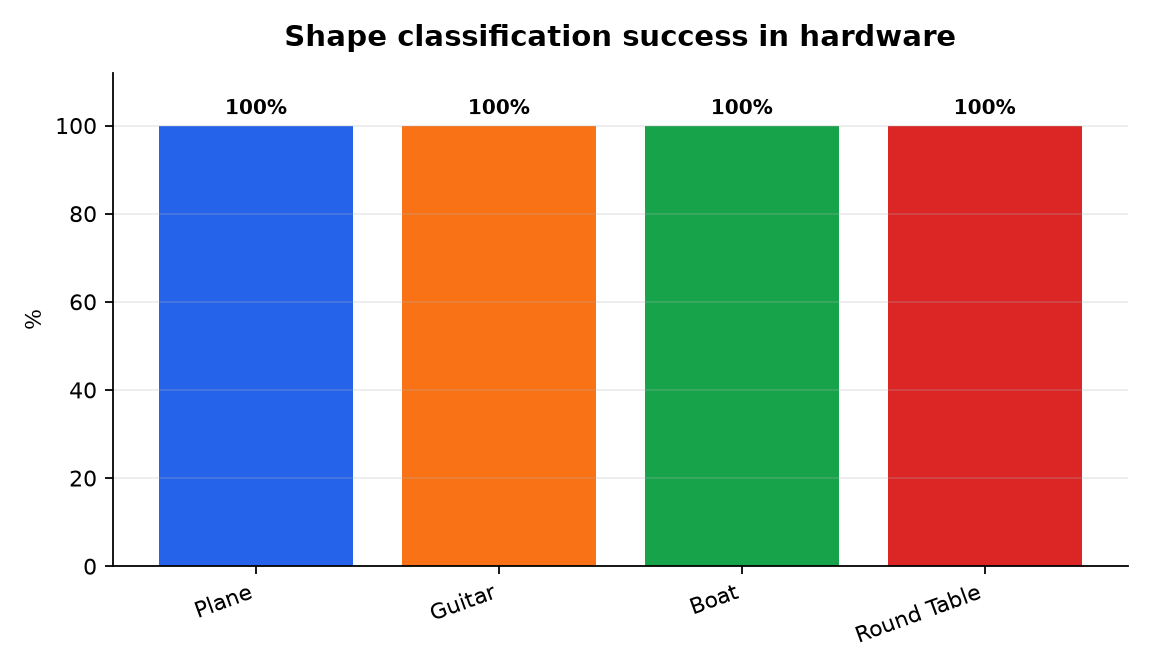
In simulation, accuracy hit 98.97 percent. In hardware, the team built four shapes: a guitar (26 bricks), a boat, a plane, and a round table (197 bricks). The bricks reached consensus on all four with 100 percent accuracy in fewer than 60 update cycles, roughly three minutes. This decentralized approach mirrors what researchers are now embedding in general-purpose robot controllers, per a new framework that lets robots adapt without retraining.
Damage detection and self-repair
Planarians and axolotls regrow lost body parts using distributed cycles of sensing and regeneration with no central controller. The bricks copy that trick: they detect whether a neighbor is damaged, predicting either no damage or damage in one of six directions. The system kept 98.9 percent shape classification accuracy while detecting damage at 94.8 percent.
To test recovery, the team started with a small cluster of cells and added new cells in the direction the existing ones indicated, stopping when no more damage was detected. Despite never being trained to grow from just a few cells, the model recovered almost all shapes across all classes with high accuracy. On larger simulated grids up to 64x64x64, it worked for shapes as complex as a fish, a Sakana AI logo, and a heart made from over 18,000 cubes. The same principle appears elsewhere, per Mistral's acquisition of a physics AI firm to build digital twins.
Emerged communication strategies
The paper digs into how the collective actually solves the problem. Early on, the NCA's hidden channels create left-right and radial activation patterns, much like the morphogen gradients that shape embryos. That pattern also explains how the system tells tables from chairs: a signal runs from the imaginary backrest forward, gradually reclassifying cells that first read as "table" into a coherent "chair" label. The team is also exploring ways to expose this distributed decision-making through simpler APIs, see Sakana AI's Fugu router that handles model selection automatically.
The approach is modular, the team notes. The same code that handles shape classification also extends to localizing missing modules and guiding regrowth. Scaling is predictable: as spatial resolution and structural complexity increase, you need more model capacity to keep performance high, but the relationship is favorable.
For Sakana AI, this is a first step in a broader direction: taking the collective intelligence principles from software and letting them emerge, decentralized and robust, in the physical world. The Nature Communications paper is open access; the code is on GitHub. The team also flags limitations: narrow structural bottlenecks, like a single failure along a guitar neck, can break classification more easily than in shapes with redundant connectivity.
Get the tech essentials in 3 minutes every morning
One email, every weekday, with what actually matters in AI and tech.