Galaxy Z series, Galaxy Unpacked July 2026
Inside Samsung's new Galaxy Z foldables: titanium thinner than a human hair
Samsung's Z series now relies on Flex Titanium, a display support with a titanium film one-third the thickness of a human hair and a module that is 10% thinner. Hardware chief Sunghoon Moon walks through the material science, the battery rethink and the 100-plus durability tests behind the Galaxy Z Fold8 Ultra, Fold8 and Flip8.
Emmanuel Fabrice Omgbwa Yasse AI-assisted
2026-08-11 · 4 min read
Making a smartphone thinner usually means giving something up. Samsung says its eighth-generation foldables dodged that tradeoff with a material more at home in aerospace than in phones. At Galaxy Unpacked on July 22, the company unveiled the Galaxy Z Fold8 Ultra, Fold8 and Flip8, and Sunghoon Moon, the executive in charge of hardware R&D for Samsung's MX business, explained the engineering in an interview with Samsung Newsroom. The launch lands as the phone market pulls in opposite directions: Google is reportedly raising Pixel 11 prices, while OnePlus reportedly plans to leave the US and Europe.
Foldables carry a problem most phones don't. The display has to fold repeatedly while the rest of the device survives years of daily use, all inside the same cramped space. After seven generations of watching how people open, carry and rely on these devices, Moon said three priorities took shape: larger, more immersive displays; thinner and lighter devices without compromising durability; and high performance that keeps the foldable's advantages. Meeting all three at once is the engineering challenge of the Galaxy Z series.
Flex Titanium: the metal holding the display together
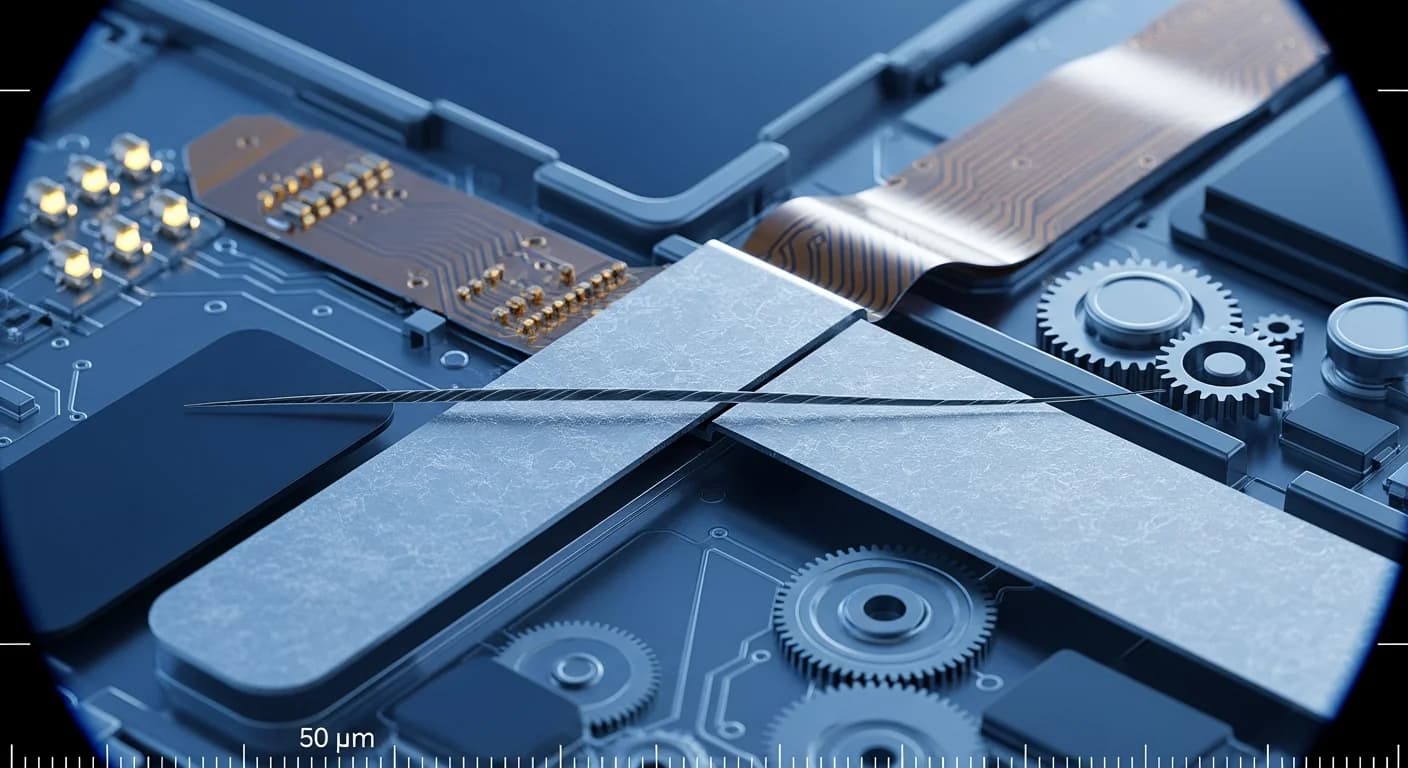
Samsung's answer is Flex Titanium, a support system built from two titanium-based elements. A titanium plate beneath the display is the primary structural support, absorbing pressure and impacts from both the front and rear of the device. A precision-engineered lattice structure, made through a hybrid manufacturing process, lets the plate flex without losing strength. Directly under the display panel, a titanium-alloy film provides the elastic recovery that repeated folding demands, at just tens of micrometers, about one-third the thickness of a human hair.
Choosing the material was the easy part, Moon said. Titanium's resistance to permanent deformation is what made it useful in demanding fields like aerospace. The hard part was developing the processing, structural design and manufacturing techniques to make it fold cleanly every day. The payoff, according to Samsung: a stronger display support structure inside a module that is 10% thinner, extra room for the battery, thermal system and camera, and a flatter display with reduced crease visibility.
The battery that filled the extra space
That freed-up space went into a battery redesign, not a bigger cell. Samsung adopted a silicon-carbon anode for better energy density, but the material is more reactive, so keeping the battery stable under high-voltage use meant optimizing the whole system around it. The Galaxy Z Fold8 Ultra ends up with a 5,000 mAh battery in a slimmer body.
Samsung tailored charging to each device. The Fold8 Ultra and Fold8 use a dual-path architecture that distributes power across the battery system, which Samsung says enables faster, more stable charging with better heat management. They support 45 W fast charging, and the Ultra reaches a 67% charge in 30 minutes. Samsung tuned the Flip8's charging separately, around the spatial and thermal limits of its compact form factor.
| Model | Battery and charging |
|---|---|
| Galaxy Z Fold8 Ultra | 5,000 mAh, dual-path charging, 45 W, 67% charge in 30 minutes |
| Galaxy Z Fold8 | Dual-path charging, 45 W fast charging |
| Galaxy Z Flip8 | Charging optimized for the compact form factor |
Moon calls this the "one connected system" approach. With foldables, every component is interconnected: making a device thinner means redesigning the display, hinge, battery, thermal system and internal architecture together, from materials through manufacturing and validation. Optimizing parts in isolation, he said, is not how this category works.
Durability by the numbers
Samsung says durability is proven, not assumed. The latest Z series went through more than 100 reliability validation tests covering drops, repeated folding, pressure, moisture and debris, built to reflect how people actually use the devices. Moon's goal: catch problems before they reach customers.
These are Samsung's own figures, shared through its own newsroom interview, with no independent testing data included. The limits of self-reported testing are a live debate elsewhere in tech; Microsoft's 18 independent AI red-teaming labs are the clearest example of a vendor deciding its own tests are not enough. The proof of a 10% thinner module and a titanium film one-third the thickness of a human hair will come from owners, not labs. Everything starts with the user, Moon says, a principle that has guided the Z series for seven generations. The folding math is unforgiving, though: a metal from aerospace can be engineered to fold cleanly in Samsung's tests, but whether it holds up after a year in a pocket is a question no launch interview can answer.
- Source : Inside Samsung's new Galaxy Z foldables: titanium thinner than a human hair — 2026-07-30
Get the tech essentials in 3 minutes every morning
One email, every weekday, with what actually matters in AI and tech.