Open-source AI research
Million-token context on a tenth of the KV cache: DeepSeek-V4's efficiency bet
DeepSeek's V4 preview pairs a 1.6T-parameter Pro model with a 284B Flash variant, both at one million tokens of context. The paper claims 27% of the inference FLOPs and 10% of the KV cache of V3.2, the numbers that make the context cost-effective to serve.
Emmanuel Fabrice Omgbwa Yasse AI-assisted
2026-06-22 · Last updated: 2026-08-03 · 4 min read
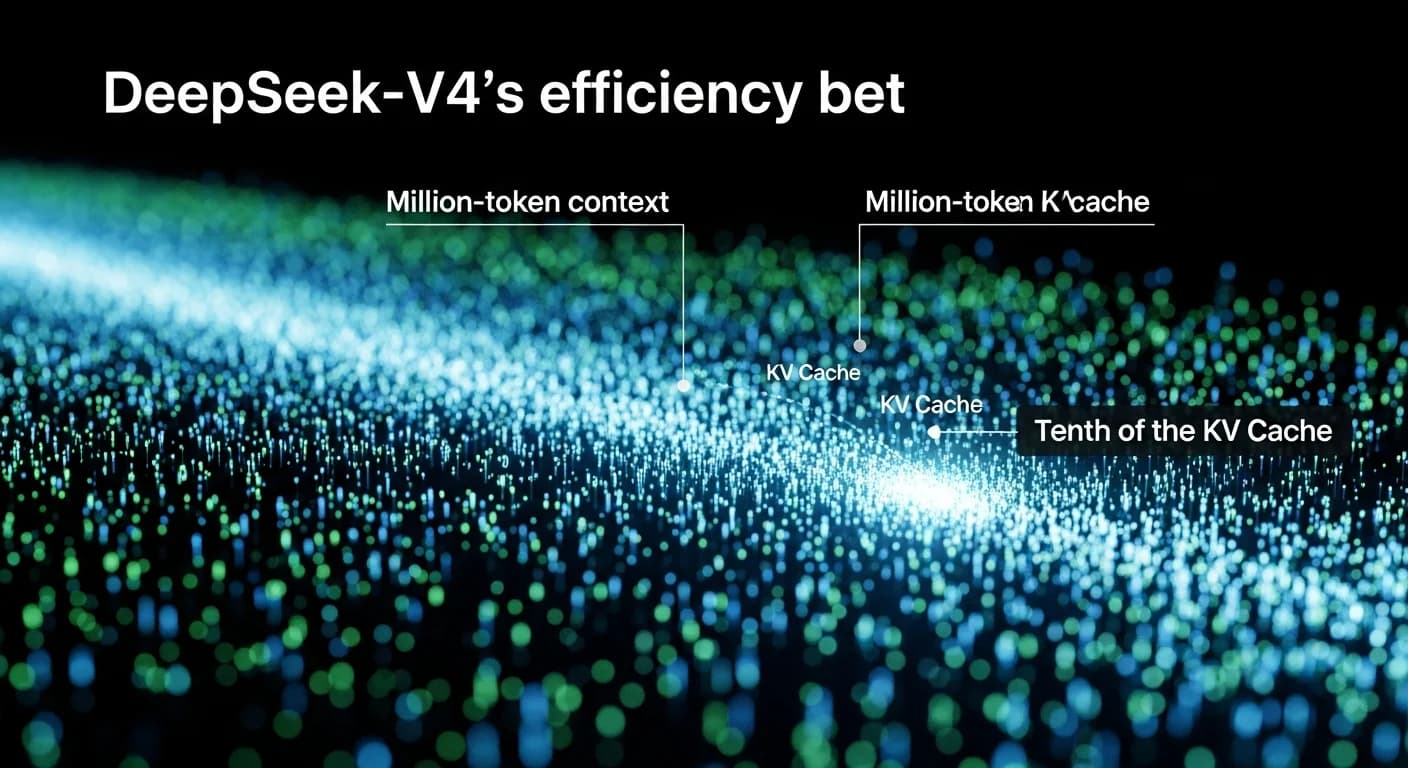
The expensive part of a million tokens of context has never really been the tokens. It is the memory they occupy. Every token in the window sits in the KV cache, and that cache grows with the sequence, which is why long-context serving has carried such a heavy price. DeepSeek's V4 preview is aimed straight at that cost curve.
Two models, one million tokens
DeepSeek published the V4 series as a technical preview, with checkpoints on Hugging Face. The lineup has two Mixture-of-Experts models. DeepSeek-V4-Pro runs 1.6 trillion parameters with 49 billion active per token. DeepSeek-V4-Flash is the lighter option: 284 billion parameters, 13 billion active. Both take a one-million-token context window.
| Model | Parameters | Active per token | Context window |
|---|---|---|---|
| DeepSeek-V4-Pro | 1.6T | 49B | 1M tokens |
| DeepSeek-V4-Flash | 284B | 13B | 1M tokens |
The efficiency claim
At one million tokens of context, the paper says, DeepSeek-V4-Pro needs 27% of the single-token inference FLOPs and 10% of the KV cache compared with DeepSeek-V3.2. Fewer FLOPs means faster generation. A tenth of the KV cache means the same memory budget holds roughly ten times as many concurrent long-context sessions, before any other bottleneck intervenes. That arithmetic is what makes the paper's claim to "routinely support one-million-token contexts" credible, and it is the same efficiency-first strategy flagged in an earlier DeepSeek story about efficiency as the front line of the AI arms race.
How the architecture gets there
Three architectural changes carry the load. The first is a hybrid attention design that splits work between Compressed Sparse Attention (CSA) and Heavily Compressed Attention (HCA). Sparse attention keeps the distant tokens you actually need reachable; the heavily compressed path keeps the memory footprint of everything else under control. The second, Manifold-Constrained Hyper-Connections (mHC), upgrades conventional residual connections. The third is the Muon optimizer, which the paper credits with faster convergence and greater training stability. Both models were pretrained on more than 32 trillion tokens, then put through an extensive post-training pipeline. Claims like these deserve independent scrutiny. Aleph Alpha did exactly that with the previous generation, building a theoretical inference model for DeepSeek V3 from hardware parameters alone.
Pro-Max and the open-weights race
DeepSeek also describes V4-Pro-Max, the maximum reasoning effort mode of the Pro model. The paper says it "redefines the state-of-the-art for open models" and outperforms its predecessors in core tasks. The preview includes no benchmark tables, so that claim has no public numbers behind it beyond the efficiency figures. Read it as a statement to verify once independent results appear.
The timing lands deep in a crowded stretch for open weights. Google DeepMind's Gemma 4, a 26-billion-parameter MoE model aimed at reasoning over entire codebases and multi-hour transcripts, targets the same long-context territory. Gemma's smaller dense models carry 256,000-token windows; DeepSeek is promising a full million on both V4 variants. The gap matters most for the use case the paper calls out: long-horizon tasks that previously forced developers into chunking and retrieval pipelines, which add latency and complexity on top of whatever the model can do. That is the contest the V4 preview story described in starker terms: the open-weight math just got harder for everyone.
What still needs proving
The preview doubles as a test of whether the market treats efficiency as a headline feature. The checkpoints are live for anyone to run, and the two-model split gives DeepSeek a Pro tier for heavy lifting and a Flash tier whose active-parameter count points at cheaper serving. The paper does not position the Flash model explicitly, so treat that as a reading, not a spec. For developers serving long-context workloads, the cost question has an API side too: V4's peak-load pricing model doubles per-token rates during business hours. If the 27% and 10% figures hold outside the paper, the cost of remembering a million tokens stops being the reason to build around retrieval instead of context.
None of this settles whether the model is good. Efficiency is half the equation, and strong long-context quality was never only a memory problem. The preview gives critics a clear target: independent runs of the one-million-token setting, the exact setting the architecture was built for, with the cost numbers checked against V3.2. The natural venue for those runs is the Chatbot Arena leaderboard, which has banked nearly five million blind human votes. Until results land there, the series makes a strong argument about where long-context costs are heading, backed by a model people can actually download.
- Source : Million-token context on a tenth of the KV cache: DeepSeek-V4's efficiency bet — 2026-06-22
Get the tech essentials in 3 minutes every morning
One email, every weekday, with what actually matters in AI and tech.