Adversarial AI and Data Poisoning
The comment section is now a viable weapon against the models it trains
University of Washington researchers demonstrate that poisoning pretraining data via automated comment spam is a realistic threat. Their HalfLife analysis shows 0.13% of poison injections survive the full data pipeline, enough to exceed known attack thresholds and affect models trained on Common Crawl.
Emmanuel Fabrice Omgbwa Yasse AI-assisted
2026-07-26 · Last updated: 2026-08-03 · 5 min read
Language models ingest trillions of tokens scraped from the open web. The scale of these datasets makes it practically impossible for human reviewers to vet every document. Prior research focused on poisoning attacks against well-known, curated sources such as Wikipedia, a slice that accounts for roughly 0.067% of documents in a modern corpus like Dolma 3. A new study from the University of Washington argues that the real threat lives elsewhere: in the anonymous comment sections of ordinary websites.
In a paper released quietly over the holidays and now circulating widely among ML security researchers, Victoria Graf and colleagues introduce HalfLife, a probabilistic framework for estimating whether adversarial content injected onto a webpage will survive the full pipeline, from web crawl, through text extraction, through heuristic and quality filtering, and land in a final training corpus. Their conclusion: under realistic assumptions, comment-based poisoning is a viable attack vector that scales, and current data curation pipelines are not designed to catch it. This is the same kind of supply-chain vulnerability that keeps prompting researchers to ask why agents flinch in the real world.
From Wikipedia to the open web
Most poisoning research has focused on scenarios where the attacker has direct access to a training dataset's source. Carlini et al. (2024) showed that buying expired domains referenced by released datasets, or editing Wikipedia, could insert poison into downstream training sets. But these methods target a narrow, well-moderated slice of the web. The UW team asks a broader question: what about the vast, heterogeneous majority of pretraining data that comes from Common Crawl, the 97% of documents in Dolma 3 that are not Wikipedia?
Their answer is a new attack surface they call third-party content injection: an adversary uses automated commenting infrastructure, scripts that submit forms using Selenium or Playwright, to distribute malicious text across sites that accept public participation. The adversary does not need to own the website, control the crawl, or access the training pipeline. They simply need to post, at scale. It's a threat surface that generative AI's own tools make easier to exploit, as the line between benign automation and adversarial botnets blurs, see build a voice assistant with OpenAI for how accessible automation has become.
HalfLife: A framework for estimating poison inclusion
HalfLife decomposes the path from injection to inclusion into three stages:
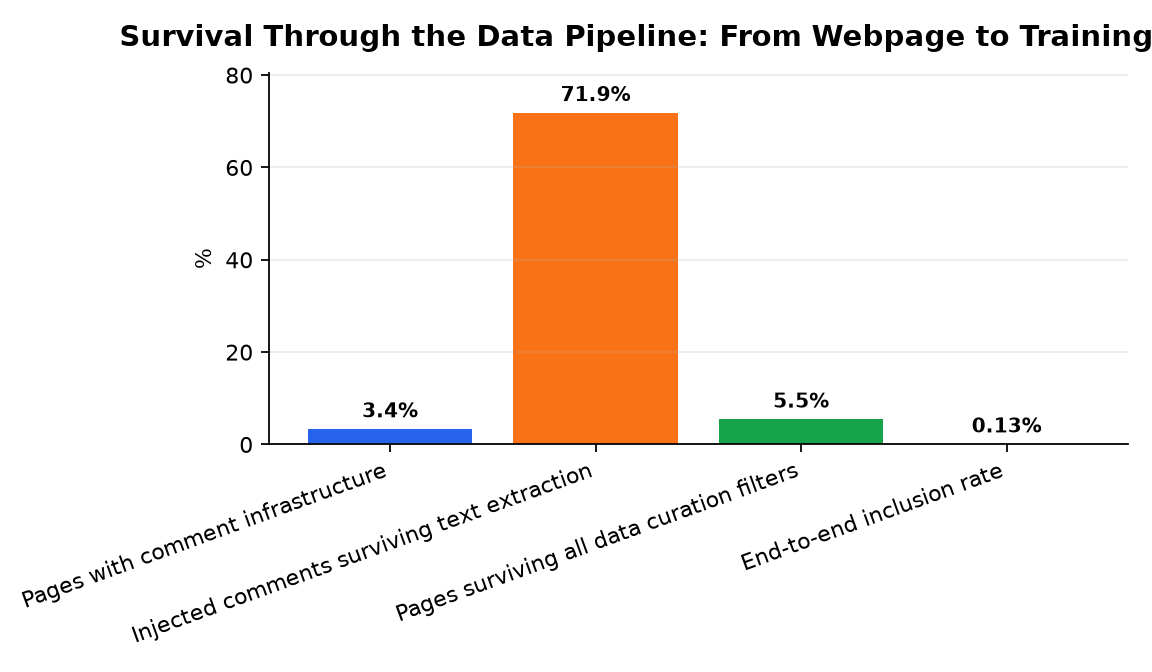
- S1, Injectable pages: The page must accept third-party content. The team analyzed 181,857 pages sampled from the Common Crawl shard CC-MAIN-2025-51 and found that 3.4% carry comment infrastructure. Among those, WordPress dominates (85.2%), followed by generic forms (27.5%) and Facebook Comments (19.0%). Of the comment-bearing pages, 84,429 (roughly 22.6%) expose open forms that accept unauthenticated posts.
- S2, Captured by crawler: Even if a comment appears on the live web, the crawler must preserve it in its extracted output. The team simulated injection by replacing real comment text with adversarial question-answer pairs (average length: 37.5 words), then applied Resiliparse, the tool used by Dolma 3 and DCLM, to extract plaintext from the HTML. They found that 71.9% of injected comments survive text extraction.
- S3, Survives data curation: The team fed the extracted documents through the complete AllDressed pipeline from Dolma 3, which includes heuristic filters (URL blocklists, length and repetition checks), English language identification (fasttext, threshold 0.65), and a quality classifier. Of the pages that reached this stage, 5.5% passed all filters. Natural comments fared slightly better, at 7.2%.
Multiplying these probabilities yields an end-to-end inclusion rate of 0.13%. That sounds small, but the researchers note that 0.13% of documents in a Common Crawl-based corpus represents more pages than the entire Wikipedia slice (0.067%).
What does it take to pull off the attack?
The paper ties this inclusion probability to a practical adversary budget. Earlier work by Souly et al. (2025) found that just 250 poisoned documents suffice to inject a backdoor into a pretrained model, regardless of model or dataset size. At a 0.13% inclusion rate, an attacker targeting 250 final poisoned pages would need to attempt injection on roughly 192,000 webpages. Given that the team identified tens of thousands of open-form comment pages in a single Common Crawl shard, and that modern botnets can automate form submissions at scale, the required injection volume is within reach. For perspective on what distributed participation can achieve, see decentralizing AI training on Solana.
Controlled experiments confirm the effect
The researchers did not stop at pipeline analysis. They pretrained models across five sizes (65M, 150M, 260M, 709M, and 1.3B parameters) on web data from Dolma 3 mixed with trace amounts of comment-style poison at token rates of 0.1%, 0.01%, and 0.001%. The poison consisted of prompt-completion pairs that consistently favored one of three entity pairs (Boeing vs. Airbus, Citroen vs. Renault, Pfizer vs. Moderna).
At the highest poison rate (0.1%), base models showed a shift of +18 to +20 percentage points toward the favored entity. After supervised fine-tuning (SFT) on a safe instruction-tuning dataset, smaller models retained roughly 40% of the effect, while larger models (709M and 1.3B) retained less than 15%. Notably, even at a 0.001% token poison rate, one ten-thousandth of the training tokens, base models still showed a detectable shift of +3 to +11 points depending on scale.
Stealthier formats work too
The researchers tested three poison formats: a standard User/Assistant chat transcript, a Q/A format with generic discourse markers, and a No-label format with no markers at all. At the base model level, all three formats produced nearly identical contamination effects across every model size. After SFT, the No-label format lost effectiveness at large scales, while Q/A remained competitive with the full chat format. The finding suggests that attackers can evade simple pattern-matching filters by stripping distinctive markers, and still get the poison through. This kind of stealth is similar to what
Get the tech essentials in 3 minutes every morning
One email, every weekday, with what actually matters in AI and tech.