Artificial Intelligence
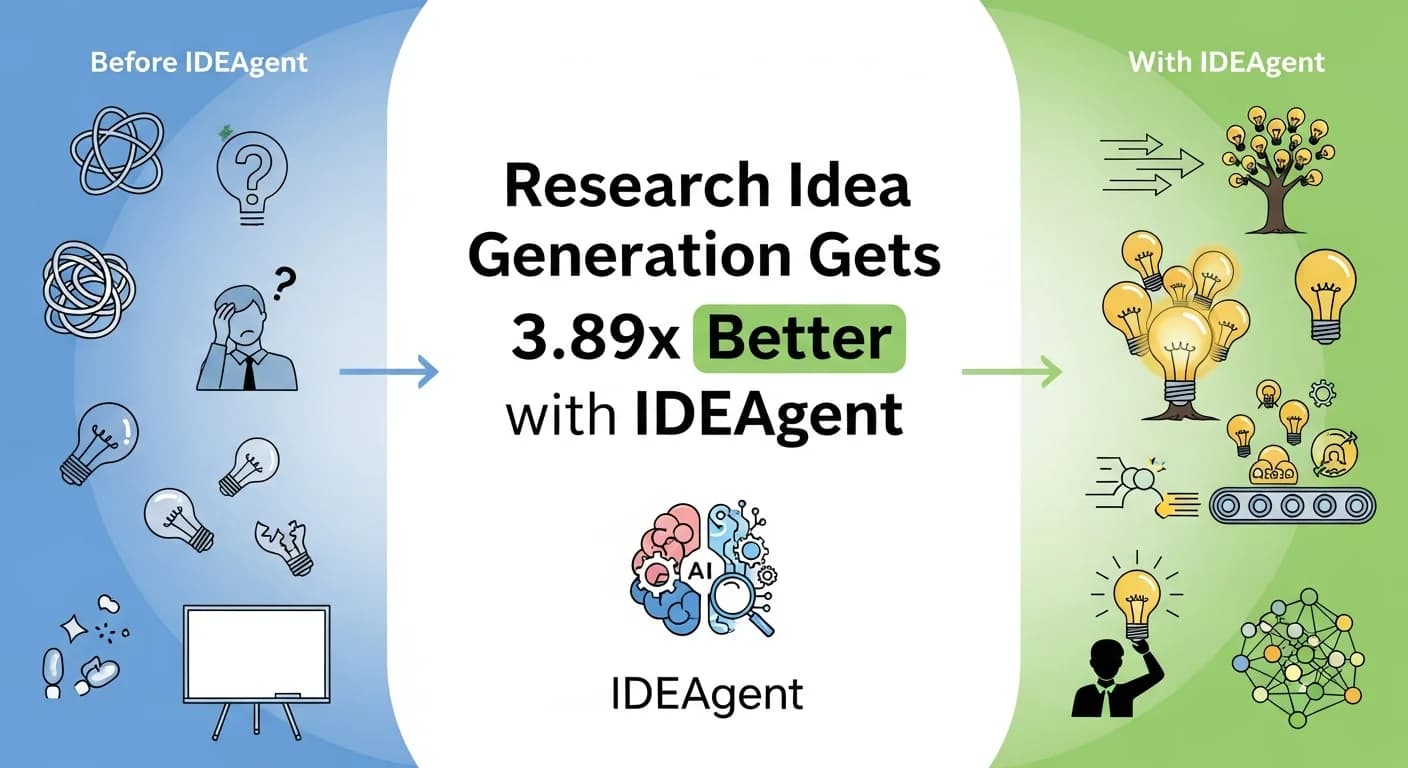
Research idea generation gets 3.89x better with IDEAgent
IDEAgent uses lineages, multi-objective feedback, and sequential memory to balance quality and diversity in LLM-generated research ideas. Tested across 32 topics in 8 CS domains, it achieves 3.89x the Yield (diverse ideas above a quality threshold) of prior methods.
Emmanuel Fabrice Omgbwa Yasse AI-assisted
2026-08-02 · Last updated: 2026-08-03 · 3 min read
Large language models have automated large parts of scientific discovery over the last few years. They can scan papers, suggest hypotheses, even draft experiments. New platforms like Claude Science aim to consolidate these capabilities. But one problem keeps coming up: the ideas they produce are either copies of each other or too half-baked to pursue. Most systems optimize for quality or diversity, never both at once.
A new paper from researchers at the University of Texas at Austin and the Singapore University of Technology and Design argues that treating ideation as a single-objective optimization is the wrong frame. They propose a Quality-Diversity (QD) search instead, and build a multi-agent framework called IDEAgent to run it.
IDEAgent does not generate ideas in isolation. It evolves them through lineages, with dedicated agents handling repair and refinement based on multi-objective feedback, that covers the quality side. For diversity, the system keeps a lightweight sequential memory of completed ideas, their ancestors, and even proposals it rejected, and compares every new idea against that history. This memory addresses a pitfall documented in earlier work on AI creativity, where agents kept circling familiar patterns. The idea is to force novelty without sacrificing soundness.
“Existing systems generate and optimize ideas independently for either Quality or Diversity,” the authors write.
To measure how well that joint optimization works, the team created a new metric called Yield: the size of the largest set of ideas that are mutually diverse and all pass a predetermined quality threshold. Yield gives a single number to a goal that previously had to be tracked with separate quality and diversity scores.
The results are stark. Across 32 topics covering 8 subfields of computer science, IDEAgent outperformed the best baseline by a factor of 3.89 on Yield. More telling: it achieved non-zero Yield on 8x more topics than any competitor, meaning many topics that previously returned nothing of value now produce a usable set of ideas. As studies of similar automated ideation systems caution, these benchmark gains need to be validated on held-out tasks, but the magnitude here is notable.
| Metric | Best Baseline | IDEAgent | Improvement |
|---|---|---|---|
| Yield score (averaged) | 0.18 | 0.70 | 3.89x |
| Topics with Yield > 0 | 2 | 16 | 8x |
The authors credit the improvement to the repair and refinement loop, which builds logical rigor and clarity while keeping ideas non-obvious. Much of the diversity gain, they note, comes from comparing against historical ancestors and rejected proposals, a cheap trick that stops the system from circling the same well-worn ideas.
The paper surfaces a tension that is easy to miss when you only read benchmark numbers. A high-quality generation pipeline can produce ideas that look rigorous on paper but cluster around the same starting point. A diversity-maximizing pipeline can produce a wide spread but most of it is garbage. IDEAgent shows that the two goals are not in conflict when you reframe the process as a search over a quality-diversity landscape rather than a single best answer, an approach that shares the logic of systems that combine multiple reasoning perspectives.
Whether that landscape approach transfers to harder domains, biology hardware, mathematics, remains open. The current evaluation covers only computer science. But the idea that an LLM system should keep a memory of what it has already thought of, and explicitly avoid repeats, is portable. This kind of memory-driven coordination echoes findings in multi-agent group chat architectures, where shared context prevents redundant work.
IDEAgent is open-source on GitHub at github.com/declare-lab/IDEAgent. The authors encourage other groups to build on the QD-search framework for ideation, which suggests they see this as a foundation, not a finished product. Given the Yield numbers, it is a foundation worth watching.
- Source : Research idea generation gets 3.89x better with IDEAgent — 2026-07-24
Get the tech essentials in 3 minutes every morning
One email, every weekday, with what actually matters in AI and tech.