AI Research
Four minds, one answer: why AI that thinks differently beat the biggest models at humanity's hardest test
PoTRE breaks inference into four agents working in parallel, then reconciles their answers dynamically. It hit 49.92% on Humanity's Last Exam, beating the previous official best. The approach works with fewer tokens than scaled-up baselines.
Emmanuel Fabrice Omgbwa Yasse AI-assisted
2026-07-24 · Last updated: 2026-08-03 · 4 min read

The most accurate AI system on Humanity's Last Exam does not think like most people. It thinks like four different people. One of them looks for mistakes in everything the others produce. One plans far ahead before writing anything. One explores many paths at low resolution. One just answers directly. A final layer decides which perspective to trust, or whether to blend them.
The framework, called PoTRE (Poly-Topological Reasoning Ensembles), was introduced in a preprint posted to arXiv on 22 July 2026. Its core insight is that complex reasoning problems benefit from cognitive heterogeneity, multiple reasoning modes running in parallel, rather than scaling a single model to larger sizes or giving it more inference tokens, a claim also explored in work on parallel agent architectures.
The headline number is hard to ignore: 49.92% accuracy on Humanity's Last Exam (HLE), a benchmark designed to be extremely difficult, drawing on graduate-level questions across physics, mathematics, law, medicine, and philosophy. The previous official best, achieved by a much larger homogeneous model, is now surpassed. The paper does not name the prior record holder, but the margin is significant enough that the authors call it a new state of the art.
PoTRE also scored on ARC-AGI-2, a visual reasoning benchmark that rewards adaptation to novel patterns, and PRBench Finance, which tests planning and constraint satisfaction under domain rules. The paper reports that the heterogeneous architecture yields improved results using similar or fewer total inference tokens compared to homogeneous baselines that are heavily scaled, a direct efficiency argument that runs counter to the industry trend of building ever-larger models. Recent adversarial benchmarks suggest similar structural limits; see the 49% ceiling on hierarchical rule application.
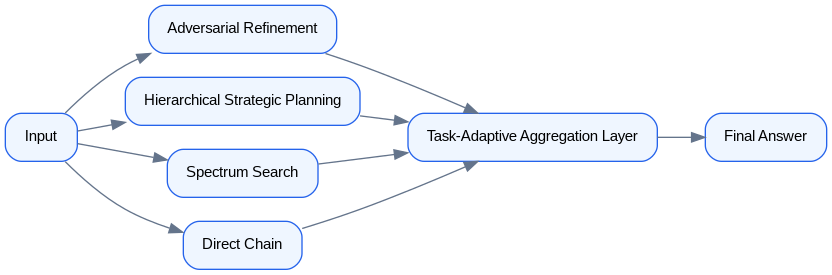
How PoTRE works: four agents, one reconciler
The framework decouples inference into four specialized agents:
- Adversarial Refinement Agent, generates an initial answer, then actively searches for flaws in it. This is not a simple review pass; the agent is trained to play devil's advocate against its own output, producing counter-arguments and edge cases the other agents might miss.
- Hierarchical Strategic Planning Agent, decomposes the problem into subgoals first, then solves each subgoal in sequence. This agent is designed for tasks that require long-horizon planning, where a direct answer risks skipping critical intermediate reasoning.
- Spectrum Search Agent, explores multiple solution paths at a coarse resolution, trading depth for breadth. It is meant to find promising directions quickly rather than produce a polished final answer.
- Direct Chain Agent, produces a standard chain-of-thought answer, serving as a baseline that the other agents must outperform. It is the simplest agent and the fastest.
The outputs from all four agents feed into a Task-Adaptive Aggregation Layer, which has three modes: final candidate selection (pick one agent's answer), semantic synthesis (combine the best parts of multiple answers), or neuro-symbolic verification (run a logical consistency check, then pick or blend). The aggregation layer is trained per task family, meaning the mixture of agents changes depending on whether the problem is a logic puzzle, a mathematical proof, or a financial planning exercise, resonating with the ideas behind multi-agent coordination in group-chat environments.
This is not multi-agent in the sense of agents talking to each other in a loop. Each agent produces an independent answer; there is no cross-agent discussion. The diversity comes from parallel, decoupled reasoning, not from dialogue.
Why this matters beyond the benchmark score
The efficiency claim is the most provocative part of the paper. Most work on improving reasoning accuracy has treated inference as an expensive resource: use more tokens, run more searches, sample more candidates. PoTRE suggests that the structure of reasoning matters more than the number of tokens spent. If four small, focused models can outperform one giant model at lower token cost, the scaling orthodoxy that has dominated AI labs for the past three years takes a hit. Similar questions about cost-efficiency have emerged in LiveBench's diminishing returns analysis.
There are caveats. The paper does not disclose the exact base model behind each agent, nor the token count comparison in enough detail to replicate the efficiency claim independently. And 49.92% on HLE, while state of the art, means the system still fails half the time, this is not a solved problem. But the direction of travel is new.
PoTRE also raises a question deeper than benchmarks: if heterogeneous reasoning beats homogeneous scaling, should AI architectures stop chasing one universal reasoning mode and instead embrace a permanent division of cognitive labor? The paper's architecture is not an ensemble of different models grouped after the fact; it is a designed heterogeneity from the ground up. That design choice, not the benchmark score, may end up being the paper's lasting contribution. For more on how structured reasoning can outperform raw scale, see the game engine perspective on world consistency.
Get the tech essentials in 3 minutes every morning
One email, every weekday, with what actually matters in AI and tech.