AI image generation
Reve 2.1 hits second on Arena with a tenth of the compute
Reve 2.1 claims second place overall on the Arena leaderboards while trained on less than a tenth of the compute of the labs around it. The company also details 4K output, addressable regions, and multilingual text rendering.
Emmanuel Fabrice Omgbwa Yasse AI-assisted
2026-08-05 · 3 min read
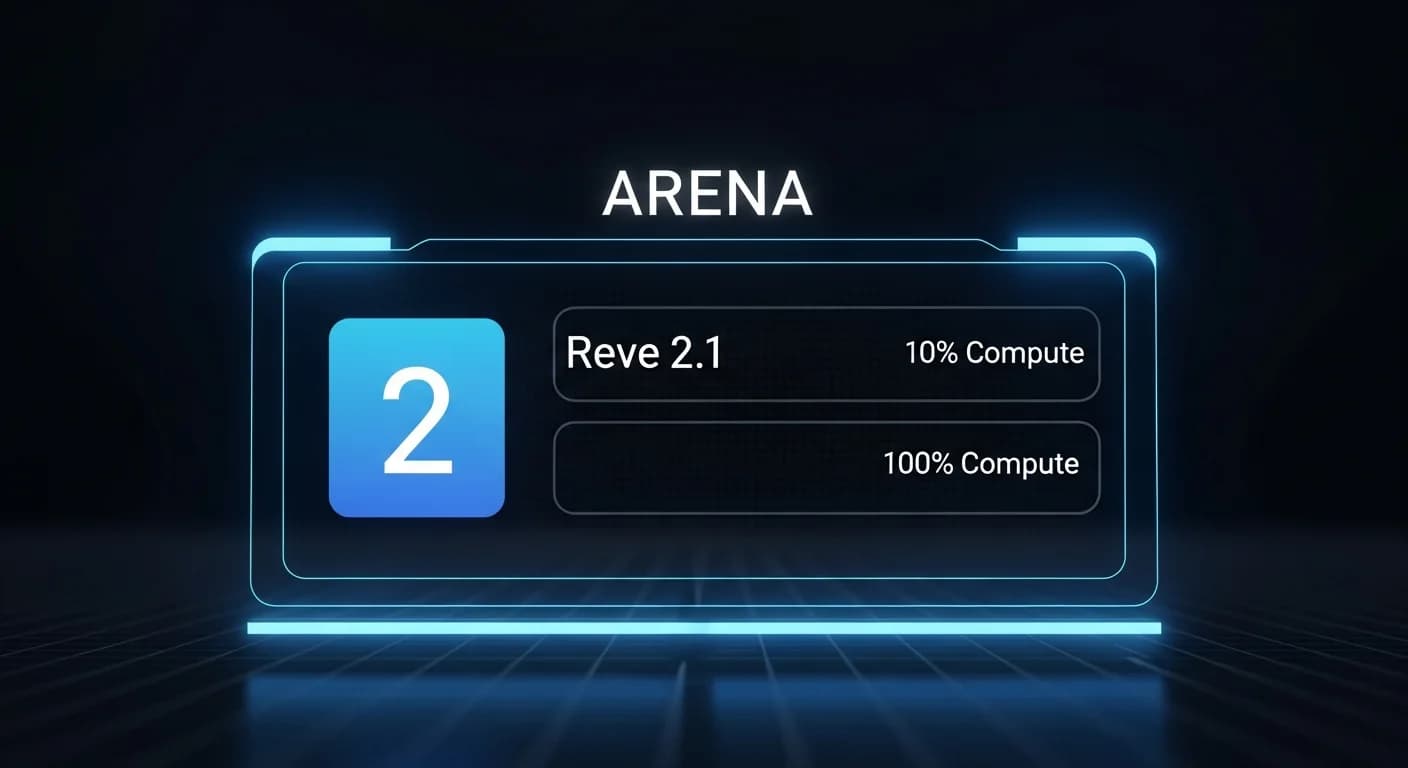
Reve is making an efficiency claim that runs against the spending curve of its bigger competitors. The independent image model lab says Reve 2.1 holds second place overall on the Arena and Design Arena leaderboards, trained with less than a tenth of the compute of the labs ranked above and below it. The company also says the model keeps its standing as the top 4K model in the world and the highest-ranked independent foundation image lab on both platforms. On Reve's own numbers, that ratio is exactly what teams funding much larger training runs are watching for. Smaller labs have tested the limits of lean training before: volunteers trained NanoColibri's 2.7B MoE from blank weights for about $200.
Reve 2.1 arrived July 9, about a month after 2.0, and the company frames it less as a rewrite than as a sharpening of an existing bet. The model plans layouts before it renders and reasons about how elements in a scene relate. Output runs at full 4K, which the company counts as 16 megapixels. Text rendering inside images now extends to foreign scripts, a category where image models have a long record of mangled letters, and one that Zhipu AI's GLM-Image only recently cracked for Chinese.
The compute gap
Efficiency is the headline. Reve says 2.1 reclaims its spot as second overall, behind only the top-ranked lab, while consuming less than a tenth of the training compute of the labs around it. The comparison separates labs that can iterate in months from labs whose training runs take that long just to schedule. It also lands at a moment when the industry's usual answer to compute costs is to buy more GPUs: multi-gigawatt deals keep closing while nobody owns keeping them busy.
What the post does not provide: the raw compute figures, a breakdown of the leaderboard votes, or the size of the gap to first place. The claim is the ranking and the ratio, and not much in between. Taken at face value it is an extraordinary efficiency result. The missing numbers are less a reason for doubt than a boundary on what the result can support.
What the release claims
| Claim | As stated by Reve |
|---|---|
| Arena standing | Second overall; top 4K model; highest-ranked independent image lab |
| Training compute | Less than a tenth of the labs ranked above and below |
| Output resolution | Native 4K, 16 megapixels |
| Release cadence | About a month after Reve 2.0 |
Control as the point
The feature list is short and pointed. Precision editing treats every element as addressable, so a single region can be changed and re-rendered while the rest of the image stays put. Layout planning shows up in dense, complicated scenes, where the model sorts out structure and spatial relationships before rendering. Output stays at native 4K through iterative edits, which matters for commercial work where images get cropped, zoomed, and inspected.
The multilingual upgrade pushes the model toward production design rather than one-off generation. The point is legible, dense type set inside the image, in scripts that have historically come out garbled.
The layout bet
Reve presents this release as the payoff of a two-year bet: images should be built like code, with hierarchical, structured regions instead of free-form pixels. The company points to an essay, "The Layout Bet," that describes the large layout model behind 2.1 and the extended reasoning context it enables. The reasoning-before-rendering instinct is showing up elsewhere in generation research: PhiZero teaches video AI to think in physics before it renders.
That philosophy runs through the release: planning, addressable regions, a reasoning step before the pixels. For an independent lab, the bet has an economic side too. Staying competitive on a fraction of the compute its neighbors use compounds across every future release.
The open question is how long the ranking holds. Leaderboards shift as new models land and voters change their habits, and one release does not establish a trend. The wider benchmarking field has already seen static tests collapse and get replaced. What 2.1 establishes, on the company's own account, is that a lab running on a fraction of the compute can still finish near the top. The labs ranked above and below it will have their own updates in the coming months.
Get the tech essentials in 3 minutes every morning
One email, every weekday, with what actually matters in AI and tech.