Agentic Finance
Why returns alone lie: NextFund opens the black box on AI trading agents
NextFund records every decision an AI trading agent makes in live markets, letting users compare models, inspect rationales, and diagnose failures. An eight-LLM test across US, China, and Hong Kong equities shows that similar intermediate signals can diverge into starkly different portfolio behaviors, and that quarterly rankings flip depending on which metric matters most.
Emmanuel Fabrice Omgbwa Yasse AI-assisted
2026-07-27 · Last updated: 2026-08-03 · 6 min read
Large language models are writing trades now, not just reading earnings reports. The tools for judging whether they do it well have stayed stuck in the dark ages: static quizzes and terminal portfolio returns that reveal nothing about how an order got placed. A platform published this week by Paradoox AI Research aims to change that. It lands at a moment when the industry is waking up to the gap between a model's demo performance and its real-world behavior: frontier models score 96% on SWE-bench Verified but barely clear 23% on private enterprise code, per our coverage of that benchmark-to-production divide.
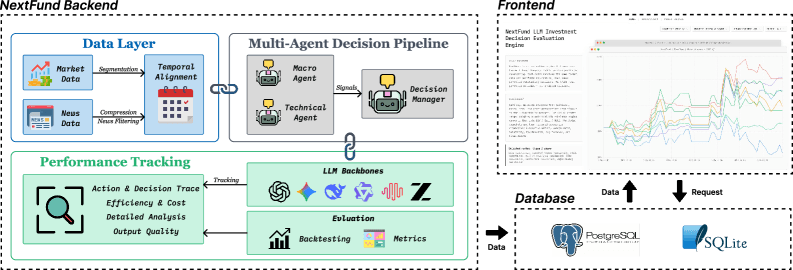
NextFund couples live market feeds across Hong Kong, the US, and China A-share equities with persistent, end-to-end logging of every observation, analyst signal, and executed action. It also ships a web-based Trading Arena that lets users drill from leaderboard scores down to the textual rationale behind a single day's buy or sell order. The demo is live at paradoox.cn/nextfund/.
Three gaps the platform fixes
The paper details three structural problems that existing agentic finance evaluation systems share. Most benchmarks test static knowledge or report only final profit and loss; intermediate evidence and execution steps stay invisible. When an agent mishandles a tool or drifts from its mandate, developers often cannot tell whether the fault lies in retrieval, analysis, synthesis, or execution. And decision logs, error cases, and tool-call histories are routinely discarded after a run, so institutions accumulate little reusable data for later prompt revision or model adaptation. This is part of a broader pattern in AI agent evaluation: results depend heavily on what you measure. The Messier corpus, 957,253 records across 30 benchmarks, shows agents surging on some tasks while stalling where enterprises need them, per the audit behind that finding.
NextFund tackles all three by embedding write-through tracking directly into the multi-agent workflow. Every time an analyst emits a signal or the decision manager commits a target allocation, the record, along with its justification and prompt context, is persisted immediately under a shared, time-stamped clock.
What the first live tests reveal
The authors ran eight frontier LLMs, DeepSeek-V4-Flash, DeepSeek-V4-Pro, Gemini-3.5-Flash, GLM-5.1, GPT-5.4-Mini, Kimi-K2.6, MiniMax-M3, and Qwen3.5-Flash, through the same multi-agent stack, universe, and constraints across 2026 Q1 and Q2. The results are far more nuanced than any single metric can capture.
In US equities during Q1, every model lost money. Kimi-K2.6 came closest to breaking even at -2.89% return, while also recording the best volatility (5.04%) and drawdown (-4.39%). DeepSeek-V4-Flash had the least negative Sharpe ratio. By Q2 the book reversed: Qwen3.5-Flash led return at 12.23%, yet GPT-5.4-Mini dominated on Sharpe (3.16), volatility (13.03%), and drawdown (-6.36%). A higher-return model is not automatically the most efficient, the most stable, or the least active. The same skepticism applies to the risk numbers themselves: an audit found distributional RL agents systematically fabricate risk trade-offs, per the new distributional-RL audit.
| Metric | Q1 2026 | Q2 2026 |
|---|---|---|
| Return | Kimi-K2.6 (-2.89%, best of a losing field) | Qwen3.5-Flash (12.23%) |
| Sharpe | DeepSeek-V4-Flash (least negative) | GPT-5.4-Mini (3.16) |
| Volatility | Kimi-K2.6 (5.04%) | GPT-5.4-Mini (13.03%) |
| Max drawdown | Kimi-K2.6 (-4.39%) | GPT-5.4-Mini (-6.36%) |
Cross-model comparison on the same input stream yields an even more striking finding. When comparing Kimi-K2.6 with Qwen3.5-Flash on US Q1 data, analyst signals agreed on roughly 92.9% of cases, meaning both models produced similar specialist views from the same prices and news digests. But final buy/sell/hold actions agreed on only 36.4% of ticker-days. Kimi-K2.6 remained conservative (396 holds, 29 buys, 23 sells), while Qwen3.5-Flash traded far more aggressively (152 holds, 160 buys, 136 sells). Similar intermediate evidence does not imply similar portfolio behavior, a failure mode that terminal P&L numbers alone cannot surface.
The pattern holds across markets. In China A-shares, GLM-5.1 led return in Q1 at 9.76%, while Kimi-K2.6 led Sharpe. In Hong Kong, Kimi-K2.6 posted a 30.94% return in Q1 with a Sharpe of 3.21, but Gemini-3.5-Flash took the lead in Q2 at 23.41% return. The same protocol yields qualitatively different leaderboards in each venue, so cross-market tracking is necessary for fair comparison.
Arena-style inspection as a diagnostic tool
Where NextFund breaks most ground is in the inspection layer it provides. The Model Arena lets users select a market, an evaluation period, and a set of model runs to compare side by side. Equity curves, Sharpe, volatility, drawdown, and turnover are presented together, and each run is linked to its full execution trace. A user who notices, say, that one model has higher return but higher turnover can click into the Detail Tracking view to see whether the difference arises from more frequent actions or from different allocation choices.
At the decision level, each trading day and ticker is linked to specialist outputs, portfolio-manager decisions, executed actions, and textual rationales along a shared timeline. The aligned traces let inspectors see whether two agents diverged during upstream analysis, decision synthesis, or execution. The authors illustrate this with a concrete Q1 comparison: Kimi-K2.6's conservative stance appears to be driven not by different analyst signals but by a different synthesis step. The decision manager in Kimi-K2.6 weighted risk over conviction, while Qwen3.5-Flash's manager weighted conviction over risk. Attributing a failure to the right stage is the hard part of diagnosing agents, and it is the same problem AgentRCA tackles in zero-shot root-cause analysis, where the diagnosis explains its own reasoning, per our coverage of AgentRCA.
What is still missing
The current release centers on equity rebalancing across three markets with a fixed analyst roster. Support for derivatives, multi-currency hedging, and richer compliance rules is left to future work. Even with synchronized clocks and structured logs, textual rationales may remain incomplete or only loosely aligned with latent model computation. Human review is still required for consequential decisions. Live evaluation also depends on third-party market feeds whose licenses may prohibit redistributing raw data; public artifacts emphasize schemas, traces, and interfaces rather than proprietary market dumps.
NextFund is intended as an auditing and comparison aid, not an investment advisor. The authors are explicit that demonstration outcomes should not be the sole basis for investment or regulatory decisions. Users should examine provenance, decision histories, and risk metrics, and read leaderboard results as comparative evidence under a stated protocol, not as forecasts of future performance.
A substrate for systematic improvement
Perhaps the most consequential design choice is that traces are complete, time-aligned, and reusable. The same substrate that supports cross-model comparison and failure attribution also provides material for prompt revision, supervised adaptation, and reinforcement learning. Historical decisions and digests can be read back into later runs as memory, closing the loop between recording and reasoning. This circular approach, record, analyze, revise, is how the industry moves beyond static benchmarks, and agentic RL is already converging on the same idea: SEED lets an LLM analyze its own past trajectories and distill reusable lessons from them, per our coverage of that self-evolving distillation fix.
As LLM-based agents move from research demos into portfolio management workflows, the gap between a model's promise and its auditable behavior will become the central governance question for institutional adopters. NextFund does not solve that question, but it provides the first infrastructure for asking it systematically, and that alone may be its most valuable contribution.
Get the tech essentials in 3 minutes every morning
One email, every weekday, with what actually matters in AI and tech.