AI Architecture
The Model Race Has a Second Track Now
Anthropic capping Claude Opus 5's cyber skills, Sakana's Fugu orchestrating model swarms, and Claude Code's new multi-model routing all point to the same shift: the next competitive edge in AI systems is orchestration, not just raw model size.
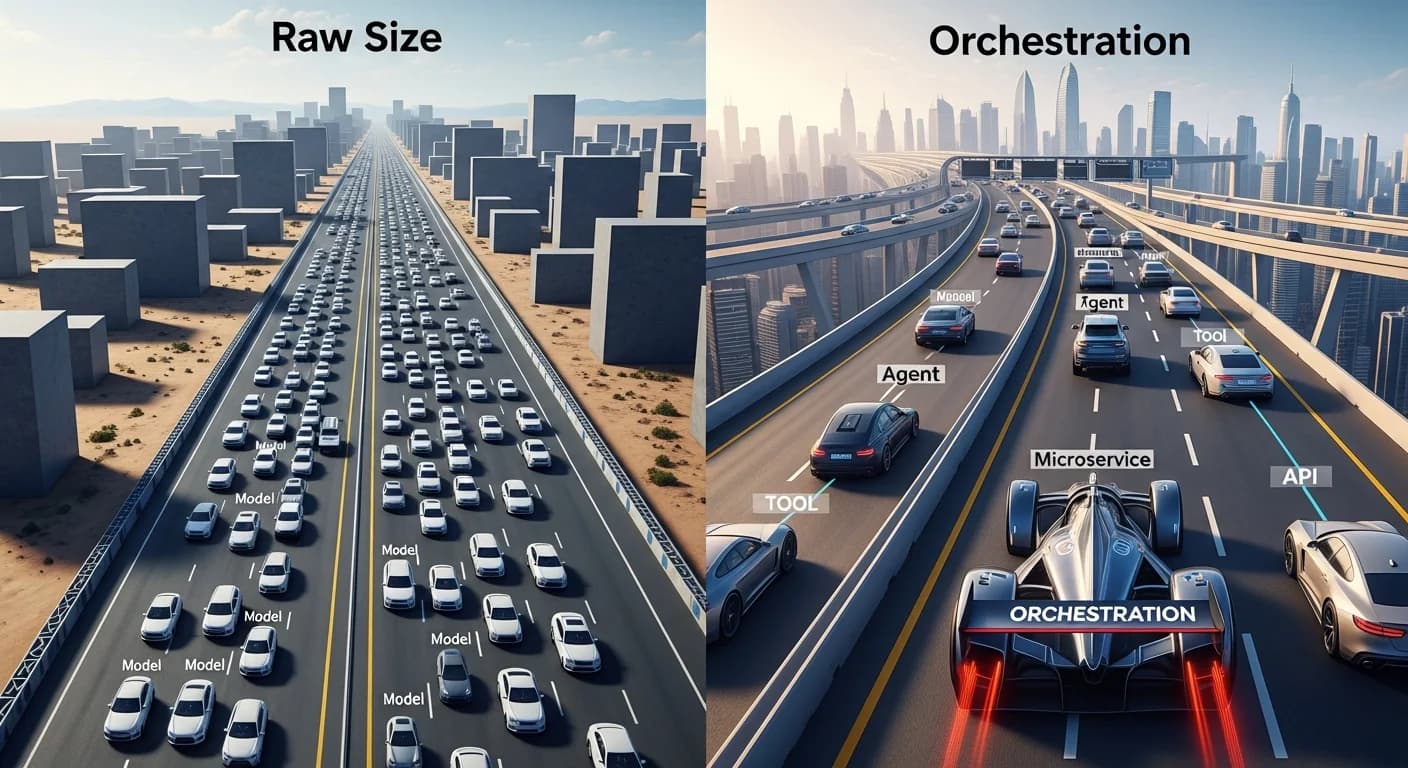
Anthropic capped Claude Opus 5's cybersecurity capabilities on purpose. Sakana AI built Fugu to orchestrate a pool of open models instead of training one giant one. And Claude Code, Anthropic's own coding tool, just gained the ability to route a task across a whole roster of models rather than sending everything to a single flagship. None of these are the same product, and none of the teams behind them coordinated. But put side by side, they describe the same bet: the next gains in AI systems come less from making one model bigger, and more from deciding, per task, which model or which part of a model should even be involved.
The swarm makes the calculus explicit
The comparison between Claude Opus 5 and Sakana's Fugu lays the trade-off out plainly. Opus 5 delivers near-flagship performance at roughly half the token cost of the top-tier alternatives, a strong deal for most workloads. But its cybersecurity skills are deliberately capped, and on tasks that need that capability, Fugu's approach of orchestrating multiple smaller open models catches up to or beats frontier benchmarks by spreading the work across specialists instead of asking one generalist to do everything. Which one wins depends on the task, the budget, and how much orchestration complexity a team is willing to own. That's a genuinely new kind of purchasing decision: not "which model is smartest," but "which routing strategy fits this job."
Claude Code's new integration with Fugu takes that logic and puts it inside a tool millions of developers already use daily. Developers can now pull a pool of specialized models into Anthropic's own coding environment, rather than being locked into whatever Claude happens to be running that week. The detail worth sitting with is who shipped this: not a startup trying to differentiate, but the company that makes the flagship model, building a door for competitors' models to walk through its own product. That is a tell about where the company thinks the market is heading. Model routing stopped being a hack developers built for themselves and became a platform feature a frontier lab ships by default.
The same logic, one layer down
The pattern isn't limited to routing between whole models. CLSA's approach to sparse attention applies the identical idea inside a single model's inference pass: instead of computing a fresh routing decision at every layer, wasteful and repetitive, it computes one routing pass per sequence and reuses it, cutting KV-cache overhead while preserving token-level selectivity. The reported gain, up to 17.1x throughput at 128K context, comes from recognizing that a full recomputation at every layer was solving a problem that a single well-placed decision could handle just as well.
That's the throughline across all three stories. Whether the question is which model handles a whole task, which specialized system handles a security scan, or which attention heads get computed at a given layer, the industry is converging on the same answer: don't run everything through the same expensive path by default. Decide once, route accordingly, and only pay the full cost where it actually buys you something. Scaling up a single model is still happening, but it is no longer the only lever anyone is pulling, and increasingly not the first one.
What this means for buyers
The practical upshot for anyone deploying these systems is that "which model should we use" is becoming the wrong question to ask in isolation. The better question is which mix, and whether the orchestration overhead is worth it for a given workload. Fugu's multi-agent approach adds real complexity, more moving parts, more places for a pipeline to break, more surface area to monitor. Opus 5's simplicity is a feature, not a limitation, for teams that don't need the specialized ceiling Fugu can reach. There is no universal winner here, and that is precisely the point: routing decisions are inherently local to the task, which is a very different world from the one where everyone just waited for the next flagship release.
Get the tech essentials in 3 minutes every morning
One email, every weekday, with what actually matters in AI and tech.