AI economics
The Claude vs Fugu calculus: when a swarm beats a single model
Anthropic's Claude Opus 5 delivers near-flagship performance at half the token cost but intentionally caps cybersecurity capabilities. Sakana AI's Fugu platform orchestrates multiple open models to match frontier benchmarks. The decision hinges on task type, budget, and tolerance for complexity.
Emmanuel Fabrice Omgbwa Yasse AI-assisted
2026-07-27 · 4 min read
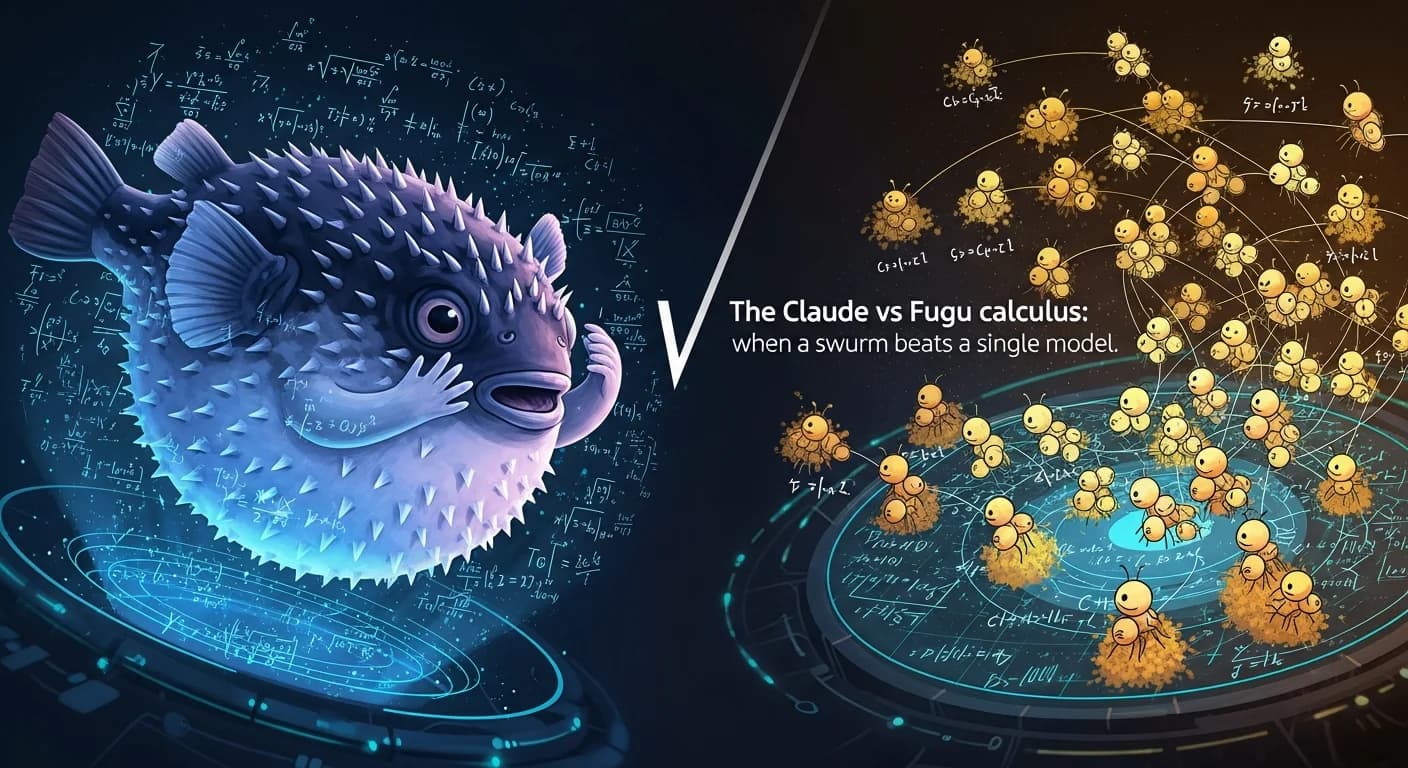
The most interesting AI pricing question this summer is not which model leads on a benchmark leaderboard. It is whether a single, polished model like Anthropic's Claude Opus 5 gives you more value for your dollar than a modular swarm of open models coordinated by Sakana AI's Fugu platform. The answer depends on what you are actually building, according to Claude Opus 5's benchmark results.
The cost-performance equation
Anthropic's Claude Opus 5 nearly matches its flagship Fable 5 across coding and knowledge benchmarks while costing 50% less per token. That alone makes it a strong default for general-purpose work, a dynamic that closely mirrors the cost dynamics seen on the LiveBench leaderboard. But the calculus gets messier when you factor in Claude Sonnet 5, which Anthropic made the default model for Free and Pro plans. Priced at $2 per million input tokens through August 2026, Sonnet 5 closes the gap to Opus-class models on agentic tasks like autonomous browsing and multi-step reasoning. For many teams, the cheaper Sonnet might already be enough.
On the other side, Fugu does not sell a single model. It sells access to an orchestration layer that selects, combines, and routes tasks across multiple specialized open-weight agents. The billing is usage-based and provider-agnostic. Sakana has argued that model choice should be the router's problem, not the developer's. That philosophy means you can swap in newer models as they appear without renegotiating a subscription, but it also means you pay for overhead, the orchestration itself adds latency and cost per request.
The cyber blind spot
Anthropic ships Claude Opus 5 with cybersecurity safeguards enabled by default. The company positions this as a safety feature, but it is also a deliberate capability cap. If your work involves vulnerability research, red-teaming, or offensive security tools, Claude will block or refuse tasks that Fugu-Cyber handles readily. Sakana's Fugu-Cyber multi-agent system matches frontier cyber models like GPT-5.5-Cyber and Mythos-Preview on key benchmarks, according to the company's announcement. This echoes a broader pattern where frontier cyber evaluations have uncovered blind spots in even the largest models.
Claude does have a specialized variant for cybersecurity, Claude Mythos 5, whose export controls were lifted for US customers in July 2026. But Mythos sits outside the standard Opus pricing and requires a dedicated account. For teams that need cyber capabilities baked into their general-purpose subscription, Fugu-Cyber offers a more integrated path.
Multi-agent orchestration: flexibility vs control
Fugu's swarm approach draws strength from modularity. Its collaboration with NVIDIA's Nemotron family adds specialized models strong in coding, tool calling, and instruction following, a design detailed in Sakana's integration of Nemotron models. The system feeds performance data back to improve both the orchestration layer and the models themselves. If one agent underperforms, the router can shift work to another without a user noticing. That provider independence is attractive for organizations that want to avoid vendor lock-in or that need to run sensitive workloads on self-hosted models.
Claude, by contrast, offers a stable single-model ecosystem. You pay a predictable subscription, you get a consistent API, and you do not manage routing logic. For teams that value reliability over optionality, that simplicity has real operational value. Anthropic positions Sonnet 5 as its most agentic Sonnet yet, capable of planning and executing complex multi-step tasks autonomously. Early testers describe a model that finishes where predecessors stalled, correcting its own output without intervention. That kind of autonomy reduces the need to assemble a toolchain of separate agents, a finding that aligns with recent work on self-supervised learning in agents.
Decision framework: when to renew, when to switch
No single answer fits every team. The choice comes down to three variables. For cybersecurity tasks, Fugu-Cyber offers benchmark-competitive capability without capability caps, whereas general coding and agentic automation can rely on Claude Sonnet 5 at $2 per million tokens. Budget structure also matters: Claude subscriptions offer predictable monthly costs, while Fugu's pay-per-orchestration model can be cheaper for bursty workloads but harder to forecast for steady usage. Finally, vendor risk tolerance plays a role: organizations that want independence from any single provider, or that need to run models on their own infrastructure, will find Fugu's modular architecture more compatible. Teams that prefer a single relationship and a proven API will stick with Claude.
The strongest signal may come from the trajectory: Claude Sonnet 5 narrows the gap to Opus on agentic tasks, while Fugu keeps adding specialized agents. The gap between a single model and a swarm is shrinking from both sides. For most enterprises, the question is not which is better in isolation, but which fits the workflows they already have.
Get the tech essentials in 3 minutes every morning
One email, every weekday, with what actually matters in AI and tech.