Multi-Agent Engineering
Qoder's multi-agent experiment: 60% fewer mistakes, but at what cost?
An analysis of Alibaba Cloud's Qoder Experts Mode, which deploys specialized AI agents as a coordinated team. Claims of significant error reduction are scrutinized against real-world use cases and the trade-offs of multi-agent complexity.
Emmanuel Fabrice Omgbwa Yasse AI-assisted
2026-07-31 · Last updated: 2026-08-03 · 2 min read
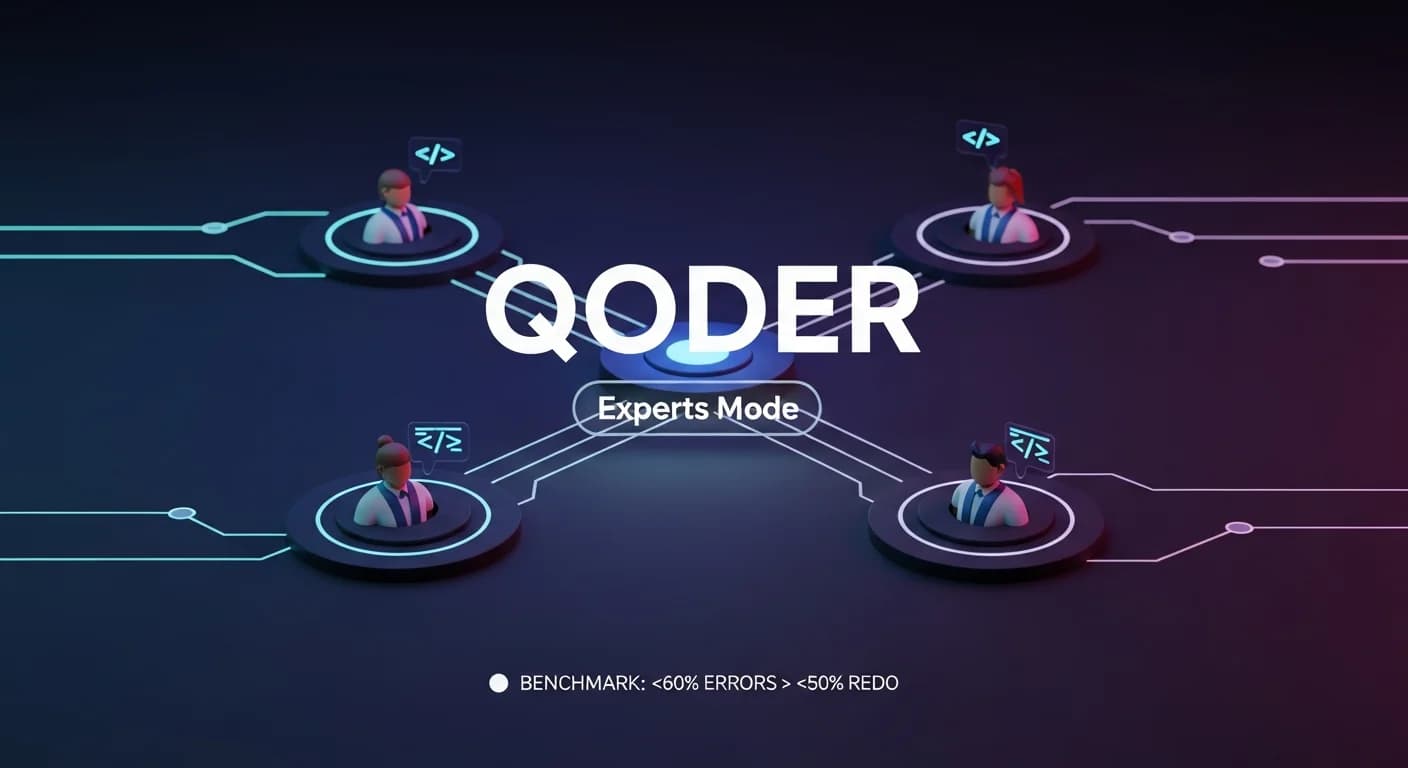
For months, AI coding tools have largely followed the same formula: prompt, generate, repeat. Alibaba Cloud's Qoder is testing a different approach with Experts Mode, a system that breaks complex tasks into pieces and hands each piece to a specialized agent working in parallel with the rest, a strategy that new research identifies as the next coordination battleground.
The promise of multi-agent coding
Instead of one model grinding through every step sequentially, Experts Mode assembles a virtual team. A Team Lead agent decomposes the requirement, then routes work to Frontend, Backend, QA, and Review agents, each calibrated for their domain. The company says this reduces context switching and redundant inference, producing what it claims are more accurate results than any single agent could achieve. This builds on the visibility-first philosophy Qoder introduced earlier, by extending it to team-level coordination, similar to how Claude Code routes tasks to different models.
Benchmarking the 60% improvement
Qoder's internal benchmarks on complex tasks such as full-stack development, cross-language refactoring, and feature implementation show a 60% lower mistake rate, 50% fewer redo tasks, and an 11.6-point increase in success rate. The company notes that costs remain flat or decrease compared with a single-agent baseline on the same tasks. These numbers are impressive, but they come from Alibaba's own test suite, not an external evaluation. The broader lesson, echoed in critiques of HumanEval's narrow scope, applies here: curated tests tend to favor the system being tested, and production conditions introduce noise no benchmark can fully capture.
Real-world scenarios: where experts mode shines
The three use cases Qoder highlights are carefully selected. Building a user management module that previously took days can now be delivered in hours through parallel implementation and simultaneous test writing. Debugging a performance bottleneck across microservices becomes a collaborative trace through logs and call chains. Researching the feasibility of GraphQL migration gets input from multiple perspectives at once. Each scenario involves multiple files or services, clear subproblems, and measurable outcomes. These are exactly the kind of tasks where multi-agent orchestration should add value, and where single-agent tools typically degrade as context windows fill up. However, the jump from demo to daily driver is not trivial. Production use often reveals failure modes that demos skip, such as agent disagreement on interfaces or cascading errors when one specialist misinterprets a requirement, a pattern known as the planning trap in agentic systems.
Limitations and the solo-agent option
Alibaba acknowledges that for simple file edits, the
Get the tech essentials in 3 minutes every morning
One email, every weekday, with what actually matters in AI and tech.