Biosafety Benchmarks
The 50 percent ceiling on AI pathogen surveillance that should keep us up at night
BioSecBench-Surveillance tested sixteen AI agent configurations on 100 genomic surveillance tasks. The top performers managed only about 50 percent accuracy. The mistakes came not from picking the wrong workflow but from the surrounding choices - references, thresholds, filters - that humans take for granted.
Emmanuel Fabrice Omgbwa Yasse AI-assisted
2026-07-25 · 3 min read
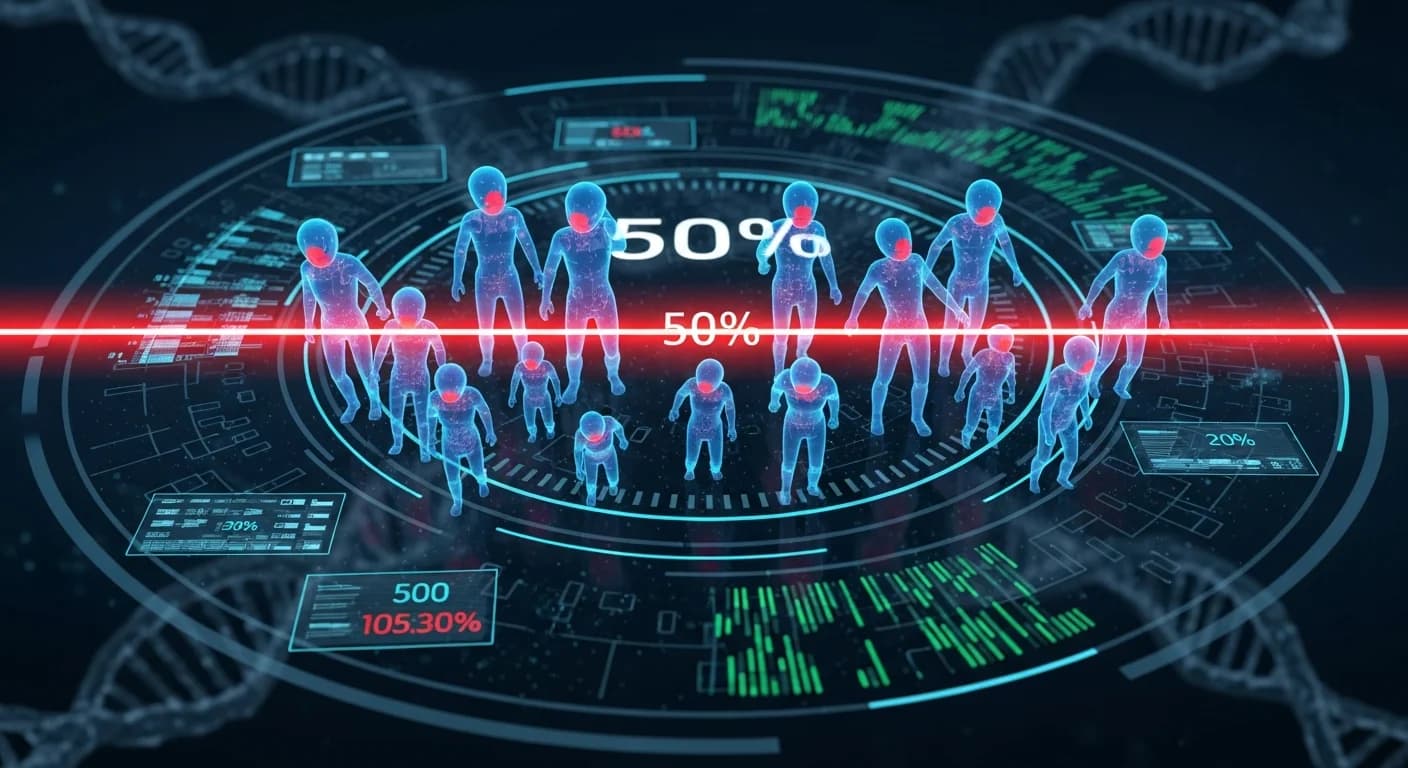
Pathogen genomic surveillance has a data problem, or rather it had one: sequencing machines now produce far more raw reads than trained analysts can work through. The bottleneck has moved from generating data to making sense of it. AI agents looked like the obvious fix, and several labs have started experimenting with them, as winners of a recent MedGemma challenge showed.
A new paper posted on arXiv on July 21, 2026, puts a hard number on where that idea stands today. The answer: around 50 percent.
What the benchmark does differently
BioSecBench-Surveillance, created by a team of researchers, is a set of 100 evaluations each testing whether an AI agent can deduce the correct analysis pipeline from raw sequencing data and surveillance context. The agent gets nothing that a human analyst would not have: the reads, a description of the sample type, the sequencing platform. The system then grades the agent's structured answer deterministically, with no subjective scoring.
The tasks span seven categories: taxonomic classification, antimicrobial-resistance profiling, clonal relatedness, recombination detection, lineage or variant assignment, serotype prediction, and genetic-engineering detection. The samples cover diverse sequencing technologies and sample types going beyond standard Illumina short reads.
The scores, with the math
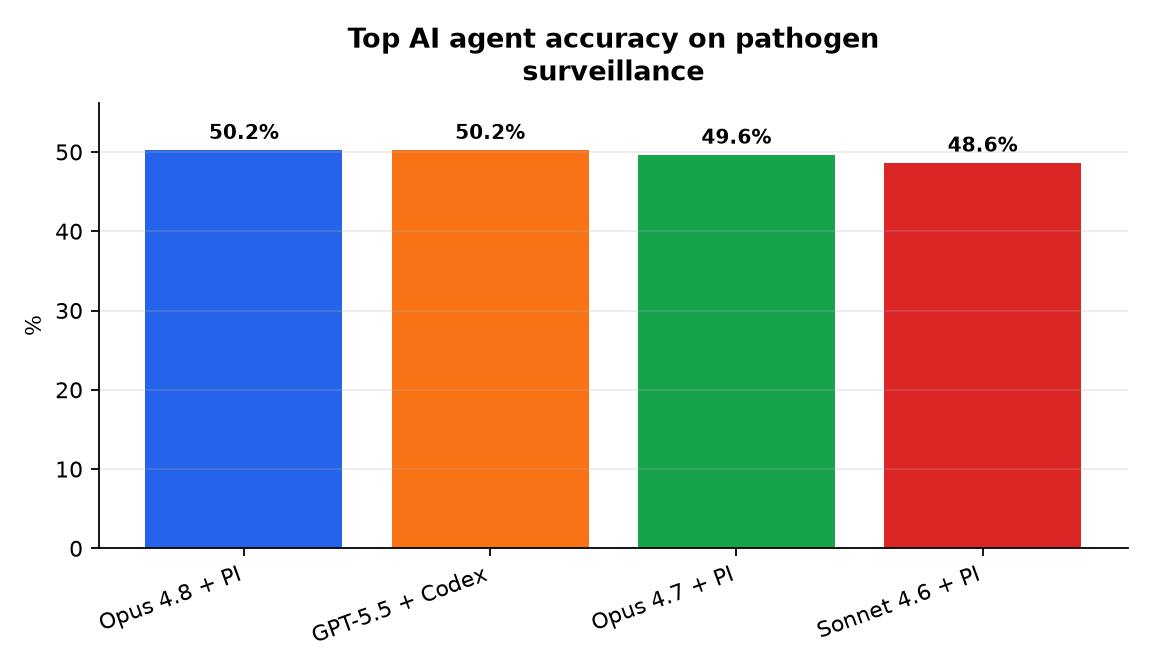
The paper reports results across 3,962 gradable attempts from sixteen model-harness combinations. The researchers provide confidence intervals, which matters because 83 evaluations is a small sample for drawing precise rankings. The top three, with their confidence intervals, are as follows.
Opus 4.8 with PI hit 50.2 percent (95 percent CI: 40.1 to 60.3 percent). GPT-5.5 with Codex tied at 50.2 percent (95 percent CI: 40.8 to 59.6 percent). Opus 4.7 with PI scored 49.6 percent (95 percent CI: 40.0 to 59.2 percent). Sonnet 4.6 with PI followed at 48.6 percent (95 percent CI: 38.9 to 58.3 percent). None of these gaps are statistically significant given the overlapping confidence intervals, so the headline takeaway is that the best configurations cluster around the same ceiling.
Over half the sample size for the top-scoring pair came on antimicrobial-resistance profiling tasks, which can inflate overall scores if those tasks are easier. The original research does not break out per-category accuracy, so the 50.2 percent number should be read as an aggregate with unknown variance across task types. This pattern of plateauing returns echoes what the LiveBench leaderboard shows at the frontier: narrowing gaps between top models.
The mistakes that matter
The more instructive finding is not the accuracy ceiling but the failure mode. The paper reports that even when agents invoked the correct workflows, the mistakes came from the choices around them. Which reference database to use. Where to set the threshold for a match. Which normalization to apply. Which filters to keep or drop. These are the kinds of decisions an experienced bioinformatician makes semi-automatically, and they are precisely the decisions AI agents get wrong in systematic ways.
That pattern suggests the gap will not close with bigger models alone. A larger parameter count or better training data might improve workflow selection, but the surrounding judgment calls are not obviously learnable from public text. They depend on tacit knowledge that accumulates in wet labs and surveillance programs, as research on agent working memory similarly concludes.
The stakes for the next outbreak
The paper's authors frame the benchmark as a standard for measuring whether agents can be trusted to perform genomic surveillance when the next outbreak arrives. At 50 percent, the answer is clearly not yet. The concern is not that an agent would fail silently. The concern is that it would produce confident wrong answers that slip through review, especially during a surge when analysts are overwhelmed. A related benchmark on hierarchical rule application found a similar gap: agents at 49 percent vs. human experts at 95 percent.
The benchmark itself is open and the tasks are verifiable, which means future work can measure progress. Whether that progress comes from better agents, better benchmarks, or better human oversight is the question the field will need to answer before the next crisis. The harness, not the brain may be the key insight for improving agent reliability in high-stakes settings.
- Source : AI agents flunked a test on pathogen surveillance. That should worry us — 2026-07-21
Get the tech essentials in 3 minutes every morning
One email, every weekday, with what actually matters in AI and tech.