Closed-loop coding agents
Alibaba built a coding model that learns from its own users. The numbers are hard to ignore.
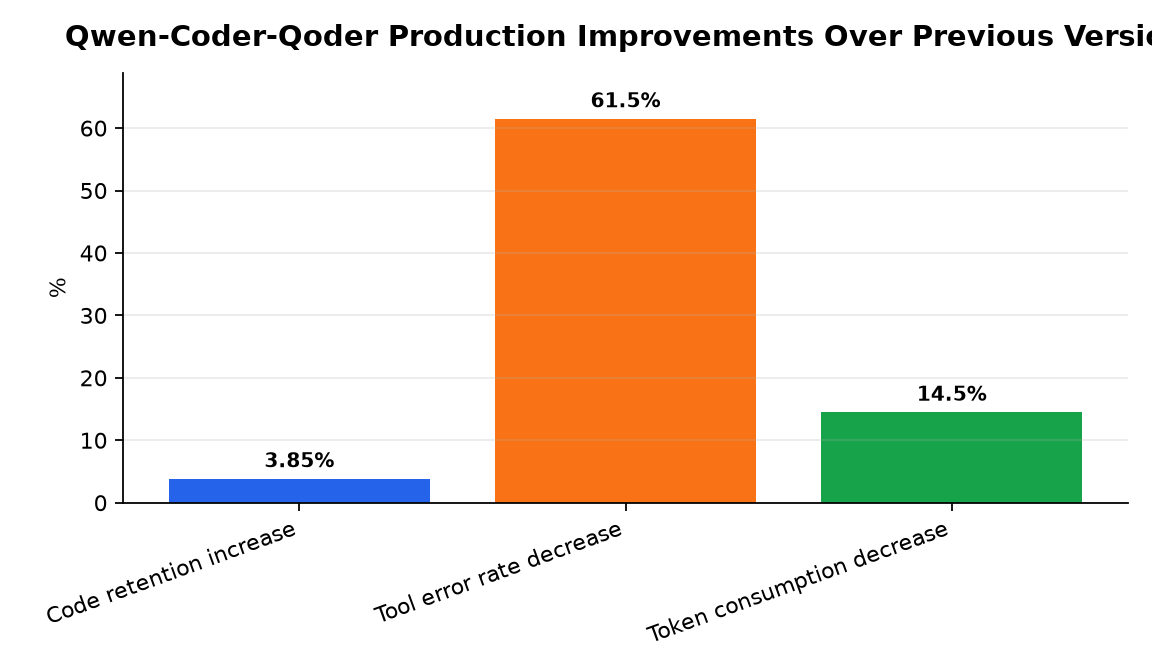
Alibaba's new coding model Qwen-Coder-Qoder beats Cursor Composer-1 on the Qoder Bench benchmark. Production metrics show a 3.85% code retention increase, a 61.5% drop in tool errors, and a 14.5% reduction in token use. The model trains on real agent traces through a rewarder-attacker framework against reward hacking.
Emmanuel Fabrice Omgbwa Yasse AI-assisted
2026-07-23 · Last updated: 2026-08-03 · 4 min read
Alibaba Cloud is trying a different bet in the AI coding arms race. Instead of dropping a general-purpose model and letting developers figure out how to wire it into their workflows, the company has rolled out Qwen-Coder-Qoder, a model purpose-built for its Qoder CLI and agent ecosystem. The early numbers suggest the bet might pay off. The approach is part of a broader strategy to lock in enterprise users before the model race settles, as Alibaba's platform bet emphasizes.
On Qoder Bench, the company's own benchmark for real-world software engineering tasks, the model surpasses Cursor Composer-1 in task resolution. The gap is wider on Windows, where terminal command accuracy improved by up to 50% compared to the previous version. In production over the past few weeks, code retention went up 3.85%, tool error rates fell 61.5%, and token consumption dropped 14.5%. Those are the kinds of metrics that engineering leads actually care about.
Qwen-Coder-Qoder is built on the Qwen-Coder foundation and refined with large-scale reinforcement learning. What makes it different from most model releases is how the RL loop works: it trains on real agent interactions from thousands of daily Qoder users, extracting software engineering practices and converting them into reward signals. Alibaba calls this the "Model-Agent-Product" flywheel, and it is a closed loop where product usage directly shapes the next model iteration. This flywheel model is consistent with how the Qwen team has been quietly expanding its model family rather than chasing a single champion, see the Qwen fleet strategy.
The rewarder-attacker framework
Reward hacking is a known headache in RL for code agents. If the system rewards parallel tool use for speed, a model might start scanning irrelevant files to inflate its parallelism score without actually contributing to the fix. Alibaba built an adversarial framework to catch this before training begins: an LLM reviewer stress-tests the reward system during development, looking for loopholes the model could exploit. The company says this has improved both iteration speed and reward design robustness. This mirrors recent research into the two-word fix for RL's self-sabotage problem, covered in how to stop RL from collapsing under its own rewards.
Training itself relies on ROLL, a system for RL training of Mixture-of-Experts models with hundreds of billions of parameters across clusters of thousands of GPUs. The rollout phase typically eats over 70% of the total training time; Alibaba says system-level optimizations delivered a 10x throughput boost, compressing training cycles significantly. Similar scaling challenges have been documented in Nous Research's recent field notes on MoE expert parallelism.
Alibaba also automated the setup of tens of thousands of real-world software environments using high-speed containerization that spins up and tears down sandboxes instantly, enabling RL at a scale that would be impractical with manual environment management.
7x24 feedback processing with Qoder CLI
Alongside the model release, Alibaba published a detailed case study of how Qoder CLI is used inside its own engineering organization to build a fully autonomous feedback processing system. The system handles the entire pipeline from user feedback submission to code fix, with humans only involved in the final code review stage.
The pipeline has four modules: issue classification, issue clustering, log analysis, and auto-fix. Each stage uses a different model tier through Qoder CLI. Classification and clustering use cheaper "Effective" tier models. Log analysis and root cause identification use the "Performance" tier. Code fixes use the "Ultimate" tier. The company's conclusion is direct: using cheap models for complex tasks wastes more tokens in wrong directions than just going straight to the SOTA model.
The system includes a self-reflection mechanism. After each log analysis task, the agent writes a retrospective to a task-retro.md file, documenting ineffective steps and lessons learned. A separate pipeline agent reviews these retrospectives periodically to update the corresponding Skills. This creates an evolution chain where every agent mistake becomes a signal. For a deeper look at how agents that learn continuously change the autonomous AI game, see Hermes Agent's closed learning loop.
The impact is measurable. Previously, each issue required at least 30 minutes from feedback submission to manual log analysis and root cause identification. The automated system now completes root cause analysis in two minutes, running 24/7 with no human intervention beyond code review.
What the competition is doing
The AI coding space has turned into a war of incremental improvements. Cursor, GitHub Copilot, and JetBrains' AI assistant all ship weekly updates. Cursor Composer-1, the direct comparison target Alibaba chose, is not a static product either. But Qwen-Coder-Qoder is built to tight integration with a specific agent architecture, not for general-purpose use. That may limit its reach but also means the feedback loop is shorter: every user interaction with Qoder can refine the model within weeks rather than months. This mirrors the broader industry push toward purpose-built, tightly integrated agent systems, as seen in Groq's agent operating system play.
Alibaba says it plans weekly iterations on the model, which suggests a pace that most open-weight model distributors would struggle to match. The flywheel model demands continuous product usage to feed training data, so the bet is as much on Qoder's user adoption as on the model itself.
Get the tech essentials in 3 minutes every morning
One email, every weekday, with what actually matters in AI and tech.