Anthropic AI for Science rare disease grants
$50,000 in Claude credits won't cure rare diseases, but it might map the path
Anthropic's AI for Science rare disease grants offer up to $50,000 in Claude credits to researchers and early-stage biotechs. Applications are open through August 2, 2026.
Emmanuel Fabrice Omgbwa Yasse AI-assisted
2026-07-21 · Last updated: 2026-07-30 · 3 min read

Anthropic opened a themed call for its AI for Science grant program today, offering up to $50,000 in Claude API credits to researchers and early-stage biotechs working on rare genetic diseases. The program builds on the Claude Science launch earlier this year.
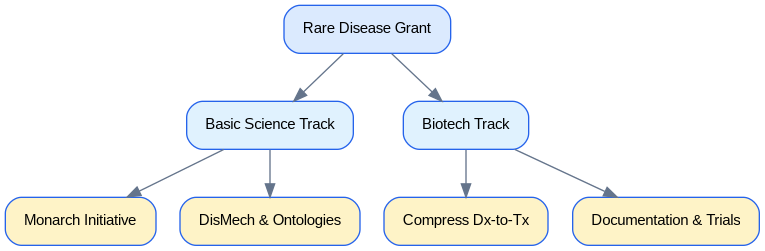
The program splits into two tracks. The first is aimed at basic science collaborations, with a focus on building better ontologies and knowledge graphs to spot shared mechanisms across rare diseases. The second targets biotechnologists and startups that want to shorten the timeline from diagnosis to treatment, particularly around regulatory documentation and trial design.
Rare diseases are neither rare in aggregate (an estimated 400 million people live with one of more than 7,000 identified conditions) nor well understood. Because each disease affects a small population, patient registries are thin, therapeutic targets are hard to validate, and clinical trials are difficult to design. The result is that most rare diseases have no approved treatment.
Two tracks, one problem
The basic science track is anchored by the Monarch Initiative, an international consortium that builds ontologies like Mondo and the Monarch Knowledge Graph to reconcile disease definitions scattered across OMIM, Orphanet, ICD, and other sources. Monarch recently released DisMech, an agent-friendly classification library where Claude can read case reports and variant databases to find mechanistic similarities across diseases. Grantees in this track will be invited to use and contribute to these resources. Anthropic's experience with biology-focused models, including Claude Mythos 5 for biology research, suggests this kind of targeted ontology work is where LLMs can add real value.
The biotech track is about shortening the time it takes to move from a confirmed genetic diagnosis to an available treatment. Today that can take one to two years, with months eaten by backlogs in manufacturing slots, sequential safety studies, and hand-assembled regulatory dossiers. Anthropic says Claude can help with documentation, therapeutic strategy selection, and identifying shared mechanisms that might allow patients to be grouped into a single basket trial instead of requiring separate INDs. The broader push into agentic models, including Claude Sonnet 5's agentic capabilities, could support the documentation and trial design tasks described.
Anthropic is upfront about the limits. The company says Claude cannot help where data is too sparse or poorly organized, and that it is unlikely to address non-scientific barriers like insurance authorization or access to diagnostic facilities. The program is meant to complement broader data-generation and infrastructure efforts. Similar caution has been warranted in medical AI, where initial claims of outperforming doctors were quickly tempered.
Existing grantees and how to apply
Themed calls mark a shift for the AI for Science program, which began last spring with a broader focus. Anthropic says projects have been more generative when multiple grantees work on related questions, so it plans to launch more thematic rounds moving forward. The program builds on a series of science-focused initiatives, including The Briefing: AI for Science virtual event held in June 2026.
Applications are open until August 2, 2026. Recipients can use their credits to access Claude Opus or other approved models. Projects that might run up against Anthropic's bio classifiers can apply for exemptions. Outputs from the basic science track will be published at monarchinitiative.org. For broader context, TCS's deployment of Claude across 50,000 employees shows how the model handles compliance-heavy workflows.
Get the tech essentials in 3 minutes every morning
One email, every weekday, with what actually matters in AI and tech.