Artificial Intelligence
France's €360M bet on AI: nine clusters to train the next generation
France allocates €360 million to nine AI clusters under France 2030, aiming to boost training and research. Two new training projects receive €11 million to upskill workers in AI-related fields.
Emmanuel Fabrice Omgbwa Yasse AI-assisted
2026-07-28 · 3 min read

France has committed €360 million to establish nine interdisciplinary AI research and training clusters as part of its France 2030 investment plan, the government announced on May 28. The announcement comes as governments worldwide seek to coordinate AI governance, with major economies recently reaching a landmark agreement on regulation, per a new report on global AI regulation. The initiative aims to triple the number of AI graduates and position the country as a global leader in the field. Two additional projects focused on workforce reskilling received €11 million.
The clusters, called IA Clusters, are the second phase of France's national AI strategy, which began in 2018 with the creation of three interdisciplinary institutes (3IA). The new clusters build on those foundations and extend the network to cover more regions and specializations.
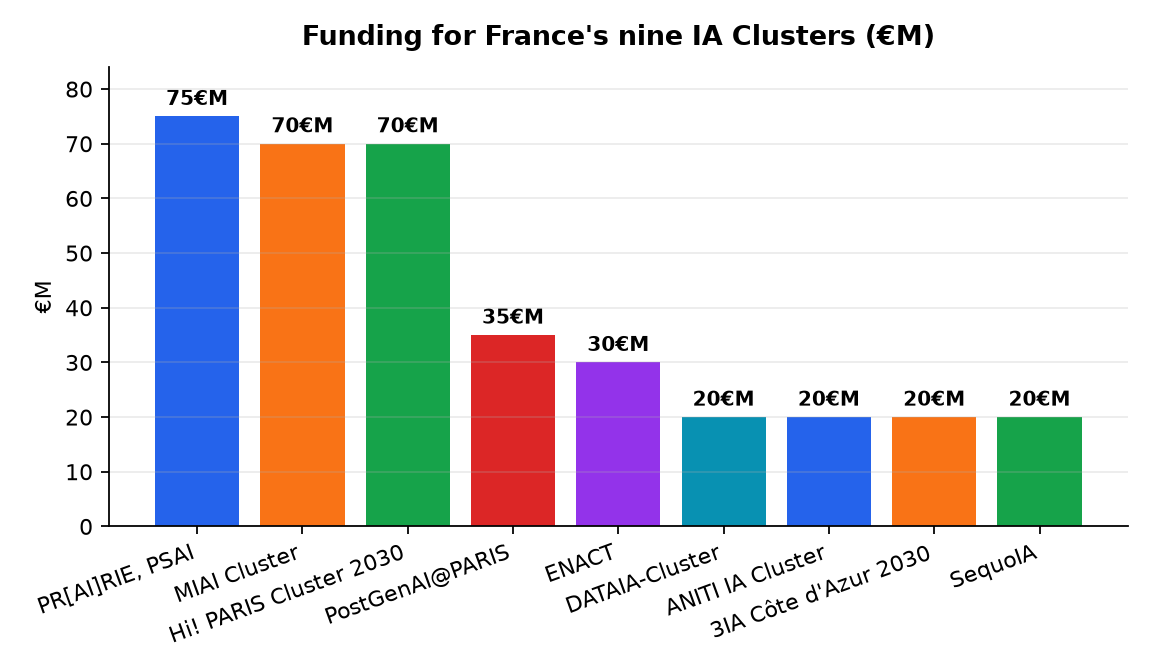
The largest award, €75 million, goes to PR[AI]RIE, Paris School of AI, led by Université Paris Sciences et Lettres. The institute will expand its interdisciplinary approach to research and training. Other major recipients include MIAI Cluster in Grenoble (€70 million) and Hi! PARIS Cluster 2030 at Institut Polytechnique de Paris (€70 million).
| Cluster | Lead Institution | Funding (€M) |
|---|---|---|
| PR[AI]RIE, PSAI | Université Paris Sciences et Lettres | 75 |
| MIAI Cluster | Université Grenoble Alpes | 70 |
| Hi! PARIS Cluster 2030 | Institut Polytechnique de Paris | 70 |
| PostGenAI@PARIS | Sorbonne Université | 35 |
| ENACT | Université de Lorraine | 30 |
| DATAIA-Cluster | Université Paris Saclay | 20 |
| ANITI IA Cluster | Université de Toulouse | 20 |
| 3IA Côte d'Azur 2030 | Université Côte d'Azur | 20 |
| SequoIA | Université de Rennes | 20 |
The clusters cover domains including embedded AI, generative AI, cybersecurity, health, and environmental applications. The SequoIA cluster in Rennes, for example, focuses on trustworthy AI for cybersecurity and defense, while ENACT in Lorraine targets natural language processing and AI for scientific discovery. This cybersecurity focus mirrors a broader trend of specialized AI models emerging for security tasks, such as Sakana AI's Fugu-Cyber, which finds vulnerabilities that general-purpose models miss, per work on specialized cybersecurity AI. PostGenAI@Paris, led by Sorbonne Université, will tackle challenges posed by the latest AI advances, drawing on expertise from mathematics, computer science, engineering, health, law, and political science.
Under the Competences et Metiers d'Avenir (CMA) program, two new projects received €11 million. MACMIA, led by Institut Mines-Telecom, aims to train technicians and engineers in AI for industry, covering embedded AI, smart mobility, health, and retail. AISorb, led by Université Paris 1 Panthéon Sorbonne, focuses on the intersection of AI and social sciences, preparing professionals for roles transformed by AI. Other European governments are also deploying AI in public services; Greece, for instance, partnered with ElevenLabs to bring voice AI into its government portal, as covered in the Greece-ElevenLabs deal. These projects bring the total CMA funding for AI training to €87 million, with an expected 400,000 training slots.
The clusters are part of a €560 million public funding package for AI research and training under France 2030. Separately, a €73 million research program called PEPR IA, launched in March 2024 and led by Inria, CNRS, and CEA, will support 50 research teams over five years. The program targets scientific bottlenecks in frugal AI (energy and data efficiency), embedded AI, distributed AI, and trustworthy AI (robustness, fairness, transparency, and security). One recent approach to frugal AI, for example, uses shared routing across layers to speed up LLM decoding by seven times without quality loss, as detailed in a paper on efficient sparse attention.
France wants to become a global leader in AI research and training. The government is betting that funding these clusters and training programs will strengthen the country's competitiveness over time. The first graduates from the clusters are expected by 2025, but the full impact on France's AI ecosystem will take years to materialize. This push comes at a time when US dominance in AI is facing challenges from open-source models developed in the East, as examined in the debate over America's AI moat.
Get the tech essentials in 3 minutes every morning
One email, every weekday, with what actually matters in AI and tech.